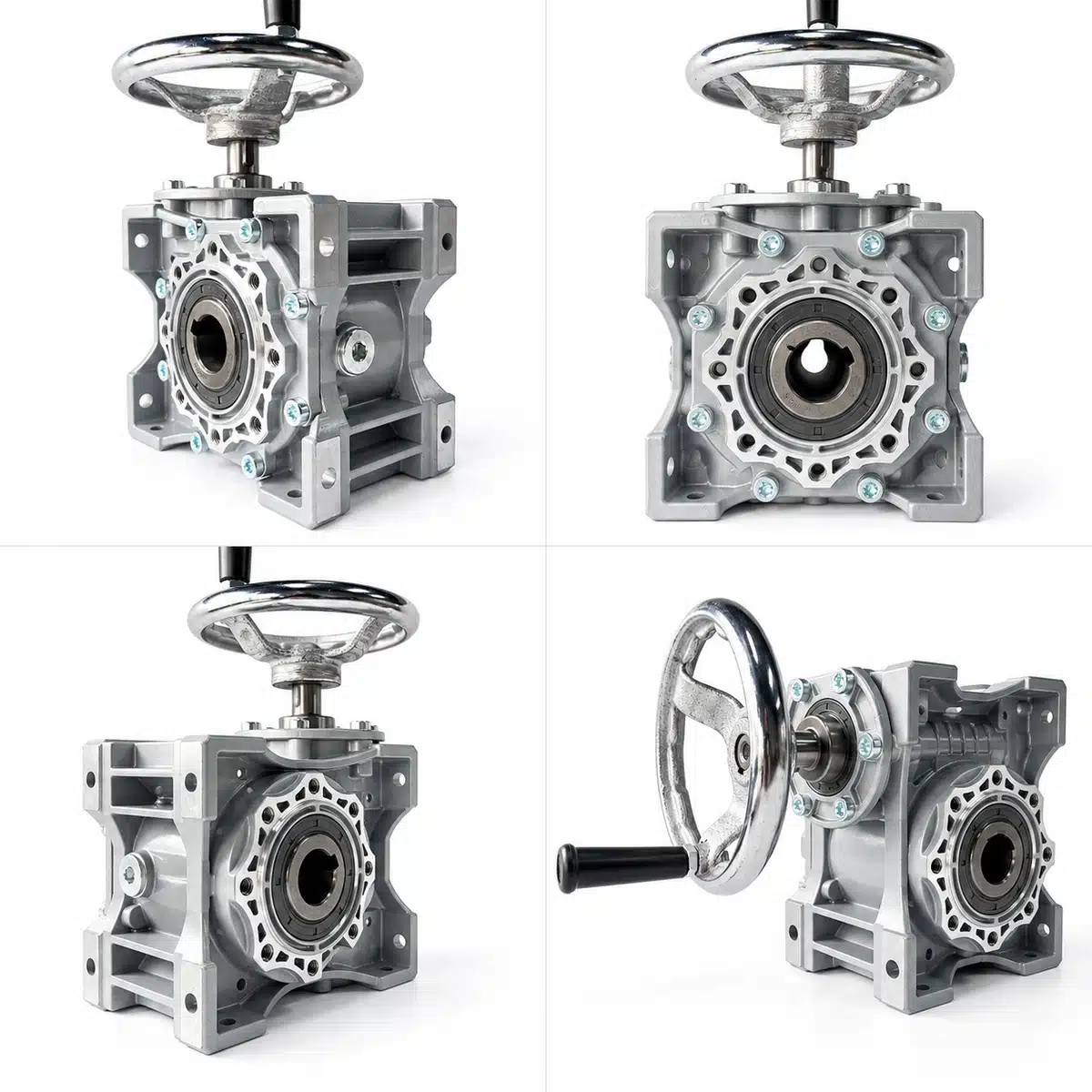
Custom Gearbox Manufacturer: Application-Specific Gearbox Design & Development
Key Takeaways
| Capability | Range |
|---|---|
| Output torque | 10 Nm to 50,000 Nm |
| Reduction ratio | 3:1 to 300:1 (single or multi-stage) |
| Gear transmission types | Worm, helical, bevel, hypoid, planetary, multi-stage combinations |
| Gear accuracy | Up to DIN 2 (ground tooth profiles) |
| Typical development timeline | 8–16 weeks, concept to validated prototype |
| Prototype quantity | Typically 1–3 units per project |
| Production MOQ (post-validation) | From 1000 units/batch |
Bottom line: You do not need a finished gearbox design — or even a specific model in mind — to start a custom gearbox project. Send us your machine drawing, application requirements, or an existing gearbox sample, and our engineering team will determine whether a standard product, a configured platform, a modification, or a completely new gearbox is the right approach.
You provide the application requirements. We engineer the transmission solution.
Table of Contents
- What Is a Custom Gearbox?
- Can You Design a Gearbox From Our Machine Drawing?
- What If I Don’t Know Which Gearbox I Need?
- Four Levels of Gearbox Solutions
- Our Custom Gearbox Capability Range
- Transmission Architectures We Engineer
- Engineering Standards and Design Tools
- Our 8-Stage Custom Gearbox Development Process
- Testing and Validation Protocol
- Development Timeline, Prototyping, and MOQ
- Example Custom Gearbox Projects
- Working from an Existing Gearbox or Competitor Unit
- Why Ubuty Is Different
- Custom Gearbox Applications by Industry
- FAQ: Custom Gearbox Development
1. What Is a Custom Gearbox?
Not every industrial machine can be powered by an off-the-shelf gearbox. When standard gear reducers cannot meet your required torque, speed, dimensions, shaft configuration, duty cycle, or operating environment, a completely new gearbox may be the right solution.
A custom gearbox is a gear reduction system engineered specifically for a particular machine, application, or operating condition — rather than selected from a catalog. It may require a new combination of gear type, gear arrangement, number of reduction stages, gear geometry, shaft configuration, bearing arrangement, housing structure, mounting interface, lubrication system, sealing system, and thermal management.
The objective is not to change one parameter. The gearbox can be engineered around the machine.
Taizhou Ubuty Co., Ltd. provides custom gearbox design, development, and manufacturing for OEM machinery manufacturers, industrial equipment companies, system integrators, distributors, and customers with application requirements that fall outside standard catalog parameters.
2. Can You Design a Gearbox From Our Machine Drawing?
Yes. A complete gearbox design is not always required at the beginning of a development project.
Customers can provide:
- A machine drawing
- A 3D CAD model
- An existing gearbox sample
- Photographs of the installation space
- Basic operating parameters (power, speed, torque)
From this information, our engineers can evaluate the available installation space, shaft position, mounting interface, load requirements, speed, torque, and operating conditions to determine the appropriate transmission concept.
You do not need to specify a gear type, ratio, or housing design before contacting us. A machine drawing alone often provides enough information — available envelope, shaft location, mounting points, and mechanical movement — for our engineering team to begin evaluating candidate transmission architectures.
If a project is a replacement or redesign, you can also provide the existing gearbox’s nameplate data, drawings, or the physical unit itself as a technical reference point.
3. What If I Don’t Know Which Gearbox I Need?
This is one of the most common starting points for a custom gearbox project — and it is not a problem.
You do not need to select a gearbox model before contacting us.
Send us your machine application, motor power, speed, torque, available installation space, and operating conditions. Our engineering team can determine whether a standard gearbox, a configured gearbox, a modified gearbox, or a completely new gearbox development project is appropriate for your application.
You may only know: “We are developing a new machine and need a transmission system.” That is enough to start the discussion. The gearbox can be engineered from the machine requirements outward — not selected from a catalog and forced to fit.
4. Four Levels of Gearbox Solutions
Not every project requires a completely new gearbox. Taizhou Ubuty supports four levels of gearbox solutions, and our engineering team determines which level actually fits your application — rather than defaulting every inquiry into a full custom development project.
Level 1 — Standard Gearbox
Select directly from an existing product line: NMRV worm gear reducers, helical gearboxes, helical-bevel gearboxes, or KKM helical-hypoid units. Appropriate when a catalog platform already meets your torque, speed, dimensional, and environmental requirements.
Level 2 — Configured Gearbox
Select ratio, motor interface, output shaft type, flange, and mounting configuration on an existing gearbox platform. This covers the majority of application-specific requirements without requiring new engineering design.
Level 3 — Modified Gearbox
Engineering modification of an existing gearbox platform to match a customer’s specific mechanical interface — special shaft dimensions, non-standard flange, adapted mounting geometry, or altered housing features — while retaining the core proven gear architecture.
Level 4 — New Gearbox Development
A completely new transmission designed from the application requirements: new gear system, shaft system, bearing system, housing, lubrication, sealing, and thermal performance, engineered specifically around the customer’s machine.
Taizhou Ubuty can support all four levels depending on the application. Our engineering team identifies the appropriate level during the initial application review — you don’t need to know in advance whether your project needs a configuration change or a completely new gearbox.
5. Our Custom Gearbox Capability Range
Before evaluating whether a custom project is feasible, it helps to know our actual engineering and manufacturing boundaries — not just a general claim of “we can build anything.”
| Parameter | Capability Range |
|---|---|
| Output torque | 10 Nm – 50,000 Nm |
| Reduction ratio (single stage) | 3:1– 60:1 |
| Reduction ratio (multi-stage) | Up to 300:1 |
| Input speed | Up to 3,000 RPM standard; higher on engineering review |
| Gear accuracy | DIN 5-6 standard machining; DIN 2-3 ground gears for precision/low-noise applications |
| Housing materials | Aluminum alloy, cast iron (GG20-GG25), fabricated steel for large custom frames |
| Gear materials | 20CrMnTi, 42CrMo alloy steel; carburized and hardened to 58–62 HRC |
| Shaft configurations | Solid, hollow, single/double output, extended, splined |
| Maximum housing envelope | Custom-fabricated housings available beyond standard catalog frame sizes |
| Sealing rating | Up to IP69K on request |
Projects outside these ranges are evaluated case-by-case with our engineering team — contact us before assuming a requirement is out of scope.
6. Transmission Architectures We Engineer
Depending on the torque, speed, space, and efficiency requirements of your application, the appropriate transmission concept may involve one or a combination of:
- Worm gearing — compact right-angle drive, cost-effective for lower-duty applications
- Helical gearing — high efficiency (94–97%), low noise, inline or parallel-shaft configuration
- Helical-bevel gearing — right-angle configuration with higher torque density than worm gears
- Helical-hypoid gearing — high-efficiency right-angle alternative to worm gearing, up to 94% efficiency
- Planetary (epicyclic) gearing — highest torque density per volume, coaxial input/output, well suited to space-constrained high-torque applications
- Multi-stage combinations — worm + helical, planetary + helical-bevel, or other hybrid architectures where a single gear type cannot meet the full ratio and torque requirement in one stage
The transmission concept is selected based on the required balance of torque, speed, efficiency, size, reliability, manufacturability, and cost — not defaulted to whichever product line is easiest for us to produce.
7. Engineering Standards and Design Tools
Custom gearbox development requires more than 3D modeling — it requires gear strength verification, bearing life calculation, and thermal analysis before a prototype is ever cut.
Gear design and verification:
- Gear tooth strength calculated per ISO 6336 and/or AGMA 2001 (bending and contact stress)
- Gear geometry and simulation using Romax Designer
- Dimensional tolerancing per DIN 3960–3967 gear accuracy standards
Bearing and shaft verification:
- Bearing life calculated per ISO 281 (L10 basic rating life)
- Shaft strength and deflection analysis for combined radial, axial, and bending loads
Structural and thermal analysis:
- Finite Element Analysis (FEA) for housing stress concentration and stiffness, applied where load conditions or space constraints warrant it
- Thermal power rating calculated from heat generation vs. housing dissipation capacity, particularly for continuous-duty applications above [12] hours/day
Design outputs are developed in 3D CAD SolidWorks with full dimensional drawings, tolerance stack-up review, and manufacturing feasibility checks before prototype release.
8. Our 8-Stage Custom Gearbox Development Process
Concept → Engineering → Prototype → Validation → Production
Stage 1: Application Analysis
We evaluate your application through the chain: Power → Speed → Torque → Load → Duty Cycle → Space → Environment. This establishes the basic engineering requirements before any transmission concept is selected.
Stage 2: Transmission Concept Development
Rather than forcing the application into an existing gearbox model, we evaluate candidate gear arrangements (worm, helical, bevel, hypoid, planetary, or multi-stage combinations) against the required balance of torque, speed, efficiency, size, reliability, and cost.
Stage 3: Gearbox Engineering Design
Detailed engineering begins: gear ratio and geometry, shaft and bearing sizing, housing structure, mounting interface, lubrication and sealing system, and thermal performance — calculated per the standards in Section 7, not estimated.
Stage 4: 3D CAD and Engineering Review
The design is developed into a detailed 3D model with assembly design, dimensional checking, component interference checking, shaft alignment verification, mounting verification, and manufacturing feasibility review.
Stage 5: Prototype Manufacturing
A prototype or engineering sample — typically 1–3 units — is manufactured for evaluation under actual or simulated application conditions.
Stage 6: Testing and Validation
See Section 9 for the specific validation protocol applied at this stage.
Stage 7: Design Optimization
The first prototype rarely represents the final production design. Development follows an iterative loop: Prototype → Test → Analyze → Optimize → Retest, addressing gear geometry, bearing arrangement, housing structure, lubrication, sealing, noise, temperature, or installation interface as needed.
Stage 8: Mass Production
Once validated, the design moves into production through an integrated chain: Engineering → Machining → Assembly → Inspection → Quality Control → Delivery.
9. Testing and Validation Protocol
Prototype validation is structured, not just a checklist — the specific protocol is adjusted to the application, but typically includes:
| Test | Protocol |
|---|---|
| No-load run | 60 minutes minimum, monitoring for abnormal noise or vibration before proceeding to load testing |
| Load test | Continuous run at rated load for a minimum of 4 hours; extended cycling for applications with frequent starts/reversing |
| Temperature monitoring | Housing temperature tracked to stabilization; verified against calculated thermal power rating |
| Noise measurement | Measured at 1 meter per ISO 1680 methodology, A-weighted |
| Vibration evaluation | Measured at bearing housings per ISO 10816 velocity severity criteria |
| Leakage inspection | Pressure or extended run-time leak test at seal locations |
| Torque verification | Measured input/output torque compared against design calculation |
| Durability / accelerated life testing | Applied where project volume and application criticality justify extended validation, simulating equivalent field operating hours |
Test reports are provided to the customer as part of the validation sign-off before the design proceeds to Stage 7 optimization or Stage 8 production release.
10. Development Timeline, Prototyping, and MOQ
| Item | Typical Range |
|---|---|
| Standard gearbox modification (Level 2–3) | 2–4 weeks |
| New gearbox development (Level 4, concept to validated prototype) | 8–16 weeks |
| Prototype quantity | 1–3 units |
| Prototype/engineering cost | Quoted per project; may be partially or fully credited against production order depending on volume |
| Production MOQ after validation | From 1000 units/batch |
| Tooling / NRE cost (if applicable) | Discussed per project; amortization into unit price available for qualified volumes |
Timelines vary depending on transmission complexity, whether new tooling is required for gears or housing castings, and the extent of validation testing needed. We provide a project-specific timeline and cost estimate after the initial application analysis (Stage 1).
11. Example Custom Gearbox Projects
Compact right-angle drive for a packaging machine (Level 4):
A packaging equipment OEM required 450 Nm continuous output torque at 45 RPM within a 120mm × 150mm × 180mm envelope — smaller than any standard catalog frame could accommodate at that torque level. Our engineering team developed a custom two-stage helical-bevel arrangement with a redesigned compact housing, validated through 500 hours of continuous load testing before release to production.
High torque density drive for a limited-space conveyor (Level 4):
A material handling OEM needed 1,200 Nm output in a radial envelope too small for a standard parallel-shaft helical solution. A planetary gear stage combined with a helical-bevel output stage delivered the required torque density within the available space, with coaxial input/output simplifying integration into the existing machine frame.
Reversing, high-shock drive for a chain conveyor (Level 3):
An application with 40+ starts/hour and frequent reversing exceeded the service factor range of standard catalog gearboxes at the required frame size. A custom bearing arrangement and reinforced shaft design, verified through accelerated cyclic load testing, extended service life to meet the customer’s target of 40,000 hours between overhauls.
(Illustrative project profiles based on typical custom gearbox engineering scenarios; specific customer details withheld for confidentiality.)
12. Working from an Existing Gearbox or Competitor Unit
You do not need a finished gearbox design to start a custom project — or even a complete set of application parameters. Starting points we regularly work from include:
- Machine drawings (available space, shaft location, mounting points, mechanical movement)
- An existing gearbox: nameplate data, dimensions, drawings, photographs
- A failed or obsolete gearbox, including imported or discontinued units that are difficult to source
- A competitor’s gearbox provided as a technical reference
From this information, we evaluate whether your requirement is best addressed through Level 1 (standard replacement), Level 2 (configuration), Level 3 (modification), or Level 4 (completely new design).
On reverse engineering and intellectual property: We can reverse-engineer dimensional and functional specifications from an existing gearbox to develop a form-fit-function equivalent for replacement or sourcing purposes. We do not replicate patented gear geometry or proprietary designs without appropriate legal rights. Customers providing third-party technical documentation, drawings, or physical samples are responsible for ensuring they hold the legal right to share this information with us for evaluation and development purposes. Projects involving branded or patented competitor designs are reviewed by our team before engineering work begins.
13. Why Ubuty Is Different
01 — 25+ Years of Power Transmission Experience
Our technical team brings more than 25 years of experience in gear design, manufacturing, and application engineering — the foundation for evaluating unfamiliar or unusual transmission requirements, not just producing catalog products.
02 — Engineering Before Manufacturing
Every custom project passes through gear strength calculation (ISO 6336/AGMA 2001), bearing life verification (ISO 281), and thermal analysis before a single component is machined. Manufacturing capability without engineering verification produces parts. Engineering verification before manufacturing produces a gearbox that performs as designed.
03 — Prototype-to-Production Capability
Development does not stop at a drawing or a single sample. Ubuty carries validated designs through the complete chain — Concept → Engineering → Prototype → Validation → Production — for customers who need a long-term manufacturing partner, not a one-time engineering favor.
04 — Standard Gearboxes and Completely New Gearbox Development, Under One Roof
Whether your application needs Level 1 (a standard NMRV, KKM unit or others) or Level 4 (a completely new transmission designed around your machine), the same engineering team and manufacturing facility support the full range — without handing you off to a different supplier when your requirements exceed a catalog product.
14. Custom Gearbox Applications by Industry
Application-specific gearboxes are developed across a wide range of machinery types:
- Food processing machinery — compact dimensions, hygienic sealing, reliable continuous operation
- Packaging machinery — specific speeds, compact installation, frequent start-stop cycling
- Conveyor systems — specific torque, output speed, shaft arrangement, and mounting dimensions
- Textile machinery — reliable continuous-duty operation with application-specific configurations
- Logistics and material handling equipment — compact geared drives for conveyors, sorters, and automated handling systems
- Construction, metallurgy, and mining equipment — high-torque, heavy-duty transmission requirements
- Special-purpose industrial machinery — where custom development provides the greatest value, for applications that don’t fit any standard gearbox catalog
15. FAQ: Custom Gearbox Development
Q: Can you design a gearbox from our machine drawing?
Yes. A complete gearbox design is not required to start a project. A machine drawing, 3D CAD model, existing gearbox sample, photographs, or basic operating parameters give our engineers enough information to evaluate available space, shaft position, mounting interface, load, speed, and torque, and determine the appropriate transmission concept.
Q: What if I don’t know which gearbox I need?
You do not need to select a gearbox model before contacting us. Send us your machine application, motor power, speed, torque, available space, and operating conditions. Our engineering team will determine whether a standard gearbox, a configured gearbox, a modified gearbox, or a completely new gearbox development project is appropriate.
Q: Can you design a completely new gearbox, not just modify an existing model?
Yes. This is Level 4 of our gearbox solution range — new gearbox development starting from application requirements rather than an existing catalog model. Our capability range covers 10–50,000 Nm output torque and ratios up to 300:1, across worm, helical, bevel, hypoid, and planetary transmission architectures.
Q: Do I need to provide a finished gearbox drawing to start a project?
No. A gearbox drawing is helpful but not required. Machine drawings, photographs, operating parameters, or a general application description are sufficient to begin the engineering evaluation.
Q: What transmission types can you engineer for a custom gearbox?
Worm, helical, helical-bevel, helical-hypoid, planetary (epicyclic), and multi-stage combinations. The transmission concept is selected based on the required torque density, space envelope, efficiency, and cost — not limited to a single product line.
Q: How long does a custom gearbox development project take?
Standard gearbox modifications (Level 2–3) typically take 2–4 weeks. New gearbox development (Level 4) — from application analysis through a validated prototype — typically takes 8–16 weeks, depending on transmission complexity and whether new gear or housing tooling is required.
Q: How many prototype units are typically built, and what does it cost?
Most projects build 1–3 prototype units for validation testing. Prototype and engineering costs are quoted per project and may be partially or fully credited against a subsequent production order, depending on volume.
Q: What testing do you perform on a custom gearbox prototype?
Standard validation includes no-load running, minimum 4-hour continuous load testing, temperature monitoring against calculated thermal rating, noise measurement per ISO 1680, vibration evaluation per ISO 10816, leakage inspection, and torque verification. Durability or accelerated life testing is added for applications where volume or criticality justifies it.
Q: Can you replicate or reverse-engineer an existing gearbox, including a competitor’s product?
We can reverse-engineer dimensional and functional specifications from an existing unit to develop a form-fit-function equivalent. We do not replicate patented gear geometry or proprietary designs without appropriate rights, and customers are responsible for ensuring they have the legal right to share third-party technical documentation with us for this purpose.
Q: What gear design standards and software do you use?
Gear tooth strength is verified per ISO 6336 and/or AGMA 2001. Bearing life is calculated per ISO 281. Gear geometry and simulation use Romax Designer, with FEA applied for housing and structural verification where load conditions warrant it.
Q: What is the minimum order quantity for a custom gearbox after development?
Production MOQ after design validation starts from 1000 units per batch, discussed on a per-project basis depending on gearbox size, complexity, and tooling requirements.
Q: What industries do you serve for custom gearbox projects?
Food processing, packaging, conveyors, textile machinery, logistics and material handling, construction, metallurgy, mining, and other special-purpose industrial machinery where standard catalog gearboxes cannot meet the application requirements.
Start Your Custom Gearbox Project
Modification adapts an existing gearbox to an application. New gearbox development creates a transmission around the application. Whichever your project needs, you don’t need to know which one in advance — that’s what our engineering evaluation is for.
Send us:
- Machine Application
- Input Power & Speed
- Required Output Speed
- Continuous & Peak Torque
- Installation Space
- Shaft / Mounting Requirements
- Machine Drawing or Photos
Our engineers will evaluate your requirements and determine the appropriate gearbox development approach — Level 1 standard selection, Level 2 configuration, Level 3 modification, or Level 4 new development.
Submit Your Gearbox Requirements → Send Your Drawing →
Taizhou Ubuty Co., Ltd. — Custom Gearbox Design, Development & Manufacturing