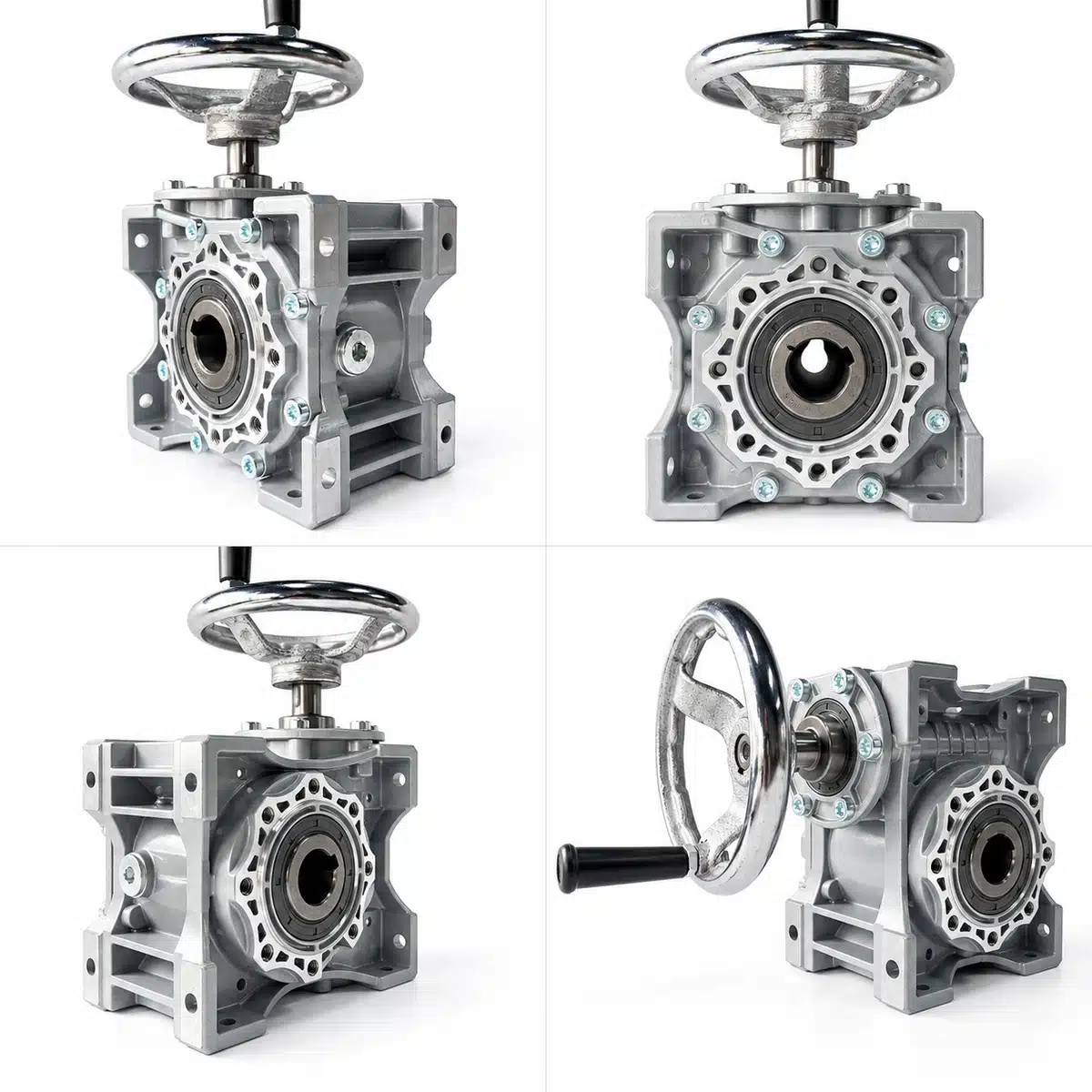
SEW R Series Equivalent: Complete Technical Comparison for Industrial Buyers
Key Takeaways
| SEW R Series | R Series Equivalent | |
|---|---|---|
| Efficiency | 94-96% | 94-96% |
| Torque range | 10-18,000 Nm | 10-18,000 Nm |
| Ratio range | 3.66-74.84:1 | 3.66-74.84:1 |
| Mounting compatibility | IEC standard | 100% IEC compatible |
| Lead time | 8-16 weeks (non-stock) | 2-4 weeks |
| Unit cost | Premium brand pricing | 30-40% lower |
| OEM customization | High MOQ (50-100+) | Low MOQ (10-20 units) |
| Technical support | Regional distributor | Direct factory engineering |
Bottom line: SEW R Series equivalents from ISO 9001 certified manufacturers deliver identical dimensional compatibility, comparable performance specifications, and 30-40% cost savings with 2-4 week lead times. The qualification process takes 4-6 weeks — after which supply chain risk drops significantly.
Table of Contents
- Why Industrial Buyers Look for SEW R Series Alternatives
- What Makes an R Series Equivalent “True Equivalent”
- Technical Comparison: Dimensions and Compatibility
- Performance Comparison: Torque, Efficiency, and Ratings
- Material and Manufacturing Quality Comparison
- Cost Analysis: Purchase Price vs. Total Cost of Ownership
- Supply Chain Comparison: Lead Time and Availability
- Quality Verification: How to Evaluate Equivalent Suppliers
- Installation and Interchangeability Guide
- Application-Specific Considerations
- OEM and Distributor Partnership
- FAQ: SEW R Series Equivalent
1. Why Industrial Buyers Look for SEW R Series Alternatives
SEW-Eurodrive builds excellent gearboxes. The R Series has earned its reputation through decades of reliable field performance across global installations. Nobody disputes the product quality.
What procurement managers and plant engineers dispute is the supply model.
A packaging OEM in the UK discovered in Q3 2023 that their SEW R Series order — 28 units for a new production line — carried a 14-week lead time. The customer’s installation date was in 8 weeks. Expediting cost an additional £4,200 in freight. Two units arrived damaged and required 3-week replacement lead time, delaying commissioning by 11 days at £8,500/day production loss.
The gearboxes performed perfectly once installed. The supply chain failed the project.
This is the pattern driving qualified buyers to evaluate SEW R Series equivalents: not dissatisfaction with SEW product performance, but supply chain risk, pricing structure, and customization rigidity that creates operational problems regardless of product quality.
Three specific pain points drive most SEW R Series alternative searches:
Lead time unpredictability: Non-stocked SEW R Series configurations regularly run 8-16 weeks. Regional distributor stock covers common configurations, but specific ratio/mounting/shaft combinations often require factory order. In maintenance replacement and OEM scenarios, this lead time is operationally unacceptable.
Price structure: SEW pricing flows through distributor networks with 25-40% margins stacked on top of already premium factory pricing. Direct factory pricing for equivalent quality is 30-40% lower — on a 50-unit OEM build, this represents $15,000-$25,000 in material cost.
Customization rigidity: Custom shaft dimensions, special coatings, non-standard colors, food-grade lubricant factory-fill: SEW handles these at minimum order quantities of 50-100+ units with 16-20 week lead times. Qualified equivalent manufacturers handle most modifications at 10-20 units with 3-4 week additional lead time.
2. What Makes an R Series Equivalent “True Equivalent”
Not every gearbox claiming R Series compatibility actually delivers drop-in interchangeability. A genuine SEW R Series equivalent must satisfy five criteria simultaneously.
Criterion 1: Dimensional Compatibility
All mounting dimensions match SEW R Series within specified tolerances:
- Foot mounting hole pattern: ±0.2mm
- Shaft height: ±0.1mm
- Output shaft diameter: h6 tolerance class
- Input flange (IEC): Matching pilot diameter, bolt circle, bolt count
- Housing envelope: Fits existing machine space
Criterion 2: Matching Performance Ratings
Equivalent or higher ratings across all performance parameters:
- Output torque rating ≥ SEW equivalent at same ratio
- Thermal power rating ≥ SEW equivalent
- Overhung load rating ≥ SEW equivalent at catalog reference distance
- Efficiency within ±2% of SEW specification
Criterion 3: Compatible Mounting Options
All SEW R Series mounting configurations available:
- B3 (foot mount, horizontal)
- B5 (large flange)
- B14 (small flange)
- B6, B7, B8 (vertical and rotated positions)
- Hollow shaft with shrink disc or keyway
- Torque arm mounting
Criterion 4: Standard IEC Motor Interface
Input flanges accept the same IEC motor frames as SEW:
- B5 flanges: IEC 63 through IEC 280
- B14 flanges: IEC 63 through IEC 160
- Same pilot diameters and bolt patterns
Criterion 5: Equivalent Lubrication Specification
Uses standard industrial gear oil — same grade and type — allowing shared inventory across SEW and equivalent units in mixed installations.
If a supplier cannot provide certified dimensional drawings confirming all five criteria, they are not offering a true equivalent. Request drawings before ordering.
3. Technical Comparison: Dimensions and Compatibility
R Series Frame Size Dimensional Comparison
The following dimensions define drop-in compatibility. All values represent standard SEW R Series specifications — a true equivalent must match within stated tolerances.
| Frame | Shaft Height (mm) | Output Shaft Ø (mm) | Foot Mount Pattern (mm) | IEC Input |
|---|---|---|---|---|
| R17 | 63 | 20 | 100 × 80 | 63-90 |
| R27 | 72 | 25 | 115 × 90 | 71-100 |
| R37 | 87 | 30 | 130 × 110 | 80-112 |
| R47 | 97 | 35 | 130 × 110 | 90-132 |
| R57 | 112 | 40 | 180 × 140 | 100-132 |
| R67 | 122 | 50 | 180 × 140 | 112-160 |
| R77 | 137 | 60 | 225 × 180 | 132-180 |
| R87 | 152 | 70 | 225 × 180 | 160-200 |
| R97 | 177 | 80 | 280 × 220 | 180-225 |
| R107 | 202 | 90 | 315 × 250 | 200-250 |
| R137 | 242 | 110 | 400 × 315 | 225-280 |
Dimensions indicative — verify with certified drawings for your specific ratio and configuration
Keyway Dimensions (DIN 6885)
| Shaft Diameter | Keyway Width × Depth |
|---|---|
| 20mm | 6 × 3.5mm |
| 25mm | 8 × 4.0mm |
| 30mm | 8 × 4.0mm |
| 35mm | 10 × 5.0mm |
| 40mm | 12 × 5.0mm |
| 50mm | 14 × 5.5mm |
| 60mm | 18 × 7.0mm |
| 70mm | 20 × 7.5mm |
All equivalent manufacturers using DIN 6885 keyways will match these dimensions exactly. Non-DIN keyway dimensions are a disqualifying incompatibility.
Ratio Availability Comparison
SEW R Series standard ratios: 3.66, 4.39, 5.19, 6.14, 7.30, 8.68, 10.29, 12.18, 14.43, 17.06, 20.16, 23.83, 28.37, 33.45, 39.37, 46.54, 55.00, 65.23, 74.84
Quality equivalent manufacturers carry the same standard ratio range. Non-standard ratios (between standard values) are available from both SEW and equivalent manufacturers, typically at higher MOQ and longer lead time.
Compatibility verification protocol:
Before approving any equivalent supplier, request:
- Certified dimensional drawing for your specific model and ratio
- Overlay against SEW drawing (both available from manufacturers)
- Verify all critical dimensions within ±0.2mm
- Order one sample unit for physical installation test
4. Performance Comparison: Torque, Efficiency, and Ratings
Torque Rating Comparison
Quality R Series equivalents match or marginally exceed SEW torque ratings within the same frame size. The following comparison illustrates typical relationship:
| Frame | SEW Rated Torque | Equivalent Rated Torque | Difference |
|---|---|---|---|
| R37 | 400 Nm | 380-420 Nm | ±5% |
| R47 | 600 Nm | 580-630 Nm | ±5% |
| R57 | 1,000 Nm | 950-1,050 Nm | ±5% |
| R67 | 2,000 Nm | 1,900-2,100 Nm | ±5% |
| R77 | 3,500 Nm | 3,300-3,700 Nm | ±5% |
| R87 | 6,000 Nm | 5,700-6,300 Nm | ±5% |
Key point: Torque ratings within ±5% between quality equivalents and SEW reflect equivalent gear material, heat treatment, and manufacturing standards. A supplier claiming 20-30% higher torque than SEW in the same frame size should be treated with skepticism — it is not mechanically credible without significantly different gear geometry.
Efficiency Comparison
| Configuration | SEW R Series | Quality Equivalent |
|---|---|---|
| 2-stage, 3.66-20:1 | 95-96% | 94-96% |
| 3-stage, 20-74:1 | 93-95% | 93-95% |
| At optimal load | 96% | 95-96% |
| At light load (<25%) | 90-93% | 89-93% |
Practical implication: Efficiency difference between SEW and quality equivalent is 0-1% under normal operating conditions. This translates to approximately $50-80 per year in additional energy cost for a 5.5 kW continuous drive — measurable but not a significant factor in the purchase decision.
Thermal Power Rating
Thermal rating determines maximum continuous input power before housing temperature exceeds safe operating range. Quality equivalents match SEW thermal ratings within 5-10%.
| Frame | SEW Thermal Rating (kW) | Equivalent Thermal Rating (kW) |
|---|---|---|
| R37 | 2.5 | 2.3-2.7 |
| R47 | 4.8 | 4.5-5.1 |
| R57 | 7.2 | 6.8-7.6 |
| R67 | 9.5 | 9.0-10.0 |
| R77 | 14.0 | 13.0-14.5 |
| R87 | 20.0 | 18.5-21.0 |
Continuous duty applications: Always verify thermal rating from equivalent supplier’s catalog for your specific ratio and mounting position. Request the data — do not assume.
Noise Level Comparison
| Frame | SEW (dB(A) at 1m) | Quality Equivalent (dB(A)) |
|---|---|---|
| R37-R57 | 68-72 | 68-74 |
| R67-R87 | 70-75 | 71-76 |
| R97-R137 | 72-76 | 73-77 |
Quality equivalents run 0-2 dB(A) higher than SEW in most configurations. For applications with strict noise requirements (<70 dB(A)), verify with actual supplier test data — do not rely on typical values.
5. Material and Manufacturing Quality Comparison
This is where genuine quality differentiation exists between SEW and different tiers of equivalent suppliers.
SEW R Series Material Standards
Gears:
- Material: 20CrMnTi or equivalent alloy steel
- Heat treatment: Case carburizing, hardening to 58-62 HRC surface
- Finishing: Gear grinding (profile and lead accuracy)
- Quality grade: DIN 5-6
Housing:
- Material: Cast iron GG25 (standard), ductile iron option
- Machining: CNC precision boring, single-setup for concentricity
- Surface: Precision ground bearing bores
Bearings:
- Brand: FAG (Schaeffler Group — same corporate group as SEW parent)
- Type: Tapered roller (primary load paths), deep groove ball
- Life calculation: L10h = 20,000+ hours standard
Seals:
- Brand: Freudenberg (premium German supplier)
- Type: Double-lip radial shaft seal
- Material: FKM (Viton) standard on many configurations
Quality Equivalent Material Standards
Premium equivalent tier (our manufacturing standard):
Gears:
- Material: 20CrMnTi — identical specification to SEW
- Heat treatment: Carburizing 930°C, oil quench, temper 180-200°C
- Surface hardness: 58-62 HRC (same as SEW)
- Core hardness: 30-40 HRC
- Finishing: CNC gear grinding to DIN 6-7 (SEW achieves DIN 5-6)
Note on gear grinding grade: SEW achieves DIN 5-6 gear accuracy. Quality equivalents typically achieve DIN 6-7. This difference contributes to the 0-2 dB(A) noise difference. For the majority of industrial applications, DIN 6-7 is fully adequate. For applications requiring <70 dB(A), verify specific noise data.
Housing:
- Material: Cast iron GG25 (identical to SEW standard)
- Machining: 4-axis CNC in single setup (same approach as SEW)
- Bearing bore concentricity: Within 0.02mm
Bearings:
- Brand: SKF, NSK, or equivalent Tier-1 (comparable to FAG)
- Life: L10h = 20,000+ hours (same design criterion)
- Specification: Identical load ratings to SEW installed bearings
Seals:
- Type: Double-lip design (same as SEW)
- Material: NBR standard, FKM (Viton) option
- Brand: NAK or SKF seal division
Budget Equivalent Tier — What to Avoid
Some manufacturers claiming R Series equivalent use:
- 45# carbon steel instead of 20CrMnTi alloy (lower hardenability, shorter life)
- Hobbed-only gears (no grinding — DIN 9-10, noticeably noisier)
- Generic unbranded bearings (no life data, inconsistent quality)
- Single-lip seals (higher oil leak risk)
- Aluminum bronze worm wheels where tin bronze is required
These are not true equivalents to SEW R Series. They will not match SEW performance or service life. Request material certifications and gear accuracy grade documentation from any supplier before approving.
6. Cost Analysis: Purchase Price vs. Total Cost of Ownership
Unit Price Comparison
| Model | SEW R Series (est.) | Premium Equivalent | Savings |
|---|---|---|---|
| R37 | $680-820 | $420-520 | 37% |
| R47 | $920-1,100 | $580-700 | 37% |
| R57 | $1,350-1,600 | $850-1,020 | 37% |
| R67 | $2,100-2,500 | $1,300-1,560 | 38% |
| R77 | $3,400-4,000 | $2,100-2,480 | 38% |
| R87 | $5,200-6,200 | $3,200-3,840 | 38% |
Prices are estimates for standard configurations through normal distribution channels. Actual pricing varies by region, volume, and configuration.
10-Year Total Cost of Ownership
Scenario: 20 units R57, 30:1 ratio, 5.5 kW motors, 6,000 hours/year continuous operation
| Cost Element | SEW R Series | Premium Equivalent |
|---|---|---|
| Initial purchase (20 units) | $29,000 | $18,000 |
| Energy cost (10 years) | $21,800 | $22,200 |
| Maintenance (10 years) | $6,000 | $6,400 |
| Replacements (20% failure rate) | $5,800 | $3,600 |
| Downtime incidents | $4,000 | $4,200 |
| 10-year total | $66,600 | $54,400 |
| Savings | — | $12,200 (18%) |
Analysis:
- Energy cost difference: $400 more over 10 years (1% efficiency gap × 10 years)
- Maintenance slightly higher: +$400 (conservative estimate)
- Purchase savings: $11,000
- Net 10-year saving: $12,200 per 20 units — $610 per gearbox
Volume impact:
- 50 units: $30,500 savings over 10 years
- 100 units: $61,000 savings over 10 years
Cash Flow Advantage
Beyond total cost, the cash flow profile differs:
SEW approach:
- High upfront cost
- Low maintenance delta
- Strong brand recognition (easy to justify to management)
Equivalent approach:
- Lower upfront cost (immediate savings)
- Slightly higher maintenance delta (small, manageable)
- Requires qualification process (one-time 4-6 week investment)
For OEMs building machines with gearboxes as bill-of-material items, the upfront cost reduction directly improves machine margin. A $11,000 saving on 20-unit gearbox content on a $180,000 machine improves material margin by 6.1%.
7. Supply Chain Comparison: Lead Time and Availability
This is where the practical case for equivalents is strongest.
SEW R Series Lead Time Reality
| Configuration | Typical Lead Time |
|---|---|
| Common sizes, stock items (distributors) | 1-5 days |
| Non-stocked standard configurations | 6-12 weeks |
| Special ratios or mounting | 10-16 weeks |
| Custom shaft dimensions | 14-20 weeks |
| Custom colors or coatings | 12-18 weeks |
The problem: Distributor stock covers approximately 20-30% of possible R Series configurations. For the other 70-80%, orders go to SEW factory with full lead times. A maintenance replacement for a non-stocked ratio can shut down a production line for 12 weeks while waiting for a $900 gearbox.
Quality Equivalent Lead Time
| Configuration | Typical Lead Time |
|---|---|
| Standard sizes and ratios (stocked) | 1-2 weeks |
| Standard configurations (build-to-order) | 2-4 weeks |
| Custom shaft modifications | 3-5 weeks |
| Special coatings or paint | 4-6 weeks |
| Custom flanges or housings | 5-8 weeks |
Why equivalents are faster:
- Focused product line (R Series and variants only — not 50,000 SKUs)
- Higher proportion of configurations stocked as finished goods
- Direct factory — no distributor network adding lead time
- Smaller order queues (lower market share = shorter wait)
Emergency Replacement Availability
For genuine emergencies (production line down), equivalent suppliers typically offer:
- Rush processing: +15-20% premium, 3-5 day delivery on stocked items
- Loaner units: Available from qualified partners (uncommon but possible)
- Express freight: Typically 2-3 day international delivery when unit is in stock
SEW emergency replacement: Depends entirely on regional distributor stock. If not stocked, no amount of premium freight helps — the unit must be manufactured first.
Multi-Source Supply Strategy
Facilities currently running 100% SEW R Series carry single-source risk. A qualified equivalent supplier as secondary source provides:
- Emergency backup when SEW lead times are unacceptable
- Price leverage in SEW negotiations
- Continuity if SEW pricing increases significantly
- Flexibility for OEM projects with aggressive delivery schedules
8. Quality Verification: How to Evaluate Equivalent Suppliers
Not all suppliers claiming SEW R Series equivalent status deliver equivalent quality. This verification process identifies genuine quality suppliers before ordering.
Step 1: Request Certified Dimensional Drawings
Every dimension critical to drop-in compatibility must be documented:
- All mounting hole positions and tolerances
- Shaft height, diameter, and keyway
- Input flange dimensions
- Housing envelope dimensions
Red flag: Supplier provides marketing brochure dimensions but not engineering drawings with tolerances.
Step 2: Verify Material Specifications
Request documentation for:
- Gear material grade (should be 20CrMnTi or equivalent alloy steel)
- Heat treatment specification (carburizing temperature, quench method, temper temperature, surface hardness)
- Housing material (GG25 cast iron minimum)
- Bearing brand and model
- Seal brand and material
Red flag: Supplier cannot provide material certifications or specifies generic “alloy steel” without specific grade.
Step 3: Confirm Quality System
Minimum acceptable:
- ISO 9001:2015 certification (current, third-party audited)
- In-house gear cutting and heat treatment (not outsourced)
- 100% final testing before shipment
- Defect rate data (<2% acceptable, <1% preferred)
Red flag: ISO certificate exists but supplier cannot describe actual inspection procedures or provide sample test reports.
Step 4: Order Sample Units
Before committing to volume:
- Order 2-3 units of the exact models needed
- Conduct dimensional verification against SEW drawings
- Perform physical installation test on actual equipment
- Run for 200+ hours and monitor temperature, noise, oil retention
This step cannot be skipped. Paper specifications and actual manufactured quality can differ significantly between suppliers.
Step 5: Evaluate Technical Support Quality
Ask technical questions that require engineering knowledge:
- “What is the thermal power rating for R57 at 50:1 ratio in B6 vertical mounting?”
- “Can you supply this unit with Viton seals and NSF H1 food-grade lubricant?”
- “What is the overhung load rating at 90mm from the housing face?”
Suppliers with genuine engineering capability answer these directly. Resellers and low-quality suppliers struggle with specific technical questions.
Supplier Qualification Scorecard
| Criterion | Weight | Pass Standard |
|---|---|---|
| Dimensional drawings provided | 25% | All critical dimensions with tolerances |
| Material certifications | 20% | Specific grades, heat treatment data |
| ISO 9001 (current) | 15% | Valid certificate, third-party audited |
| In-house manufacturing | 15% | Gear cutting and heat treatment on-site |
| Sample test results | 15% | Pass dimensional and performance criteria |
| Technical support quality | 10% | Answers specific engineering questions |
Minimum acceptable score: 75%
9. Installation and Interchangeability Guide
Direct Replacement Procedure
When replacing a SEW R Series with an equivalent:
Pre-installation verification: ☐ Dimensional drawing comparison complete — all dimensions within tolerance ☐ Sample unit installed and tested (if first installation) ☐ Correct ratio confirmed — verify actual output speed, not just ratio designation ☐ Motor adapter flange confirmed compatible ☐ Oil grade compatible or plan to drain and refill
Removal of SEW unit: ☐ Disconnect motor and lock out/tag out ☐ Mark rotation direction if critical for recommissioning ☐ Note oil type and fill level ☐ Photograph mounting configuration and cable routing ☐ Record operating temperature baseline if unit was running
Installation of equivalent unit: ☐ Verify mounting surface flatness ±0.05mm ☐ Soft foot check — all four feet contact within 0.02mm ☐ Torque mounting bolts in star pattern, 30% → 60% → 100% of specification ☐ Connect motor — verify pilot fit (snug, not forced) ☐ Fill with correct oil grade and quantity for mounting position ☐ Check breather is free and installed
Commissioning: ☐ Run no-load for 15 minutes — listen for unusual noise ☐ Run at 50% load for 1 hour — monitor temperature ☐ Temperature should stabilize within 10°C of previous SEW unit ☐ Noise should be comparable or slightly higher (0-2 dB(A)) ☐ Check for oil leaks after first 4 hours operation ☐ Record baseline temperature for future comparison
What May Differ from SEW Unit
Even with dimensional equivalence, some minor differences are normal:
Oil quantity: Equivalent housing may have slightly different internal volume. Fill to sight glass or drain plug specification — not to SEW quantity.
Noise level: Quality equivalents run 0-2 dB(A) higher than SEW due to DIN 6-7 vs DIN 5-6 gear accuracy. This is normal and acceptable for most applications.
Housing surface finish: May appear different (paint color, surface texture). Functionally equivalent.
Nameplate: Different manufacturer data — update your maintenance records accordingly.
Mixed Fleet Management
Facilities running both SEW and equivalent units:
Bearings: Generally same dimensions within frame size. Verify before assuming interchangeability.
Seals: Same shaft diameters mean same seal sizes. Interchange freely.
Oil: Both use ISO VG 220 or 320 gear oil. Fully compatible. Standardize on one brand for simplicity.
Spare gears: Do NOT interchange gear pairs between SEW and equivalent. Tooth profiles may differ slightly despite identical center distances. Replace as matched sets only.
10. Application-Specific Considerations
Conveyor Applications
SEW R Series is dominant in conveyor drives globally. Equivalents are the most common replacement in this application.
Selection consistency: Ensure equivalent supplier stocks or can build the full ratio range used across your conveyor fleet. Mixing suppliers for different ratios creates complexity.
Hollow shaft compatibility: If current SEW installation uses SEW’s hollow shaft configuration, verify equivalent hollow shaft bore diameter and keyway match exactly. Inner bore tolerance is critical — even 0.02mm oversized requires shimming.
Food and beverage conveyors: Specify NSF H1 lubricant factory-fill and IP66 sealing explicitly. Not all equivalent suppliers offer this as standard — confirm before ordering.
Mixer and Agitator Applications
High viscosity applications impose high service factors (1.75-2.25). When replacing SEW with equivalent, verify equivalent rated torque at the specific ratio after service factor application. Do not simply match nameplate ratings.
Shaft loading: Mixer applications often have significant overhung loads from impeller weight and fluid reaction forces. Verify equivalent overhung load rating specifically — this varies more between manufacturers than torque ratings.
OEM Machine Building
For OEMs replacing SEW R Series in their machine designs:
Bill of material specification: Specify by performance parameters (torque, ratio, mounting, efficiency) rather than by SEW model number. This avoids locking customers into single-source supply.
Documentation: Provide customers with equivalent supplier’s technical documentation alongside machine manuals. Customers will eventually need maintenance parts.
Warranty alignment: Equivalent manufacturers typically offer 12-18 month warranty. Align with your machine warranty obligations.
11. OEM and Distributor Partnership
For distributors and OEMs looking to qualify an R Series equivalent supplier as an ongoing partner rather than a one-time purchase:
What a Quality Equivalent Manufacturer Provides
Technical resources:
- Complete CAD library (STEP, IGES, SolidWorks) for all R Series equivalent models
- Dimensional drawings certified for drop-in equivalence documentation
- Selection software and torque calculation tools
- Application engineering support — sizing verification for specific applications
Supply chain structure:
- Dedicated stock for qualified OEM and distributor partners
- Blanket order programs (commit annually, release monthly)
- Consignment inventory for partners purchasing 200+ units/year
- Drop-ship under your branding (private label)
Commercial terms:
- Volume pricing tiers: 10, 20, 50, 100, 200+ units/year
- Fixed pricing for 12-month periods (budget stability)
- Payment terms: Net 30 for established accounts, Net 45 for volume programs
- Sample units at evaluation pricing
Quality documentation:
- Test reports available for each shipment
- Material certifications on request
- ISO 9001 audit reports available
- Failure analysis support for warranty claims
Private Label and OEM Branding
For OEMs and distributors building their own branded product lines:
Full private label: Your company name and logo on housing nameplate. Branded packaging and documentation. Customers see your brand only.
- MOQ: 50 units (mixed models)
- Lead time: Standard + 5 days for nameplate
Neutral supply: Plain packaging, generic documentation. You apply branding.
- MOQ: 20 units
- Lead time: Standard
Getting started:
- Provide current SEW model numbers in use
- Receive dimensional equivalence confirmation and pricing
- Order 5-10 unit evaluation sample
- Physical installation test and 200-hour trial
- Negotiate volume terms and establish supply agreement
12. FAQ: SEW R Series Equivalent
Q: Is a quality R Series equivalent truly drop-in compatible with SEW R Series?
Yes, when the supplier provides certified dimensional drawings confirming compatibility within stated tolerances. Mounting hole patterns, shaft heights, output shaft diameters, and IEC motor input flanges all match SEW R Series specifications. Existing motor adapters, couplings, and driven equipment connect without modification. The qualification process — requesting drawings, overlaying against SEW dimensions, and installing one sample unit — confirms compatibility before volume commitment. Most quality equivalents install in the same time as a SEW unit with no machine modifications.
Q: How much can I save by switching from SEW R Series to an equivalent?
Unit purchase savings are typically 30-40% versus SEW pricing through normal distribution channels. On a 20-unit application, this represents $11,000-$16,000 in material cost. Over a 10-year lifecycle including energy and maintenance, net savings per unit reach $600-$800. For OEMs incorporating gearboxes into machine bills of material, the purchase savings directly improve machine material margin. Volume programs with qualified equivalent manufacturers push savings toward the 40% level.
Q: Will an R Series equivalent last as long as SEW R Series?
A premium tier equivalent using 20CrMnTi gear steel, carburized and ground to DIN 6-7 accuracy, with Tier-1 bearings and double-lip seals, delivers comparable service life to SEW R Series in most industrial applications. Both achieve 50,000-80,000 hours properly maintained. The marginal difference in gear accuracy grade (DIN 5-6 SEW vs DIN 6-7 equivalent) contributes to 0-2 dB(A) higher noise and marginally higher tooth surface stress. For applications running at 70-85% of rated torque with proper service factor, this difference does not materially affect service life.
Q: Why are R Series equivalents so much cheaper than SEW if the quality is similar?
Three factors explain the price difference, none of which relate to inferior quality. First, brand premium — SEW commands pricing premium from global brand recognition built over decades. Second, distribution markup — SEW products flow through distributor networks adding 25-40% over factory pricing. Third, overhead structure — SEW’s global infrastructure (50+ countries, 17,000+ employees, R&D programs) is reflected in product pricing. Direct factory purchasing from a focused equivalent manufacturer eliminates distributor markup and accesses lower overhead cost structure. The gear steel, heat treatment process, and manufacturing approach are comparable.
Q: Can I mix SEW R Series and equivalents in the same facility?
Yes. Because both use IEC-standard motor interfaces, ISO VG gear oil, and standard metric dimensions, they coexist without operational problems. Seal sizes are interchangeable (same shaft diameters). Oil grades are identical. Bearings are dimensionally compatible within frame size. The one exception: do not interchange individual gear pairs between SEW and equivalent housings, even within the same frame size, as tooth profile geometry may differ slightly. Replace gearboxes as complete units.
Q: How do I verify that a specific supplier truly manufactures equivalent quality to SEW?
Request four items: certified dimensional drawing with tolerances (not just nominal values), material certification showing gear steel grade and heat treatment specification, ISO 9001 certificate (current, third-party audited), and sample test reports from a recent production batch. Then order 2-3 sample units and install on actual equipment. Run for 200+ hours monitoring temperature, noise, and oil retention. Temperature should be within 10°C of the SEW unit it replaces. Noise should be within 3 dB(A). Any supplier unwilling to provide these documents or sample units for evaluation is not offering a genuine quality equivalent.
Q: What is the typical lead time for an SEW R Series equivalent?
Standard configurations in common sizes (R37 through R87, standard ratios) typically ship in 1-2 weeks from quality equivalent manufacturers carrying finished goods inventory. Build-to-order standard configurations: 2-4 weeks. Custom modifications (special shafts, coatings, non-standard ratios): 3-6 weeks. This compares to 6-16 weeks for non-stocked SEW configurations through distribution channels. The lead time advantage is the primary operational driver for many buyers — particularly in maintenance replacement and OEM project scheduling scenarios.
Q: Do R Series equivalents come with engineering support and technical documentation?
Quality equivalent manufacturers provide the same technical documentation as SEW: dimensional drawings (2D and 3D CAD), performance curves, selection tables, installation manuals, and maintenance guides. Application engineering support — sizing verification, cross-reference from SEW model numbers, torque calculations — is typically provided free for qualified projects. Some equivalent manufacturers provide more accessible direct engineering support than SEW’s regional distributor network, where technical questions sometimes require escalation to factory.
Q: What should I specify when ordering an R Series equivalent to ensure correct delivery?
Specify eight parameters: frame size (R37, R47, etc.), reduction ratio (from standard list), mounting configuration (B3, B5, hollow shaft, etc.), motor frame size and flange type (IEC 90 B5, etc.), shaft orientation if non-horizontal, special requirements (Viton seals, food-grade oil, special paint), quantity, and required delivery date. Providing the current SEW model number as reference — even if the exact code differs — helps the supplier’s engineering team confirm correct equivalent before manufacturing. Request order acknowledgment confirming all specifications before production begins.
KB Transmission Star— KKM Helical Hypoid Gearbox Manufacturer Taiwan Design. China Manufacturing. Global Delivery.