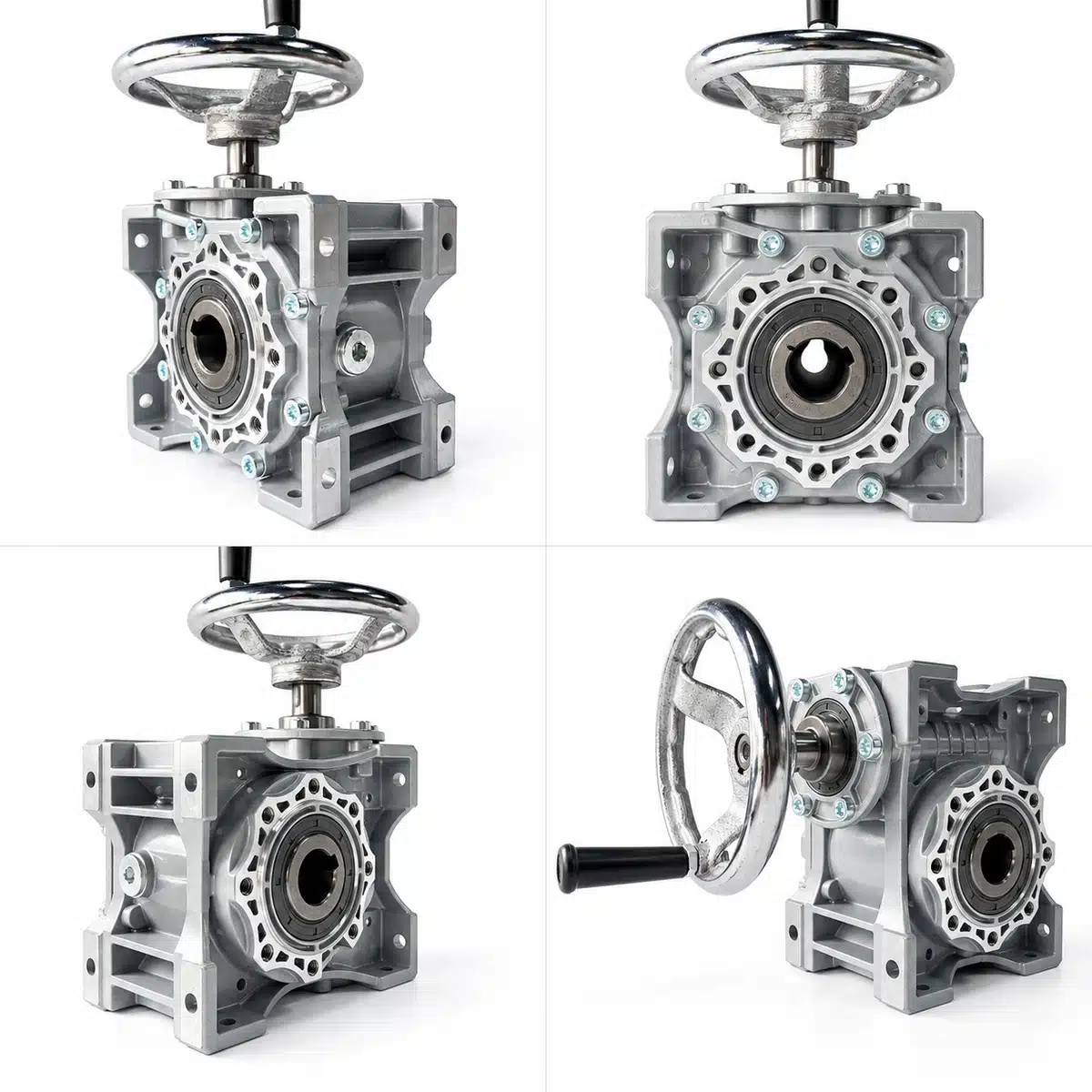
Inline Helical Gearbox for Mixer and Agitator Applications
Key Takeaways
| Selection Factor | Mixer/Agitator Requirement | R Series Specification |
|---|---|---|
| Torque profile | High continuous, peak at startup | Service factor 1.75-2.25× |
| Shaft loading | High overhung + axial thrust | Verify both ratings |
| Duty cycle | Often 24/7 continuous | Check thermal rating first |
| Speed range | Typically 20-200 RPM output | Ratios 10:1-74:1 adequate |
| Environment | Often corrosive, washdown | Specify IP66, Viton seals |
| Backlash | Low requirement | Standard 8-15 arcmin OK |
| Self-locking | Not required | Helical suitable |
Bottom line: Mixer and agitator drives are thermally demanding, shaft-loading intensive applications. Correct specification requires verifying thermal rating before mechanical torque rating — most failures in this application result from thermal overload, not gear tooth breakage.
Table of Contents
- Why Mixer and Agitator Drives Fail Prematurely
- R Series Helical Gearbox Advantages for Mixing Applications
- Understanding Mixer Load Characteristics
- Step-by-Step Selection Procedure
- Shaft Loading: Overhung and Axial Thrust Calculations
- Thermal Management for Continuous Duty Mixing
- Industry-Specific Application Guide
- Mounting Configurations for Mixers
- Maintenance Schedule for Mixer Gearboxes
- FAQ: Helical Gearbox for Mixer and Agitator
1. Why Mixer and Agitator Drives Fail Prematurely
A chemical processing plant replaced their mixer gearbox three times in four years. Each time the diagnosis was the same: bearing failure leading to gear damage. Each replacement cost $3,800 in parts plus $12,000 in production downtime. Total failure cost over four years: $47,400.
The root cause was identified on the fourth investigation. The gearbox was correctly sized for mechanical torque. It was running at 140% of its thermal power rating — continuously, 22 hours per day, mixing a high-viscosity polymer compound at elevated temperature.
The gearbox was not undersized mechanically. It was undersized thermally. The distinction matters enormously in mixer and agitator applications.
Four failure patterns account for the majority of premature mixer gearbox failures:
Thermal overload (most common): Continuous duty mixing generates heat from both motor losses and internal gearbox friction. Housing temperature rises until oil viscosity breaks down, bearing lubrication fails, and progressive damage begins. The gearbox appears correctly sized by torque — but exceeds thermal power rating.
Underestimated shaft loads: Mixer impellers create both radial force (from fluid drag) and axial thrust (from pumping action and impeller weight). Many engineers calculate torque correctly but ignore these shaft loads. Output bearing fails under combined loading.
Service factor omission: High-viscosity mixing applications start under load. Startup torque can reach 3-5× running torque when impeller is submerged in cold, viscous material. Selecting on running torque without service factor means every cold startup exceeds gearbox rated capacity.
Wrong gearbox type: Worm gear reducers are common in mixing applications due to low cost and compact size. For continuous duty above 12 hours per day, worm gear heat generation (25-45% of input power) makes thermal management difficult and operating costs high. Helical gearboxes at 94-96% efficiency run significantly cooler and cost less to operate.
2. R Series Helical Gearbox Advantages for Mixing Applications
Thermal Performance
The defining advantage of helical gearboxes in continuous mixing applications is heat generation rate.
Heat comparison at 5.5 kW input, continuous duty:
| Gearbox Type | Efficiency | Heat Generated | Housing Temp (20°C ambient) |
|---|---|---|---|
| Worm gear, 30:1 | 72% | 1.54 kW | 82-90°C |
| R Series, 30:1 | 95% | 0.28 kW | 55-63°C |
The worm gear runs 25-30°C hotter under identical conditions. At 82-90°C, oil degrades within 1,500-2,500 hours. Seals harden and leak within 8,000-12,000 hours. The R Series running at 55-63°C maintains oil quality to 8,000-12,000 hours and seals last 20,000-30,000 hours.
For 24/7 continuous mixing, this temperature difference is the difference between annual gearbox maintenance and 4-5 year replacement cycles.
Service Life
R Series helical gearboxes use hardened steel gear pairs — 20CrMnTi carburized to 58-62 HRC meshing with hardened pinion. No progressive wear component exists in normal operation.
Worm gears use hardened steel worm (58-62 HRC) meshing with bronze worm wheel. The bronze wheel wears progressively. In mixing applications with frequent starts and high torque, bronze wheel life is typically 20,000-35,000 hours before replacement is required.
Expected service life comparison:
- Worm gear (continuous mixing): 20,000-35,000 hours to worm wheel replacement
- R Series helical (continuous mixing): 50,000-80,000 hours to overhaul
Energy Cost Reduction
Annual energy cost for mixer drive at 5.5 kW, 22 hrs/day, 340 days/year (7,480 hrs/year), $0.12/kWh:
| Gearbox Type | Annual Energy Cost | 10-Year Cost |
|---|---|---|
| Worm gear, 72% eff. | $5,500 | $55,000 |
| R Series, 95% eff. | $4,173 | $41,730 |
| Annual savings | $1,327 | $13,270 |
The R Series unit costs $400-600 more upfront. It recovers this premium in energy savings within 4-6 months of continuous operation.
3. Understanding Mixer Load Characteristics
Mixer and agitator loads differ fundamentally from conveyor loads. Understanding these differences drives correct specification.
Viscosity-Dependent Torque
Mixing torque is not constant — it varies with fluid temperature and composition:
Cold start condition:
- Polymer, adhesive, food product at ambient temperature
- Viscosity 5-20× higher than operating viscosity
- Starting torque: 3-5× running torque
- Duration: 15-60 minutes until material reaches operating temperature
Hot running condition:
- Material at process temperature
- Design running torque
- Steady state after warmup
Implication for service factor: Cold start torque multiplier must be captured in service factor selection. A polymer mixer running at 400 Nm steady-state may impose 1,600-2,000 Nm at cold start. Service factor 4.0-5.0 for the cold start condition? No — the correct approach is to verify peak torque against gearbox rated torque directly, while applying standard service factor (1.75-2.25) for frame size selection based on running torque.
Practical rule: For high-viscosity applications with cold start conditions, verify that rated gearbox torque ≥ estimated peak startup torque. Use a soft starter or VFD to limit startup torque if peak torque would otherwise exceed the gearbox rating.
Axial Thrust Loading
Impeller design determines axial thrust direction and magnitude:
Downward pumping impellers (most common):
- Axial thrust directed downward (toward gearbox)
- Magnitude: 20-40% of radial force typical
- Increases with impeller diameter and submersion depth
Upward pumping impellers:
- Axial thrust directed upward (away from gearbox)
- May partially unload output bearing
- Check bearing can handle thrust in both directions
Multiple impellers:
- Axial loads may partially cancel (counter-rotating stages)
- Or compound (same pumping direction)
- Calculate net axial force on output shaft
Overhung Load from Impeller Weight
Impeller weight creates a static overhung load on the output shaft — even before fluid forces are applied.
Typical impeller weights by size:
| Impeller Diameter | Typical Weight |
|---|---|
| 200-300mm | 2-8 kg |
| 300-500mm | 8-25 kg |
| 500-800mm | 25-80 kg |
| 800-1,200mm | 80-200 kg |
At a shaft extension of 300mm, a 50 kg impeller creates:
F_static = 50 × 9.81 = 490 N at 300mmAdd fluid reaction forces (typically 1.5-3× static weight for process conditions) and total overhung load can reach 1,000-1,500 N before torque-induced shaft loading is considered.
4. Step-by-Step Selection Procedure
Step 1: Determine Required Output Torque
T₂ = P × 9,550 / n₂Where:
- P = Required mixing power (kW) — from process engineering or mixer manufacturer
- n₂ = Required impeller speed (RPM)
Example:
- Mixing power: 7.5 kW
- Impeller speed: 65 RPM
T₂ = 7.5 × 9,550 / 65 = 1,101 NmIf mixing power is not known: Use empirical power number correlation for your impeller type, or specify based on similar existing installations. Contact mixer manufacturer for process-specific power requirements.
Step 2: Calculate Reduction Ratio
i = n₁ / n₂- Motor speed: 1,450 RPM
- Required impeller speed: 65 RPM
i = 1,450 / 65 = 22.3 → nearest standard ratio: 23.83:1Actual impeller speed: 1,450 / 23.83 = 60.8 RPM
Check process tolerance: ±8% for most mixing applications is acceptable. If exact speed required, specify VFD.
Step 3: Apply Service Factor
Mixer and agitator service factors:
| Application | Hours/Day | Material | Service Factor |
|---|---|---|---|
| Light agitator, low viscosity | <8 | Water-like | 1.25-1.50 |
| Standard mixer | 8-16 | Medium viscosity | 1.50-1.75 |
| Heavy mixer, continuous | >16 | High viscosity | 1.75-2.25 |
| Polymer/adhesive mixer | Any | Cold start condition | 2.00-2.50 |
| Kneader or sigma mixer | Any | Very high viscosity | 2.25-2.75 |
| Reversing mixer | Any | Any | +0.25 |
Example:
- High viscosity polymer, 22 hrs/day, cold start conditions
- Base service factor: 2.00
- Add for cold start: +0.25
- Total: 2.25
T_design = 1,101 × 2.25 = 2,477 NmStep 4: Select Frame Size
Required: 2,477 Nm at ratio 23.83:1
| Model | Rated Torque at 23:1 | Utilization | Decision |
|---|---|---|---|
| R67 | 1,250 Nm | 198% | ✗ Undersized |
| R77 | 2,150 Nm | 115% | ✗ Marginal |
| R87 | 3,500 Nm | 71% | ✓ Acceptable |
Select R87 — 71% utilization with adequate margin for application severity.
Step 5: Verify Thermal Rating (Critical for Mixers)
This step governs continuous mixer applications.
- Selected: R87
- Motor power input: 7.5 kW / 0.95 (gearbox efficiency) = 7.89 kW input
- R87 thermal rating (continuous): 20.0 kW
7.89 kW < 20.0 kW ✓ — Thermally adequate with substantial margin.
If thermal rating is insufficient:
- Upsize one frame (most common solution)
- Specify synthetic oil (+10-15% thermal capacity)
- Add cooling fan (+15-25°C improvement)
- Reduce duty cycle (if process allows)
Step 6: Verify Shaft Loads
Calculate both overhung load and axial thrust. Verify each against catalog ratings. See Section 5 for detailed calculations.
Step 7: Specify Motor Power
P_motor = T₂ × n₂ / (9,550 × η)
P_motor = 1,101 × 60.8 / (9,550 × 0.95) = 7.37 kW
Select: 11 kW motor (next standard size above 7.37 kW × 1.20 minimum margin)
5. Shaft Loading: Overhung and Axial Thrust Calculations
Overhung Load Calculation for Mixers
Mixer overhung load has two components: static (impeller weight) and dynamic (fluid reaction forces).
Static component:
F_static = m_impeller × gDynamic component (fluid reaction):
F_dynamic = k × T₂ / r_impellerWhere k = empirical factor:
- Paddle impellers: k = 0.5-1.0
- Turbine impellers: k = 0.8-1.5
- Anchor/gate impellers: k = 1.0-2.0
Total overhung load:
F_total = F_static + F_dynamicExample:
- Impeller mass: 35 kg
- Impeller radius: 0.25m
- T₂ = 1,101 Nm, k = 1.2 (turbine)
F_static = 35 × 9.81 = 344 N
F_dynamic = 1.2 × 1,101 / 0.25 = 5,285 N
F_total = 344 + 5,285 = 5,629 N
Verify against R87 catalog at actual shaft extension distance.
R87 overhung load rating at 100mm from housing face: 14,000 N 5,629 N < 14,000 N ✓
If shaft extension is longer (e.g., 250mm for deep tank), recalculate allowable load:
F_allowed at 250mm = 14,000 × (100 / 250) = 5,600 N
5,629 N > 5,600 N — marginally exceeds
Solution: Use R97 with higher overhung rating, or reduce shaft extension with intermediate bearing.
Axial Thrust Verification
Axial thrust rating is listed separately in most gearbox catalogs. For R Series, tapered roller bearings handle combined radial and axial loads — but axial capacity must be verified.
Typical axial thrust estimate:
F_axial = 0.25 to 0.40 × F_radialFor our example: F_axial ≈ 0.30 × 5,629 = 1,689 N
Check R87 axial load capacity. Standard R Series handles axial loads up to 25-35% of radial rating. If axial thrust exceeds this, specify thrust bearing adapter or use right-angle K Series which handles combined loading better.
6. Thermal Management for Continuous Duty Mixing
Heat Generation in Mixer Gearboxes
P_heat = P_input × (1 - η)
P_heat = 7.89 × (1 - 0.95) = 0.39 kW
For continuous 22-hour operation, this 0.39 kW must dissipate continuously through the housing.
Factors Increasing Thermal Load in Mixing
Elevated ambient temperature: Many mixing processes operate in heated environments — batch reactors, heated tanks, food processing areas at 35-45°C. Each 10°C ambient increase reduces available thermal headroom by approximately 8%.
Enclosed installation: Mixers often mount above tanks with poor ventilation around the gearbox. Without airflow over cooling fins, heat dissipation drops 30-40%.
Continuous 24/7 operation: No rest periods. Temperature reaches steady-state and holds there continuously. Any thermal rating shortfall accumulates rather than recovers.
Thermal Management Solutions
| Solution | Temperature Reduction | Cost | Maintenance Impact |
|---|---|---|---|
| Synthetic oil (PAO/PAG) | 8-15°C | Oil cost ×2-3 | Longer change intervals |
| Cooling fan on housing | 15-25°C | $180-420 | Annual inspection |
| Upsize one frame | 20-35°C | +25-35% unit cost | None |
| External oil cooler | 25-40°C | $900-2,800 | Cooler maintenance |
| Improve ventilation | 5-15°C | Low | None |
Recommended approach for continuous mixing >16 hrs/day:
- Specify synthetic PAO or PAG oil (first line of defense, lowest cost)
- Ensure 150mm minimum clearance on all housing sides
- Verify thermal rating with 20% margin (not marginal)
- Add cooling fan if ambient temperature exceeds 35°C
7. Industry-Specific Application Guide
Chemical Processing
Challenges:
- Corrosive vapors attack standard paint and seal materials
- Continuous 24/7 operation in heated environments
- Frequent product changes requiring washdown
- ATEX (explosion-proof) requirements in some zones
Specification requirements:
- Viton (FKM) seals — chemical resistance to solvents, acids
- Epoxy chemical-resistant coating (not standard paint)
- IP65 minimum sealing
- ATEX certification if required by zone classification
- Synthetic lubricant (chemical compatibility with potential contamination)
Common R Series for chemical mixers: R67-R107 depending on batch size and viscosity. Ratios 20:1-40:1 typical for 30-100 RPM impeller speeds.
Food and Beverage Processing
Challenges:
- Frequent high-pressure washdown (daily)
- Food contact zone contamination risk from oil leaks
- Stainless steel requirements in some facilities
- NSF/FDA compliance for lubricants
Specification requirements:
- IP66 or IP69K sealing for high-pressure washdown
- NSF H1 food-grade synthetic lubricant (factory-fill)
- Viton seals (chemical resistance to cleaning agents)
- Stainless steel output shaft (optional but preferred)
- Smooth housing surfaces (no crevices for bacterial growth)
- White or light-colored epoxy coating (shows contamination)
Common R Series for food mixers: R47-R87. Ratio selection depends on product — dough mixers typically 10-25 RPM (high ratio), beverage blending 60-150 RPM (lower ratio).
Pharmaceutical Manufacturing
Challenges:
- GMP (Good Manufacturing Practice) documentation requirements
- Particle contamination risk (zero tolerance in cleanroom areas)
- Validation documentation for regulatory compliance
- Frequent sanitization with aggressive chemicals
Specification requirements:
- Full material certifications (traceability)
- IP66 or higher
- Electropolished stainless housing (custom — cleanroom applications)
- NSF H1 or USP Class VI compatible lubricant
- Validation documentation package (IQ/OQ support)
- Clean design (no exposed fasteners, no cavities)
Wastewater Treatment
Challenges:
- Continuous 24/7 outdoor exposure
- Corrosive atmosphere (H₂S in some applications)
- Large impellers — high overhung and axial loads
- Difficult maintenance access
Specification requirements:
- IP65 minimum, IP66 preferred
- Corrosion-resistant coating (polyurethane or zinc-rich primer)
- Stainless steel hardware
- Heavy-duty bearings (verify oversized overhung load rating)
- Extended oil drain intervals (remote location)
- Synthetic oil (minimize maintenance visits)
8. Mounting Configurations for Mixers
Vertical Shaft Down (Most Common)
Gearbox mounts above tank. Output shaft points downward into vessel. Motor mounts above gearbox inline (R Series) or beside gearbox (K Series for right-angle).
Oil level requirement: Vertical mounting changes oil distribution inside gearbox. Manufacturer specifies different fill quantity for V5/V6 orientation. Always specify mounting orientation on purchase order — gearbox ships with oil set for specified position.
Seal loading: Lower shaft seal carries oil weight — specify double-lip seal as minimum. Enhanced seal with spring-loaded lip for extended impeller shaft in deep tanks.
Horizontal Shaft (Side-Entry Mixers)
Motor and gearbox horizontal. Output shaft enters vessel through side wall. Common for large storage tanks where top entry is impractical.
Additional considerations:
- Flange mounting to tank wall (B5 or custom)
- Mechanical seal on shaft where it penetrates vessel wall
- Support bearing at tank entry point to reduce gearbox overhung load
- K Series right-angle often preferred (motor above drive level, clear of tank)
Portable and Clamp-Mount Mixers
Small mixers on portable stands or drum clamps:
- R Series compact frame sizes (R17-R47)
- Typically 0.18-2.2 kW motors
- Ratios 20:1-50:1 for 30-75 RPM typical
- B3 foot mount to portable frame
- Lightweight aluminum housing preferred
9. Maintenance Schedule for Mixer Gearboxes
Standard Maintenance Intervals
| Task | Interval | Critical For Mixers |
|---|---|---|
| Visual leak inspection | Daily | High — food/pharma contamination risk |
| Oil level check | Weekly | High — vertical mounting critical |
| Temperature monitoring | Weekly | High — continuous duty thermal management |
| Seal condition inspection | Monthly | High — washdown and corrosive environments |
| Mounting bolt torque check | Monthly | Medium — vibration from impeller |
| Breather cleaning | Monthly | High — washdown blocks breather |
| Coupling or shaft inspection | Quarterly | High — axial and overhung loads |
| Vibration analysis | Quarterly | High — impeller imbalance detection |
| Alignment verification | Annually | Medium |
| Oil change — mineral | 4,000-6,000 hrs | — |
| Oil change — synthetic | 10,000-15,000 hrs | Recommended for continuous duty |
Mixer-Specific Maintenance Notes
Impeller inspection: Inspect impeller for wear, corrosion, and buildup at each tank cleaning. Imbalanced or damaged impellers create vibration that accelerates gearbox bearing wear.
Shaft seal monitoring: In food and pharmaceutical applications, any oil leak constitutes a contamination event. Inspect output shaft seal at every maintenance interval. Replace proactively at 15,000 hours or at first sign of weeping — do not wait for visible leakage.
Breather maintenance: Washdown frequently blocks breathers with water ingress or debris. Blocked breather causes pressure buildup, accelerates seal failure. Clean or replace monthly in washdown environments.
Oil analysis program: For continuous mixing operations, oil analysis at 2,000-hour intervals provides early warning of contamination, viscosity breakdown, and wear particle generation. More valuable than fixed change intervals in applications where contamination can occur.
10. FAQ: Helical Gearbox for Mixer and Agitator
Q: What is the best gearbox for a continuous duty mixer?
For continuous duty mixers running 16+ hours per day, inline helical R Series gearboxes provide the best combination of thermal performance, service life, and operating cost. Their 94-96% efficiency generates substantially less heat than worm gear equivalents — critical for continuous operation. The all-steel gear pair eliminates the progressive bronze wheel wear that limits worm gear service life. Specify with synthetic PAO or PAG lubricant for best thermal management and extended oil change intervals. Size based on design torque (running torque × service factor 1.75-2.25) and verify thermal power rating — not just mechanical torque rating — for continuous applications.
Q: How do I calculate torque for a mixer gearbox?
Calculate output torque from mixing power and speed: T₂ = P × 9,550 / n₂ (where P is mixing power in kW and n₂ is impeller speed in RPM). Then apply service factor: T_design = T₂ × f_s. Use service factor 1.75-2.25 for continuous high-viscosity mixing, 1.25-1.50 for light intermittent agitation. For cold-start conditions with high-viscosity materials, also verify that rated gearbox torque exceeds estimated peak startup torque — which can reach 3-5× running torque for viscous materials at ambient temperature. Use a VFD or soft starter to limit cold-start torque if necessary.
Q: Why do mixer gearboxes overheat?
Mixer gearbox overheating typically results from one of four causes: thermal power rating exceeded (most common — gearbox correctly sized for torque but not for continuous heat dissipation), inadequate ventilation around gearbox housing, elevated ambient temperature in processing area, or continuous duty without adequate oil cooling provision. Verify thermal power rating from catalog against actual motor input power before installation. For installations where housing runs above 80°C, specify synthetic lubricant, add cooling fan, or upsize to next frame. Temperature trending over time is more useful than single readings — a gradual 15°C rise over months indicates developing thermal problem.
Q: What is the typical service life of a helical gearbox on a mixer?
Properly specified and maintained inline helical gearboxes achieve 50,000-80,000 hours in mixer applications. With synthetic lubrication and disciplined maintenance, 80,000-100,000+ hours is achievable. Service life is primarily determined by correct specification — particularly adequate service factor and thermal rating — rather than operating hours alone. An R Series unit running at 70-80% of rated torque with appropriate service factor and synthetic oil will significantly outlast a nominally sized unit running at 90-95% of rated torque. Bearing life, not gear life, typically determines actual service interval in well-specified helical gearboxes.
Q: Do I need special seals for washdown mixer applications?
Yes. Standard NBR (nitrile) seals are inadequate for frequent washdown with chemical sanitizers. Specify FKM (Viton) seals for chemical resistance to chlorine-based cleaners, quaternary ammonium compounds, peracetic acid, and caustic cleaning agents. Combine Viton seals with IP66 housing protection (IP69K for high-pressure washdown above 80 bar) and ensure the breather is sealed or protected against water ingress. For food and pharmaceutical applications, factory-fill with NSF H1 food-grade lubricant to eliminate contamination risk from any incidental seal weeping.
Q: Can I use R Series inline helical for a side-entry mixer?
Yes, with attention to mounting geometry and shaft loading. Side-entry applications mount the gearbox horizontally with the output shaft entering the vessel through a side wall. Key considerations: specify B5 flange mounting to vessel wall or support structure, install a support bearing at the vessel wall entry point to transfer overhung load away from gearbox output bearing, verify axial thrust capacity (side-entry impellers can generate significant axial loading), and use K Series right-angle if motor-above-vessel geometry is preferred (cleaner installation, better drainage). Calculate total overhung load including both impeller weight and fluid reaction forces at the gearbox output shaft.
Q: What is the difference between R Series and K Series for mixer applications?
R Series inline helical positions motor and output on the same axis — motor sits above gearbox which sits above vessel (top-entry) or beside vessel (side-entry). K Series helical-bevel positions motor perpendicular to output — motor mounts beside gearbox rather than above it, reducing total height for top-entry configurations. For most top-entry mixer applications, R Series is the preferred choice: slightly higher efficiency (94-96% vs 93-95%), lower cost, and adequate torque range. K Series is preferred when headroom above the vessel is limited (motor-beside reduces height by 30-40%), or when the application requires ratios above 74:1 unavailable in single-stage R Series.
Published by KB Transmission Star— KKM Helical Hypoid Gearbox Manufacturer Taiwan Design. China Manufacturing. Global Delivery.
— Helical Gearbox Manufacturer