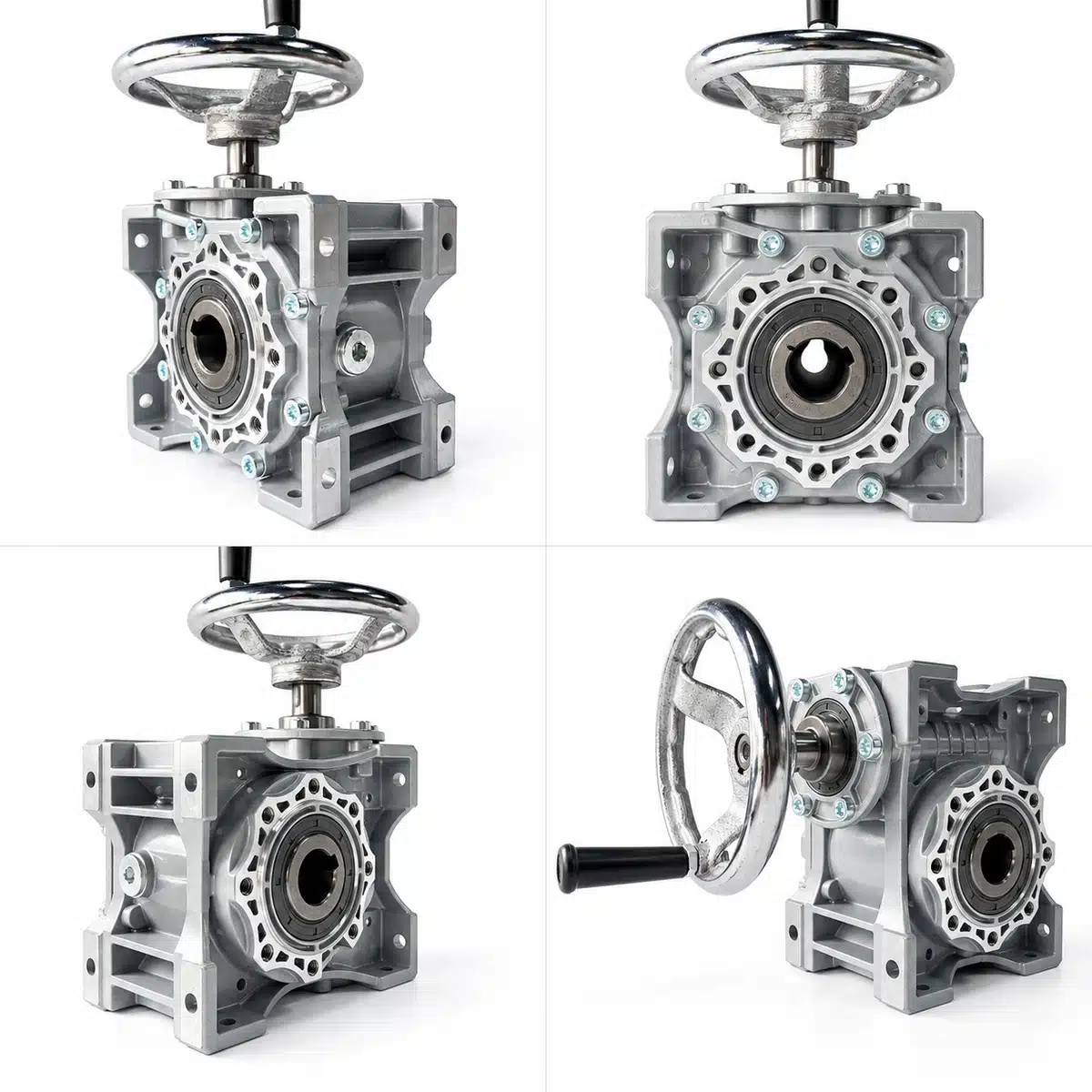
Why Replace NMRV Worm Gearboxes with KKM Helical-Hypoid Gearboxes?
A Higher-Efficiency Replacement Path for NMRV Worm Gear Reducers
NMRV worm gear reducers remain widely used in conveyors, packaging machinery, food-processing equipment and general industrial drives because of their compact right-angle design, broad ratio availability and simple installation.
However, worm gearing relies heavily on sliding contact between the worm and worm wheel. As the reduction ratio increases, transmission losses can become increasingly important—particularly in continuous-duty applications where energy consumption, thermal performance and available output torque matter.
The KKM Series helical-hypoid gearbox provides an alternative for applications where users want to retain a compact right-angle drive while improving transmission efficiency.
Rather than treating KKM as a universal drop-in replacement for every NMRV configuration, the correct engineering approach is to compare:
gearbox size, ratio, required output torque, motor frame and flange, output interface, mounting dimensions, mounting position and service conditions.
This guide explains where KKM can provide an advantage and what engineers should verify before replacing an existing NMRV reducer.
NMRV vs KKM: What Is the Fundamental Difference?
The primary difference is the gearing principle.
| Feature | NMRV Worm Gear Reducer | KKM Helical-Hypoid Gearbox |
|---|---|---|
| Transmission principle | Worm and worm wheel | Gear / hypoid transmission |
| Contact characteristic | Higher sliding component | Predominantly rolling/meshing gear contact |
| Right-angle output | Yes | Yes |
| Compact industrial layout | Yes | Yes |
| Efficiency behavior | Decreases significantly at higher ratios | Higher and more stable across available ratios |
| Ratio availability | Broad single-stage range | B Series for lower ratios; C Series for higher ratios |
| IEC motor options | Available | Available |
| Best suited to | General worm-drive applications, compact drives, applications where worm characteristics are required | Energy-sensitive, continuous-duty and higher-efficiency right-angle drives |
The NMRV catalog also emphasizes that efficiency depends on operating conditions and that gearbox selection must account for service factor, ambient conditions, starts per hour and load classification rather than ratio alone.
The Main Reason to Consider KKM: Transmission Efficiency
A simple statement such as “worm gearboxes are 60% efficient” is technically incomplete.
NMRV efficiency changes with gearbox size and reduction ratio.
The KKM040–090 comparison data makes this difference particularly clear.
KKM vs NMRV Transmission Efficiency
| Ratio | KKM040 / NMRV040 | KKM050 / NMRV050 | KKM063 / NMRV063 | KKM075 / NMRV075 | KKM090 / NMRV090 |
|---|---|---|---|---|---|
| 7.5 | 94% / 87% | 94% / 88% | 94% / 88% | 94% / 91% | 94% / 90% |
| 10 | 94% / 85% | 94% / 86% | 94% / 87% | 94% / 90% | 94% / 89% |
| 20 | 94% / 78% | 94% / 79% | 94% / 81% | 94% / 85% | 94% / 84% |
| 30 | 94% / 70% | 94% / 72% | 94% / 74% | 94% / 80% | 94% / 78% |
| 40 | 94% / 65% | 94% / 67% | 94% / 70% | 94% / 77% | 94% / 75% |
| 50 | 94% / 62% | 94% / 63% | 94% / 66% | 94% / 74% | 94% / 72% |
| 60 | 94% / 58% | 94% / 59% | 94% / 62% | 94% / 71% | 94% / 69% |
| 75 | 92% / 52% | 92% / 53% | 92% / 57% | 92% / 66% | 92% / 63% |
| 100 | 92% / 47% | 92% / 49% | 92% / 51% | 92% / 61% | 92% / 59% |
Source: KKM040–090 selection comparison data. The values above are catalog/selection data for the listed gearbox sizes and ratios and should not be interpreted as a universal efficiency value for every worm or hypoid gearbox.
This distinction is important.
At relatively low ratios, the efficiency difference may be modest. At higher ratios, the efficiency advantage of the KKM architecture becomes considerably larger in the supplied selection data.
What Does Higher Efficiency Mean for Output Torque?
Gearbox output torque can be approximated by:
T₂ = T₁ × i × η
where:
- T₂ = gearbox output torque
- T₁ = motor torque
- i = reduction ratio
- η = transmission efficiency
This means two gearboxes driven by the same motor at the same nominal ratio can produce different calculated output torque when their transmission efficiencies differ.
Example: 0.75 kW Motor + 60:1 Reduction
The supplied KKM selection data uses a motor torque of approximately 4.8 N·m for a 0.75 kW motor.
For NMRV063 at 60:1, using η = 0.62:
4.8 × 60 × 0.62 = 178.6 N·m
For KKM063 at 60:1, using η = 0.94:
4.8 × 60 × 0.94 = 270.7 N·m
Under these calculation assumptions, the KKM example produces approximately 51.6% more calculated output torque from the same motor torque and nominal reduction ratio.
This does not mean that every KKM installation automatically delivers 51.6% more usable torque. Final gearbox selection must still respect the gearbox’s rated output torque, service factor and application load.
Can a Smaller Motor Be Used with KKM?
In some applications, potentially yes—but it must be verified by torque and service-factor calculations.
The supplied comparison material provides an example in which an application requiring approximately 100 N·m is compared using:
- 1/2 HP + NMRV50, 80:1
- 1/4 HP + TKM050, 80:1
The example calculates annual electricity consumption based on 220 V, the stated motor currents, 8 operating hours per day and 240 operating days per year. Under those specific assumptions, the higher-efficiency gear arrangement permits the smaller motor to satisfy the stated torque requirement.
The important engineering principle is therefore:
Do not downsize the motor simply because KKM is more efficient. Recalculate required output torque, gearbox rating and service factor first.
KKM Ratio Range vs NMRV
The two product families do not use exactly the same ratio architecture.
According to the supplied KKM040–090 selection table:
| KKM Series | Available Ratios |
|---|---|
| KKM040B / KKM050B | 5, 7.5, 10, 15, 20, 25, 30, 40, 50, 60 |
| KKM063B / KKM075B / KKM090B | 7.5, 10, 15, 20, 25, 30, 40, 50, 60 |
| KKM040C–KKM090C | 75, 100, 125, 150, 200, 250, 300 |
The comparison table lists NMRV single worm reducers through ratios up to 80 and 100 for the corresponding sizes, while PC+NMRV combinations are listed at 120, 150, 180, 240 and 300.
This is why replacement should be based on the required output speed and torque, not merely by copying the existing gearbox model designation.
IEC Motor Compatibility
KKM040–090 supports multiple IEC motor frame combinations.
| KKM Size | Typical Motor Options | IEC Frames | B14 Flange OD | B5 Flange OD |
|---|---|---|---|---|
| KKM040 | 1/8–1/2 HP | 56 / 63 / 71 | 80 / 90 / 105 mm | 120 / 140 / 160 mm |
| KKM050 | 1/4–1 HP | 63 / 71 / 80 | 90 / 105 / 120 mm | 140 / 160 / 200 mm |
| KKM063 | 1/2–2 HP | 71 / 80 / 90 | 105 / 120 / 140 mm | 160 / 200 / 200 mm |
| KKM075 | 1/2–5 HP | 71 / 80 / 90 / 100 / 112 | 105 / 120 / 140 / 160 / 160 mm | 160 / 200 / 200 / 250 / 250 mm |
| KKM090 | 1–5 HP | 80 / 90 / 100 / 112 | 120 / 140 / 160 / 160 mm | 200 / 200 / 250 / 250 mm |
These are the combinations stated in the supplied KKM selection table.
This flexibility can make KKM suitable for retrofit projects where retaining an IEC motor is desirable.
However:
IEC frame compatibility alone does not establish complete mechanical interchangeability.
Motor flange diameter, input interface, output bore/shaft, keyway, mounting pattern, center height and surrounding machine clearance must also be checked.
Is KKM a Direct Drop-In Replacement for NMRV?
Not automatically.
KKM helical-hypoid gear units are designed as a replacement option for many applications currently using NMRV worm gear reducers. Corresponding KKM frame sizes are available for common NMRV sizes, with NMRV-compatible mounting and output interfaces designed to simplify retrofit projects.
However, matching the frame size alone does not guarantee complete interchangeability. Before replacing an existing NMRV gearbox, the reduction ratio, required output torque, IEC motor interface, hollow bore or output shaft, mounting position, service factor and application conditions should be verified.
NMRV to KKM Replacement Cross-Reference
KKM helical-hypoid gear units are designed around NMRV-compatible mounting and output interfaces. The KKM mounting dimensions are compatible with the corresponding NMRV series and that the hollow bore and output shaft dimensions remain unchanged.
The following table provides a practical frame-to-frame starting point for replacement selection:
| Existing NMRV | Primary KKM Candidate | Common Ratio Range | Mounting Interface | Output Interface | Engineering Status |
|---|---|---|---|---|---|
| NMRV040 | KKM040B | 5:1–60:1 | NMRV-compatible | NMRV-compatible hollow bore / output shaft design | Verify motor, ratio and load |
| NMRV050 | KKM050B | 5:1–60:1 | NMRV-compatible | NMRV-compatible hollow bore / output shaft design | Verify motor, ratio and load |
| NMRV063 | KKM063B | 7.5:1–60:1 | NMRV-compatible | NMRV-compatible hollow bore / output shaft design | Verify motor, ratio and load |
| NMRV075 | KKM075B | 7.5:1–60:1 | NMRV-compatible | NMRV-compatible hollow bore / output shaft design | Verify motor, ratio and load |
| NMRV090 | KKM090B | 7.5:1–60:1 | NMRV-compatible | NMRV-compatible hollow bore / output shaft design | Verify motor, ratio and load |
Important: The table above identifies the primary corresponding frame and common ratio overlap. It does not mean that matching the frame number alone completes the replacement selection.
For common NMRV ratios up to 60:1, the corresponding KKM B-stage frame is normally the first configuration to evaluate.
For NMRV applications using 75:1, 80:1 or 100:1, do not assume that the same B-stage configuration applies. The required output speed and torque should be checked against the corresponding KKM C-stage selection data.
Before ordering a replacement, verify:
- Existing NMRV frame size
- Required reduction ratio
- Required output speed
- Required continuous and peak output torque
- Service factor
- Motor power and IEC frame
- B5 or B14 motor flange
- Hollow bore or solid output shaft dimensions
- Keyway and shaft details
- Gearbox mounting-hole pattern
- Center height and critical envelope dimensions
- Mounting position
- Radial/axial load
- Duty cycle, starts per hour and ambient conditions
The NMRV catalog itself specifies service-factor selection according to operating hours, starting frequency and load classification, and notes adjustments for ambient temperature and other operating conditions.
Why Higher Efficiency Can Improve Gearbox Thermal Performance
Transmission efficiency and heat generation are closely related in industrial gearboxes. Not all of the mechanical power entering a gearbox reaches the output shaft. Part of the input power is lost through gear-mesh friction, bearing losses, lubricant churning and other internal losses, with much of this lost energy ultimately dissipated as heat.
NMRV worm gear reducers transmit power through substantial sliding contact between the worm and worm wheel. As the reduction ratio increases, sliding losses can become more significant, which is one reason transmission efficiency generally decreases at higher ratios.
KKM helical-hypoid gear units use a different gear geometry designed to achieve higher transmission efficiency. Under comparable operating conditions, lower transmission losses mean that less input energy is converted into heat inside the gearbox. This can reduce the thermal load on the drive system, particularly in continuous-duty and higher-ratio applications.
Typical Temperature-Rise Advantage
Based on our practical operating experience, KKM gear units typically show approximately 20% lower temperature rise than comparable NMRV worm gear reducers under similar load and operating conditions.
Actual temperature rise varies with gearbox size, reduction ratio, transmitted load, input speed, duty cycle, lubricant, ambient temperature, mounting position and installation conditions.
What Determines Actual Gearbox Temperature?
Actual operating temperature depends on multiple factors, including:
- transmitted load and output torque;
- reduction ratio;
- input speed;
- operating hours and duty cycle;
- ambient temperature;
- lubricant type and condition;
- mounting position;
- gearbox size;
- starts and stops; and
- surrounding airflow and installation conditions.
For this reason, KKM should be evaluated on the basis of its higher transmission efficiency, lower transmission losses and application-specific thermal performance, rather than by assigning a fixed operating temperature to every KKM or NMRV gearbox.
When replacing an existing NMRV gearbox because of excessive operating temperature, the complete drive system should therefore be checked—including load, ratio, motor power, input speed, duty cycle, lubrication, mounting position and ventilation—before selecting the corresponding KKM unit.
In continuous-duty applications where gearbox heat generation is a recurring concern, the combination of higher transmission efficiency and typically lower temperature rise can be an important reason to evaluate a KKM helical-hypoid gearbox as an alternative to an existing NMRV worm gear reducer.
When Should You Consider Replacing NMRV with KKM?
KKM is particularly worth evaluating when an existing NMRV application has:
- continuous or long-hour operation;
- a relatively high reduction ratio;
- energy consumption as an important operating-cost factor;
- limited thermal margin;
- insufficient available output torque from the existing motor/reducer combination;
- a desire to evaluate motor downsizing;
- repeated worm-drive replacement or maintenance;
- a requirement for a compact right-angle gearbox.
By contrast, replacement should not be automatic when the application depends on worm-drive behavior such as self-locking or resistance to back-driving.
The NMRV catalog specifically explains that worm gearbox reversibility depends on efficiency and operating conditions; dynamic and static reversibility are not identical.
If holding a suspended or safety-critical load is required, use an appropriate brake or engineered holding system rather than assuming that either gearbox will provide safe load holding.
KKM vs NMRV: Engineering Comparison
| Selection Criterion | NMRV Worm Gearbox | KKM Helical-Hypoid Gearbox | Engineering Consideration |
|---|---|---|---|
| Right-angle drive | Yes | Yes | Both can serve compact 90° drive layouts |
| Efficiency | Ratio-dependent | Higher in supplied comparison data | Advantage becomes more significant at higher ratios |
| Heat generation | Higher losses can mean more heat | Lower transmission losses | Actual temperature depends on operating conditions |
| Output torque from same motor | Reduced by lower η | More input power can reach output | Verify rated gearbox torque |
| High ratios | Available in worm and combination configurations | C Series extends to 300:1 | Compare output speed, not model name alone |
| IEC motors | Available | Multiple IEC frame/flange options | Verify exact flange and interface |
| Back-driving behavior | Worm characteristics may be useful | Do not assume equivalent self-locking behavior | Important for lifting/holding applications |
| Retrofit potential | Existing installed base | Designed for many NMRV-type applications | Verify critical dimensions before ordering |
| Motor downsizing | Often limited by required output torque | May be possible in selected applications | Recalculate torque and service factor |
A Practical NMRV-to-KKM Replacement Procedure
A reliable retrofit should start with the machine requirement rather than the gearbox label.
Step 1 — Record the existing drive
Photograph the nameplate and record NMRV size, ratio, motor power, motor frame, mounting position and output arrangement.
Step 2 — Determine the actual machine requirement
Confirm output speed, continuous torque, peak torque, operating hours, starts per hour and driven-machine load classification.
Step 3 — Select the KKM ratio
Choose the KKM ratio that provides the required output speed. Do not assume that an NMRV 80:1 must always be replaced by a mechanically identical “80:1” configuration.
Step 4 — Verify torque and service factor
Check catalog-rated torque rather than relying solely on theoretical:
motor torque × ratio × efficiency.
Step 5 — Verify the IEC motor interface
Confirm motor frame plus B5/B14 flange configuration.
Step 6 — Verify critical dimensions
Check bore/shaft, keyway, mounting holes, center height, flange, envelope and clearance.
Step 7 — Confirm application-specific requirements
Check mounting position, radial load, axial load, ambient temperature and any requirement for braking or resistance to back-driving.
Manufacturing Quality and Dimensional Inspection
Reliable gearbox replacement depends on more than matching the reduction ratio and rated torque. For an NMRV-to-KKM retrofit, dimensional accuracy is equally important because the gearbox must interface correctly with the existing motor, driven shaft, mounting points and surrounding machine structure.
KKM gear units are manufactured using controlled machining and inspection processes, with 3D measuring equipment used for sampling inspection of critical machining tolerances. This helps maintain dimensional consistency across key gearbox interfaces and production batches.
For OEM and replacement applications, particular attention is given to critical interface dimensions such as the mounting pattern, output bore or shaft, center height, motor interface and other installation-related dimensions.
This dimensional control is especially important when KKM is being evaluated as a replacement for an existing NMRV gearbox. A reducer may provide the correct ratio, output speed and torque, but it will not be a successful retrofit if its mechanical interfaces do not match the existing machine.
For this reason, an NMRV-to-KKM replacement should be verified from both perspectives:
Performance compatibility: ratio, output speed, rated torque, service factor and operating conditions.
Mechanical compatibility: motor interface, output bore or shaft, keyway, mounting dimensions, mounting position and installation clearance.
Combining these two checks provides a more reliable basis for selecting the correct KKM configuration for OEM production or NMRV replacement projects.
Need Help Replacing an Existing NMRV Gearbox?
Send us:
NMRV model + ratio + motor power + motor frame + mounting position + output bore/shaft + application + required output speed/torque.
Our engineering team can review the operating requirement and identify a suitable KKM configuration.
Request an NMRV-to-KKM Replacement Check
View KKM Helical-Hypoid Gear Units
Frequently Asked Questions
Can KKM directly replace an NMRV worm gearbox?
KKM can be evaluated as a replacement for many NMRV-type applications, but the model number alone does not prove drop-in interchangeability. Ratio, torque, IEC motor interface, output dimensions, mounting dimensions and operating conditions should be checked before ordering.
Is KKM more efficient than NMRV?
In the supplied KKM040–090 comparison data, KKM B-series efficiency is listed at 94% across the shown 5–60 ratios, while the corresponding NMRV values vary with size and ratio. At 60:1, for example, the listed NMRV efficiencies range from 58% to 71% across the compared sizes. KKM C-series values are listed at 92% for the shown 75–300 ratios.
Does a higher-efficiency gearbox always allow a smaller motor?
No. Higher efficiency can reduce the motor power required to achieve a given output torque in some applications, but motor downsizing must be verified against required torque, acceleration, service factor, gearbox rating and operating conditions.
Does KKM run cooler than NMRV?
Under comparable operating conditions, the higher transmission efficiency of KKM helical-hypoid gear units can reduce transmission losses and heat generation. Based on our practical operating experience, KKM gear units typically show approximately 20% lower temperature rise than comparable NMRV worm gear reducers under similar load and operating conditions.
This is a typical observed difference rather than a guaranteed value. Actual temperature rise depends on gearbox size, load, speed, ratio, ambient temperature, lubricant, duty cycle, mounting position and installation conditions.
Can KKM replace a PC+NMRV combination?
It may be possible depending on required ratio and torque. The supplied selection table lists KKM C-series ratios from 75 to 300 and separately lists PC+NMRV combinations at 120, 150, 180, 240 and 300. Selection should therefore be based on required output speed, torque and installation dimensions rather than ratio alone.
Is KKM self-locking like a worm gearbox?
Do not assume so. Worm-drive reversibility itself varies with efficiency and operating conditions, and a KKM gear arrangement should not be selected on the assumption that it reproduces worm-gear self-locking behavior. Safety-critical holding applications require an engineered braking or holding solution.