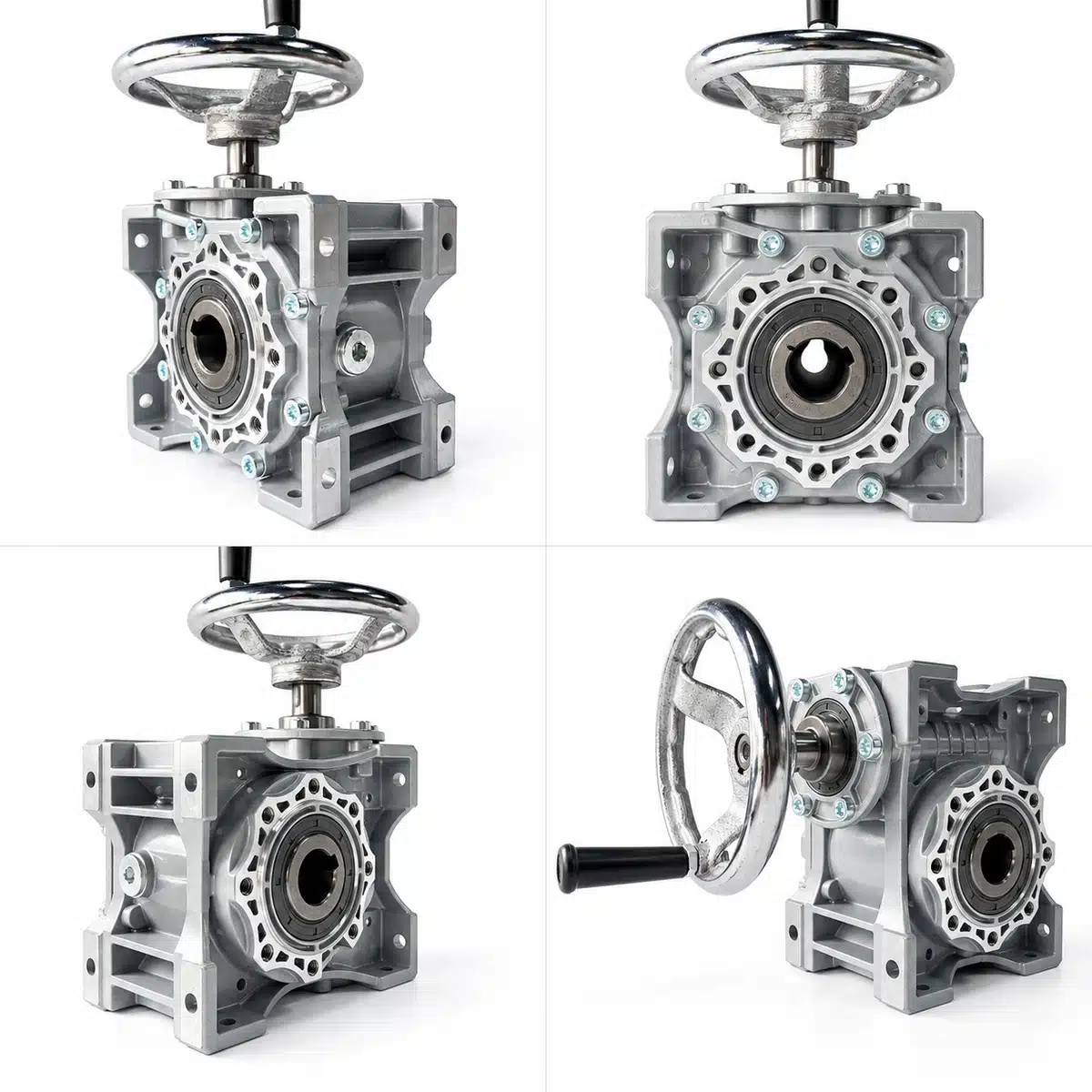
Worm Gearbox Working Principle Explained: A Manufacturer’s Technical Guide
In the sophisticated world of industrial automation and mechanical power transmission, the worm gearbox working principle remains one of the most elegant and widely utilized engineering concepts. For B2B buyers, distributors, and OEM engineers, understanding the mechanics behind this technology is not just an academic exercise—it is a critical requirement for optimizing machine performance, ensuring longevity, and maximizing cost-efficiency.
As a specialized worm gearbox manufacturer, we provide this comprehensive guide to demystify the worm gear mechanism and explain how a worm drive transmission can be the defining component of your next industrial project.
What Is a Worm Gear Mechanism?
At its core, a worm gear mechanism is a non-parallel, right-angle gear arrangement. It consists of two primary elements: the worm (the input screw) and the worm wheel (the output gear).
Unlike a standard spur gear set, where the shafts are parallel, the worm gear set features shafts that cross each other, typically at a 90-degree angle. This configuration allows for an incredibly compact footprint. The “worm” resembles a screw with a continuous helical thread, while the “worm wheel” (also known as the worm gear) looks like a high-precision spur gear with curved teeth designed to envelop the worm’s profile.
In a professional industrial worm gearbox, the worm is almost always the driving element. As the worm rotates, its thread “slides” across the teeth of the wheel, inducing rotation. This fundamental design is what allows for massive speed reduction in a single stage—something impossible for most other gear types.
Worm and Worm Wheel Interaction: The Science of Sliding
To truly understand the worm gearbox working principle, one must look at the interface between the two components. Unlike helical or spur gears, which rely on rolling contact, the worm drive transmission relies heavily on sliding contact.
1. The Helical Movement
As the input motor turns the worm shaft, the helical thread of the worm acts like a moving inclined plane. It pushes against the teeth of the worm wheel. Because the worm is constrained axially, its rotation forces the wheel to turn.
2. Material Selection and Friction
Because of the sliding nature of the interaction, friction is a primary factor. This is why material selection is the “secret sauce” for any high-quality manufacturer:
- The Worm: Usually made of case-hardened alloy steel (like 20CrMnTi) to ensure the threads do not deform under pressure.
- The Worm Wheel: Typically manufactured from specialized bronze alloys (such as Phosphor Bronze QSn12-2). Bronze is a “sacrificial” metal with low friction coefficients against steel, which helps manage the heat generated by the sliding action.
3. The “Self-Locking” Feature
One of the most valuable outcomes of the worm gear mechanism interaction is the potential for self-locking. In high-ratio gearboxes (typically above 40:1 or 50:1), the friction between the worm and the wheel is so high that the wheel cannot rotate the worm. This provides an inherent safety braking mechanism, preventing back-driving in applications like elevators or inclined conveyors.
Transmission Ratio Explained
One of the greatest advantages of the worm gearbox working principle is the ability to achieve high transmission ratios in a single, compact housing.
Calculating the Ratio
The ratio of a worm drive transmission is determined simply by the number of “starts” on the worm and the number of teeth on the worm wheel.
- If a worm has a single thread (one start) and the wheel has 60 teeth, the ratio is 60:1.
- One full 360-degree rotation of the worm will move the wheel by only one tooth.
Single vs. Multi-Start Worms
- Single Start: Offers the highest ratios and the strongest self-locking capability, but with lower mechanical efficiency.
- Double/Four Start: Features multiple threads wrapped around the shaft. This increases the lead angle, which improves efficiency and allows for faster output speeds, though it reduces the “braking” effect of the self-locking feature.
For B2B buyers, selecting the right ratio is a balance between the required output torque and the desired speed reduction.
Efficiency of Worm Gear Drives
Efficiency is often the most discussed topic when analyzing the worm gearbox working principle. Because the transmission is based on sliding friction rather than rolling, some energy is lost as heat.
Factors Affecting Efficiency:
- Lead Angle: Higher lead angles (found in multi-start worms) are generally more efficient.
- Lubrication: High-quality synthetic oils are mandatory for industrial worm gearboxes to reduce friction and dissipate heat.
- Ratio: Generally, the higher the reduction ratio, the lower the efficiency. A 10:1 gear set might have 90% efficiency, while a 100:1 set might operate at 60% efficiency.
Manufacturer’s Tip: To maximize efficiency, we precision-grind our worm threads and use computer-aided design (CAD) to optimize the tooth contact pattern (the “footprint” where the gears touch). This ensures that load is distributed evenly, minimizing localized heating and wear.
Advantages and Limitations
Understanding the worm drive transmission requires an honest look at its strengths and trade-offs.
Advantages:
- Compactness: You can achieve a 100:1 reduction in a box the size of a toaster. To do this with spur gears, you would need a massive, multi-stage system.
- Quiet Operation: The sliding action is inherently quieter than the “clicking” mesh of spur gears. This is vital for hospitals, offices, and theater stages.
- Shock Load Resistance: The bronze wheel can absorb sudden impacts or torque spikes better than hardened steel gears.
- Right-Angle Output: Perfect for space-constrained factory floors.
Limitations:
- Heat Generation: Due to friction, they run hotter than helical gearboxes. Proper ventilation is required.
- Wear: The bronze wheel will eventually wear down (by design) to protect the steel worm. However, with proper lubrication, an NMRV-style gearbox can last tens of thousands of hours.
Conclusion: Choosing a Transmission Partner
The worm gearbox working principle is a masterclass in mechanical leverage. By converting high-speed motor input into high-torque, slow-speed output through a 90-degree worm gear mechanism, industries can power everything from heavy-duty mixers to precision packaging lines.
As a dedicated factory, we don’t just sell hardware; we provide the engineering expertise to ensure your worm drive transmission is perfectly matched to your load requirements. Whether you need a high-efficiency multi-start unit or a self-locking high-ratio reducer, our team is here to guide your selection.
Ready to see the principle in action? Contact us for a technical consultation to find the exact specifications for your next build.