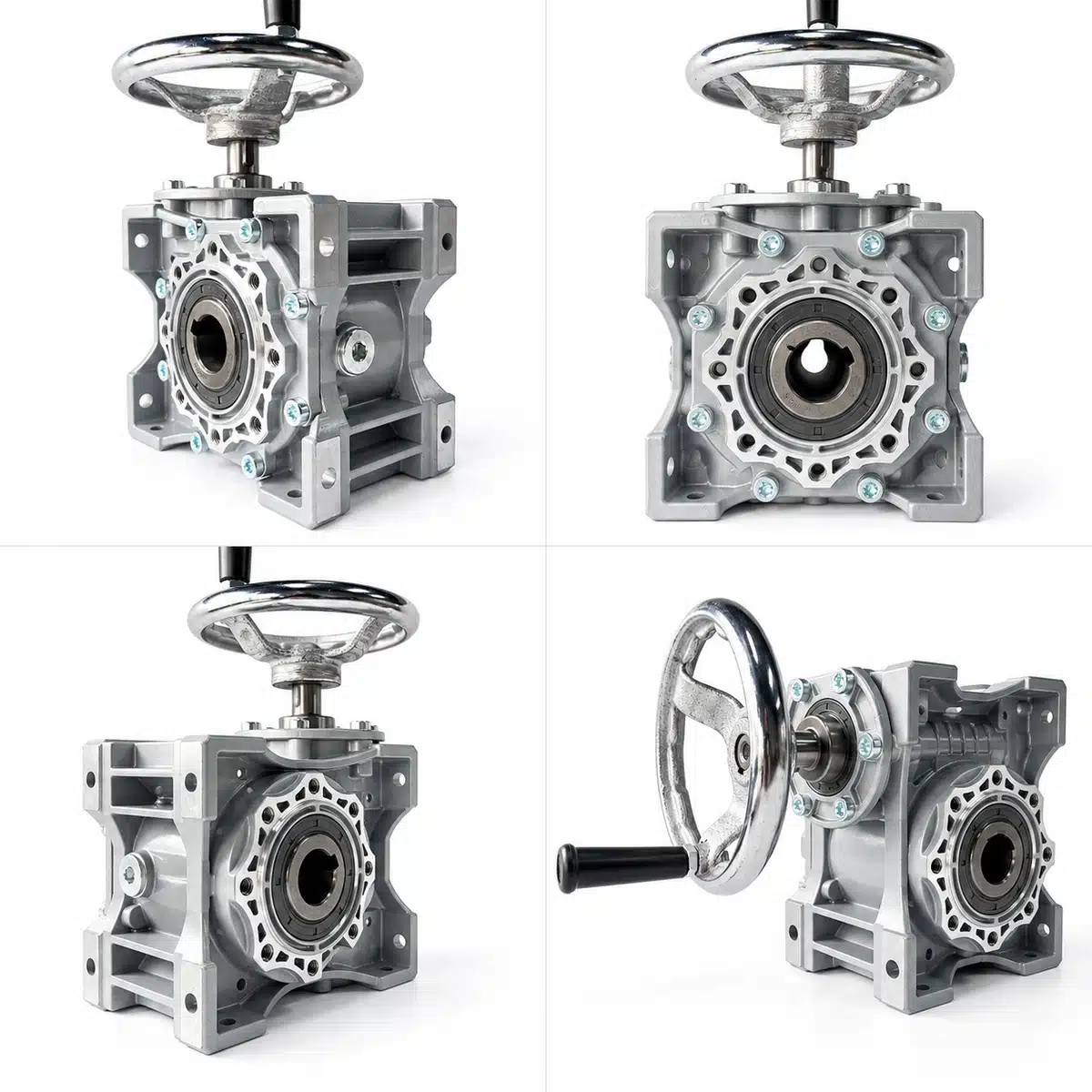
Industrial Gearmotor Guide: Maximizing Efficiency in Power Transmission
Selecting the right driving force for your industrial machinery is a decision that balances engineering precision with long-term operational costs. For B2B procurement managers and engineers, the choice often boils down to a fundamental question: Should you invest in an integrated industrial gearmotor, or opt for a separate motor and gearbox setup?
As a dedicated manufacturer of high-performance transmission solutions, we have seen how the right choice can reduce maintenance by 40% and increase energy efficiency by up to 20%. This guide provides a deep dive into the technical nuances of industrial gearmotors and explores the critical “gear motor vs gearbox” debate to help you make an informed investment.
What is an Industrial Gearmotor?
An industrial gearmotor is a single, integrated unit that combines an electric motor with a gear reducer. Unlike traditional systems where a motor and a gearbox are connected via a coupling or belt, the gearmotor is engineered as a unified component. The motor’s internal shaft is typically integrated directly into the first stage of the gearbox, creating a compact and highly efficient power source.
The Anatomy of an Integrated Unit
In our manufacturing facility, we focus on three core elements that define a premium industrial gearmotor:
- The Prime Mover: High-efficiency AC or DC motors, often IE3 or IE4 rated for energy savings.
- The Gear Head: Precision-cut gears (Helical, Bevel, or Worm) designed for specific torque requirements.
- The Housing: High-strength cast iron or aluminum enclosures that protect internal components from dust, moisture, and vibration.
Gear Motor vs Gearbox: Which is Right for Your Application?
The most common point of confusion in B2B procurement is the distinction between a “gear motor” and a “gearbox” (also known as a standalone gear reducer). While they perform the same basic function—increasing torque and reducing speed—their mechanical execution differs significantly.
1. The Integrated Gear Motor
The gearmotor is designed for simplicity and space-saving.
- Pros: Compact footprint, eliminated alignment issues, lower installation costs, and higher mechanical efficiency due to fewer connecting parts.
- Best For: Conveyor systems, packaging machinery, agitators, and applications where space is at a premium.
2. The Standalone Gearbox
A gearbox requires a separate motor to be mounted via an adapter, coupling, or belt drive.
- Pros: High flexibility. If the motor fails, you can replace it without disturbing the gearbox, and vice-versa. It also allows for the use of specialized motors (e.g., explosion-proof or servo motors) that might not be available in integrated formats.
- Best For: Heavy-duty mining equipment, large-scale industrial crushers, and custom machinery where the motor type may change over time.
Key Comparison Table
| Feature | Industrial Gearmotor (Integrated) | Standalone Gearbox + Motor |
| Installation | Plug-and-play, easy alignment | Requires precision alignment |
| Space Requirement | Minimal / Compact | Large / Extended |
| Maintenance | Unit replacement or major teardown | Independent component replacement |
| Efficiency | Higher (Reduced coupling loss) | Moderate (Coupling/Belt losses) |
| Cost | Generally lower total system cost | Higher due to additional hardware |
Selecting the Right Gear Type for Your Industrial Gearmotor
Not all gearmotors are created equal. The “gear” part of the equation determines the unit’s torque capacity, efficiency, and noise levels.
Helical Gearmotors
Helical gears are the workhorses of the industry. Because the teeth are cut at an angle, they engage gradually, leading to smoother and quieter operation.
- Efficiency: 95% – 98%
- Application: General manufacturing, pumps, and fans.
Bevel Gearmotors (Right-Angle)
When power needs to be transmitted at a 90-degree angle, bevel gearmotors are the gold standard. They offer high torque density and efficiency.
- Efficiency: 90% – 95%
- Application: Material handling and heavy-duty logistics.
Worm Gearmotors
Worm gears are valued for their high reduction ratios and self-locking capabilities. They are the most cost-effective solution but have lower efficiency due to sliding friction.
- Efficiency: 50% – 85%
- Application: Elevators, small conveyors, and simple automation.
Manufacturing Excellence: How Quality is Built
Standing from the perspective of a factory, the difference between a gearmotor that lasts 10 years and one that fails in 6 months lies in the manufacturing capability.
Precision Grinding and Metallurgy
A high-quality industrial gearmotor must utilize gears that have undergone carburizing and quenching. This process creates a hard, wear-resistant outer shell while maintaining a ductile core that can absorb shock loads. Our CNC grinding processes ensure that gear teeth meet DIN Class 5 or 6 precision, which is vital for reducing heat and friction—the two primary killers of gear units.
Sealing and Lubrication
B2B buyers often overlook the importance of seals. We utilize high-temperature Viton seals as standard to prevent oil leakage, which is the leading cause of catastrophic gear failure in the field. Furthermore, the use of synthetic lubricants in integrated units can extend the service life of the gearmotor by up to 30% compared to mineral oils.
Quality Control Standards for B2B Buyers
When auditing a gearmotor supplier, your procurement team should insist on the following quality benchmarks:
- Vibration Analysis: Excessive vibration indicates poor gear alignment or imbalanced motors.
- Noise Testing: Gearmotors should operate within 65-75 dB ranges depending on the power rating.
- Thermal Imaging: Under full load, the temperature rise should not exceed the motor’s insulation class (typically Class F).
- IP Rating: For industrial environments, a minimum of IP55 is required to protect against dust and water splashes.
Conclusion: Investing in Reliability
In the gear motor vs gearbox debate, there is no universal winner—only the right solution for your specific torque, space, and maintenance requirements. However, for most modern B2B applications, the industrial gearmotor offers a superior balance of efficiency, ease of installation, and cost-effectiveness.
As a manufacturer, we recommend starting your selection process by calculating your required Service Factor. A gearmotor that is perfectly sized for your load will not only save energy but will drastically reduce your total cost of ownership (TCO) over the lifetime of the machine.
Need a custom power transmission solution? Contact our engineering department for a technical consultation on your next project.