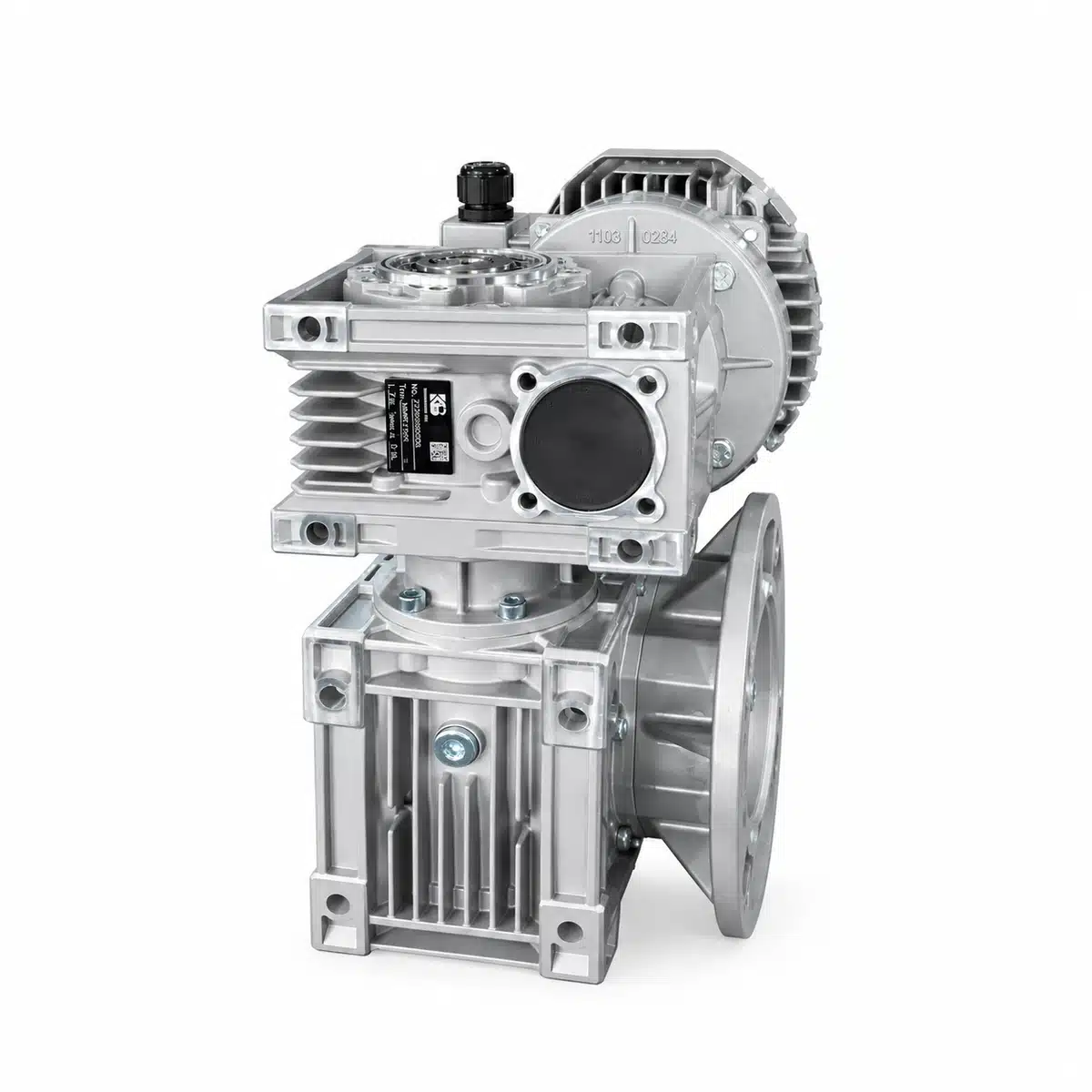
Description
Double Reduction Gearbox Manufacturer | NMRV Double Worm Gearbox
NMRV Double Worm Gearboxes for Extreme Ratios, Low Output Speeds & Industrial Drives
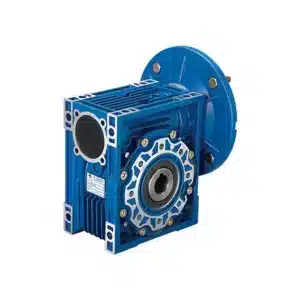
KB Transmission Star is a double reduction gearbox manufacturer supplying NMRV double worm gearboxes for industrial applications that require extremely low output speeds, high total reduction ratios and compact power transmission.
A double reduction worm gearbox connects two worm gear reducers in sequence. The first gearbox reduces the motor speed before transmitting power to the second gearbox, allowing much higher total reduction ratios than a conventional single-stage worm reducer.
Our NMRV double reduction gearbox range is designed for conveyors, mixers, packaging machinery, food processing equipment, rotary tables, material handling systems and other industrial applications requiring reliable low-speed transmission.
Key Advantages
- NMRV + NMRV two-stage worm gearbox construction
- Catalogued total ratios from 100:1 to 5,000:1
- Multiple standard double reduction combinations
- Extremely low output speeds
- High torque multiplication
- Compact modular construction
- IEC motor compatibility
- Multiple mounting positions
- OEM and custom gearbox support
- Engineering selection assistance
Double Reduction Gearbox Factory & OEM Manufacturing
KB Transmission Star supplies double reduction worm gearboxes through Taizhou Ubuty Co., Ltd., an industrial gearbox manufacturer in China.
We support OEM machinery manufacturers, industrial distributors, and equipment builders with double-stage worm gearbox selection, manufacturing, and export supply.
Our double reduction gearboxes combine two worm reduction stages to achieve very low output speeds and high total reduction ratios. Available solutions include motor-connected and shaft-input configurations for industrial machinery and custom equipment projects.
Gearbox Manufacturing
Our manufacturing and quality-control processes cover gearbox housing machining, transmission component inspection, gearbox assembly, lubrication, and operational checks to support consistent product quality.
OEM & Distributor Supply
We support OEM branding, gearbox and motor assemblies, output shaft configurations, mounting requirements, and repeat industrial orders.
Engineering Selection Support
Our team assists customers in selecting gearbox configurations based on motor power, total reduction ratio, required output torque, service factor, operating duty, and installation requirements.
Whether you need a compact double worm gearbox for an OEM machine or a larger configuration for industrial equipment, KB Transmission Star can help identify a suitable gearbox arrangement before quotation.
Double Reduction Worm Gearbox at a Glance
100–5,000:1 Total Reduction Ratios
Standard double-stage combinations provide extremely high total reduction ratios for low-speed industrial drives.
16 Double Reduction Worm Gearbox Combinations
Available combinations range from compact NMRV025/030 units to larger NMRV063/150 configurations.
Two Sequential Worm Reduction Stages
Two worm gearbox stages multiply the available reduction ratio while maintaining a compact modular drive arrangement.
Engineering-Based Selection
The correct gearbox should be selected according to motor power, output speed, output torque, service factor, duty cycle and mounting requirements.
What Is a Double Reduction Gearbox?
A double reduction gearbox uses two sequential gear-reduction stages to achieve a higher overall reduction ratio than a conventional single-stage gearbox.
In an NMRV double worm gearbox, the output of the first worm reducer drives the input of the second worm reducer.
Total Reduction Ratio
iₜ = i₁ × i₂
Where:
- iₜ = total reduction ratio
- i₁ = first-stage reduction ratio
- i₂ = second-stage reduction ratio
For example:
30:1 × 60:1 = 1,800:1
With a nominal 1,400 rpm motor:
1,400 ÷ 1,800 ≈ 0.78 rpm theoretical output speed
This is why double worm gearboxes are especially useful when machinery requires extremely low output speeds without using a large or mechanically complex transmission system.
For a practical 1,800:1 two-stage configuration, see our NMRV50/110 double worm gearbox technical guide.
How an NMRV Double Reduction Gearbox Works
The operating principle is simple:
Electric Motor → First Worm Stage → Second Worm Stage → Low-Speed Output
Electric Motor
The motor provides the input power and rotational speed.
First NMRV Worm Gearbox
The first-stage reducer performs the primary speed reduction.
Second NMRV Worm Gearbox
The second-stage reducer further reduces the output speed and increases the available torque.
Final Output
The second gearbox delivers the final low-speed, high-ratio mechanical output to the driven machine.
Each NMRV double reduction configuration is selected using dedicated performance data for the complete two-stage gearbox arrangement.
NMRV Double Reduction Gearbox Technical Specifications
| Parameter | Specification |
|---|---|
| Gear Type | Two-stage worm gear reduction |
| Product Configuration | NMRV + NMRV |
| Catalogued Total Ratios | 100:1–5,000:1 |
| Output Speed | Very low speed depending on motor speed and total ratio |
| Motor Power | Selected according to gearbox combination, ratio and service factor |
| Motor Connection | IEC motor / motor adapter |
| Output | Hollow shaft or optional solid output shaft |
| Mounting | Multiple installation positions |
| Housing Material | Aluminum alloy for NMRV025–NMRV105; cast iron for NMRV110–NMRV150. NMRV105 and NMRV110 share the same housing dimensions and mounting interfaces, with different housing materials. |
| Selection Parameters | Motor power, ratio, output speed, output torque, radial load and service factor |
NMRV025–105 gearboxes use die-cast aluminum alloy housings, while NMRV110–150 sizes use cast-iron housings. Hardened worm components and wear-resistant bronze worm wheels provide durable power transmission for industrial applications.
Engineering Note: Maximum permissible motor power and output torque cannot be determined by reduction ratio alone. Final selection must be checked against the specific NMRV combination, required torque, service factor and actual operating conditions.
NMRV + NMRV and NRV + NMRV Configurations
KB Transmission Star supplies double reduction worm gearboxes in two input configurations to meet different industrial drive requirements.
NMRV + NMRV — Motor-Adapted Configuration
This configuration combines two worm reduction stages with a motor-adapted input, making it suitable for compact geared motor assemblies requiring high reduction ratios and low output speeds.
NRV + NMRV — Shaft-Input Configuration
This configuration uses a shaft-input arrangement, providing flexibility for machinery driven by an external motor or another power transmission system.
Both configurations are available for OEM machinery, industrial equipment and replacement applications. Final selection depends on the required reduction ratio, input connection, motor specifications, output torque and mounting arrangement.
NMRV105 and NMRV110 Housing Options
NMRV105 features an aluminum alloy housing, while NMRV110 uses a cast-iron housing. Both models share the same dimensions and mounting interfaces, offering different housing materials for the same installation requirements.
Available Double Reduction Worm Gearbox Combinations
The following table presents 16 available NMRV + NMRV double reduction gearbox combinations. Each configuration should be selected according to motor power, total reduction ratio, output torque, service factor and installation requirements.
| NMRV Combination | Typical Application Level |
|---|---|
| NMRV025 + NMRV030 | Ultra-compact drives |
| NMRV025 + NMRV040 | Compact high-ratio drives |
| NMRV030 + NMRV040 | Compact machinery |
| NMRV030 + NMRV050 | Small industrial drives |
| NMRV030 + NMRV063 | Higher output torque |
| NMRV040 + NMRV050 | General machinery |
| NMRV040 + NMRV063 | Conveyor applications |
| NMRV040 + NMRV075 | Medium-duty drives |
| NMRV040 + NMRV090 | High-ratio applications |
| NMRV050 + NMRV090 | Medium/high torque |
| NMRV050 + NMRV105 | Industrial machinery |
| NMRV050 + NMRV110 | Heavy-duty reduction |
| NMRV063 + NMRV105 | High-torque drives |
| NMRV063 + NMRV110 | High-torque drives |
| NMRV063 + NMRV130 | Heavy-duty industrial |
| NMRV063 + NMRV150 | Largest standard combination |
Important: Not every ratio is available at every motor power. Always select the gearbox combination using the relevant performance data instead of multiplying two nominal NMRV ratios and assuming the resulting configuration is mechanically suitable.
NMRV Double Reduction Gearbox Technical Selection Guide
Double reduction gearbox selection should be based on actual operating requirements rather than reduction ratio alone.
Key Selection Parameters
- P1n — rated motor/input power
- n2 — output speed
- M2n — rated output torque
- i — total reduction ratio
- Fr2 — permissible output radial load
- fs — service factor
Representative Selection Data
Engineering Selection Notice
The following tables provide representative performance data for selected KB NMRV + NMRV double reduction gearbox configurations.
A service factor (fs) below 1.0 indicates that the listed operating point requires additional engineering review. Final selection must consider the application load, required service factor, operating hours, starting frequency and thermal conditions.
| NMRV Combination | Motor Power | Total Ratio | Output Speed | Rated Output Torque | Service Factor |
|---|---|---|---|---|---|
| NMRV025/030 | 0.06 kW | 100 | 14.0 rpm | 25 Nm | 1.3 |
| NMRV025/030 | 0.06 kW | 150 | 9.3 rpm | 33 Nm | 0.9 |
| NMRV025/030 | 0.06 kW | 200 | 7.0 rpm | 41 Nm | 0.7 |
| NMRV025/040 | 0.06 kW | 300 | 4.7 rpm | 56 Nm | 1.2 |
| NMRV025/040 | 0.06 kW | 500 | 2.8 rpm | 94 Nm | 0.7 |
| NMRV025/040 | 0.06 kW | 900 | 1.6 rpm | 125 Nm | 0.5 |
| NMRV025/040 | 0.06 kW | 1,500 | 0.9 rpm | 185 Nm | 0.3 |
| NMRV025/040 | 0.06 kW | 3,000 | 0.5 rpm | 280 Nm | 0.2 |
| NMRV025/040 | 0.06 kW | 5,000 | 0.3 rpm | 348 Nm | 0.1 |
| NMRV030/040 | 0.06 kW | 100 | 14.0 rpm | 26 Nm | 2.7 |
| NMRV030/050 | 0.06 kW | 300 | 4.7 rpm | 61 Nm | 2.4 |
| NMRV030/063 | 0.06 kW | 400 | 3.5 rpm | 76 Nm | 3.4 |
| NMRV040/075 | 0.06 kW | 1,500 | 0.9 rpm | 248 Nm | 1.8 |
| NMRV040/075 | 0.06 kW | 3,000 | 0.5 rpm | 305 Nm | 0.8 |
| NMRV040/075 | 0.06 kW | 5,000 | 0.3 rpm | 409 Nm | 0.5 |
Higher-Power Selection Examples
| NMRV Combination | Motor Power | Total Ratio | Output Speed | Rated Output Torque | Service Factor |
|---|---|---|---|---|---|
| NMRV063/110 | 1.1 kW | 100 | 14.0 rpm | 535 Nm | 2.1 |
| NMRV063/110 | 1.1 kW | 150 | 9.3 rpm | 774 Nm | 1.5 |
| NMRV063/110 | 1.1 kW | 200 | 7.0 rpm | 1,005 Nm | 1.1 |
| NMRV063/110 | 1.1 kW | 250 | 5.6 rpm | 1,224 Nm | 1.0 |
| NMRV063/110 | 1.1 kW | 300 | 4.7 rpm | 1,312 Nm | 1.0 |
| NMRV063/130 | 1.1 kW | 300 | 4.7 rpm | 1,274 Nm | 1.3 |
| NMRV063/130 | 1.1 kW | 400 | 3.5 rpm | 1,621 Nm | 1.0 |
| NMRV063/130 | 1.1 kW | 600 | 2.3 rpm | 2,510 Nm | 0.7 |
| NMRV063/150 | 1.1 kW | 150 | 9.3 rpm | 771 Nm | 2.6 |
| NMRV063/150 | 1.1 kW | 300 | 4.7 rpm | 1,456 Nm | 1.6 |
| NMRV063/150 | 1.1 kW | 500 | 2.8 rpm | 2,024 Nm | 1.2 |
| NMRV063/150 | 1.1 kW | 750 | 1.9 rpm | 2,931 Nm | 0.8 |
| NMRV063/105 | 1.5 kW | 100 | 14.0 rpm | 730 Nm | 1.3 |
| NMRV063/105 | 1.5 kW | 300 | 4.7 rpm | 1,789 Nm | 0.6 |
| NMRV063/130 | 1.5 kW | 400 | 3.5 rpm | 2,210 Nm | 0.7 |
| NMRV063/150 | 1.5 kW | 300 | 4.7 rpm | 1,985 Nm | 1.2 |
| NMRV063/150 | 1.5 kW | 400 | 3.5 rpm | 2,350 Nm | 1.1 |
| NMRV063/150 | 1.5 kW | 600 | 2.3 rpm | 3,404 Nm | 0.8 |
These performance examples show how motor power, total ratio, output speed, output torque and service factor are related for specific NMRV double-stage combinations.
For detailed engineering calculations, see our worm gear reducer torque calculation guide.
Important Engineering Note
A very high reduction ratio does not automatically mean that a gearbox is suitable for the application.
As total ratio increases, the available service factor may decrease. Motor power, output torque, duty cycle, starting frequency and thermal conditions must therefore be considered before selecting a double reduction gearbox.
For example, a configuration may technically provide a ratio of 5,000:1 while having a relatively low service factor at that operating point.
For continuous industrial operation, the gearbox should always be selected according to the complete performance data rather than ratio alone.
How to Select the Right Double Reduction Gearbox
1. Determine the Required Output Speed
Calculate the required total reduction ratio:
i = n₁ ÷ n₂
Where:
- n₁ = input motor speed
- n₂ = required output speed
2. Determine the Required Output Torque
Use the actual driven-machine load rather than selecting the gearbox from motor power alone.
The selected gearbox must provide sufficient rated output torque for the application.
3. Identify the Duty Cycle
Consider:
- Operating hours per day
- Number of starts per hour
- Continuous or intermittent operation
- Driven-machine load characteristics
4. Apply the Correct Service Factor
Service factor should be determined according to:
- Load classification
- Daily operating time
- Starting frequency
- Ambient conditions
- Shock loading
The required service factor depends on the actual operating conditions and driven-machine load characteristics.
5. Select the NMRV + NMRV Combination
Choose a combination that provides:
- Required total ratio
- Required output speed
- Sufficient output torque
- Acceptable service factor
- Suitable motor power
6. Verify Installation Dimensions
Before ordering, confirm:
- Output shaft or hollow-shaft diameter
- Output flange
- Motor frame
- Mounting-hole dimensions
- Gearbox orientation
- Available installation space
Why Service Factor Matters
A gearbox may provide the correct reduction ratio but still be unsuitable if the available service factor is too low.
This is particularly important with double worm gearboxes because very high reduction ratios can generate substantial output torque from comparatively small motor powers.
For engineering selection, please provide:
Motor Power · Motor Speed · Required Output Speed · Required Torque · Operating Hours per Day · Starts per Hour · Driven Machine · Mounting Position
Double Worm Gearbox vs. Helical-Worm Gearbox
Not every high-ratio application should use two worm stages.
| Selection Factor | Double Worm Gearbox | Helical-Worm Gearbox |
|---|---|---|
| Reduction Capability | Very high | High |
| Extremely Low Output Speed | Excellent | Good |
| Compact Right-Angle Layout | Excellent | Excellent |
| Transmission Efficiency | Lower | Higher |
| Thermal Performance | More demanding | Generally better |
| Back-Driving Resistance | Potentially higher | Application dependent |
| Continuous-Duty Efficiency | Requires careful selection | Often preferable |
| Typical Application | Extreme ratios / very low speed | Efficiency-sensitive continuous drives |
Which Gearbox Should You Choose?
Choose an NMRV + NMRV double worm gearbox when an extremely high reduction ratio and very low output speed are the primary requirements.
Consider an S Series helical-worm gearbox when transmission efficiency, thermal performance and continuous-duty operation are more important than achieving an extreme total reduction ratio.
Professional Gearbox Manufacturer – Strict Quality Control
KB Transmission Star supplies industrial gearboxes for OEMs, distributors, machinery manufacturers and industrial end users.
Our manufacturing and inspection processes cover gearbox housing machining, transmission component inspection, assembly, lubrication, operational testing and export packaging.

Actual Double Reduction Gearbox Assembly – Factory Supply Example
NMRV063-7.5 + NMRV105-60 + 1.5 kW Motor
KB Transmission Star has supplied this double reduction worm gearbox assembly, combining an NMRV063 first-stage reducer (7.5:1), an NMRV105 second-stage reducer (60:1), and a 1.5 kW electric motor.
This configuration demonstrates our ability to supply assembled double-stage worm gearboxes for OEM machinery manufacturers, industrial equipment builders, and gearbox distributors.
| Parameter | Value |
|---|---|
| First Stage | NMRV063 |
| First-Stage Ratio | 7.5:1 |
| Second Stage | NMRV105 |
| Second-Stage Ratio | 60:1 |
| Motor | 1.5 kW |
| Total Nominal Ratio | 450:1 |
Total Ratio
7.5 × 60 = 450:1
With a nominal 1,400 rpm motor:
1,400 ÷ 450 ≈ 3.1 rpm theoretical output speed
For a typical 60 Hz, four-pole motor operating at approximately 1,750 rpm:
1,750 ÷ 450 ≈ 3.9 rpm theoretical output speed
Engineering Note: Final output speed, permissible torque and service factor must be confirmed using the actual motor and gearbox operating data.
How Much Reduction Can a Double Worm Gearbox Provide?
A double reduction worm gearbox achieves high total reduction ratios by combining two sequential worm reduction stages. The overall reduction ratio is calculated by multiplying the individual ratios of the first and second stages.
KB Transmission Star offers NMRV + NMRV double reduction gearbox configurations with catalogued total ratios ranging from 100:1 to 5,000:1.
The appropriate configuration depends on motor power, required output speed, output torque, service factor and operating conditions. Higher reduction ratios do not automatically mean higher permissible output torque.
Double Reduction Gearbox Applications
Conveyors and Material Handling
Suitable for slow-speed conveyors, transfer equipment and indexing systems requiring controlled movement.
Mixers and Agitators
Double reduction gearboxes provide low rotational speed and substantial torque multiplication for mixing and agitation systems.
Packaging Machinery
Suitable for indexing mechanisms, auxiliary drives and low-speed packaging equipment.
Food Processing Equipment
Used in conveyors, mixers and handling systems requiring compact low-speed transmission.
Rotary Tables
High reduction ratios make double worm gearboxes suitable for very low-speed rotational and positioning applications.
Industrial Automation
Suitable for mechanical auxiliary drives, indexing systems and industrial machinery where compact high-ratio transmission is required.
Are Double Worm Gearboxes Self-Locking?
Some worm gearbox configurations can provide resistance to back-driving, particularly at higher reduction ratios.
However, a double reduction worm gearbox should not automatically be considered self-locking simply because it contains two worm stages.
Self-locking or irreversibility depends on several factors:
- Worm lead angle
- Transmission efficiency
- Friction
- Lubrication
- Operating temperature
- Vibration
- External load
- Operating conditions
Dynamic and static irreversibility are operating characteristics that must be evaluated for the specific gearbox configuration. Vibration and shock can also affect resistance to back-driving.
Safety Notice: For lifting, hoisting, elevator or personnel-safety applications, gearbox self-locking must never be used as a substitute for an independently rated mechanical brake.
NMRV Worm Gearbox Materials and Construction
Housing
Die-cast aluminum alloy for NMRV025–105 sizes and cast iron for larger NMRV110–150 sizes.
Worm
Hardened steel worm components provide wear resistance and durable operation.
Worm Wheel
Wear-resistant bronze alloy is used for the worm wheel.
Modular Housing Design
The compact modular design supports multiple installation positions and double-stage gearbox combinations.
NMRV Double Reduction Gearbox Dimensions
Correct dimensional verification is essential when integrating a new gearbox or replacing an existing double reduction gearbox.
Detailed dimensional drawings are available for each NMRV double reduction gearbox combination. Because overall dimensions, shaft sizes, mounting interfaces and motor connections vary by gearbox combination, dimensional compatibility should be confirmed before ordering or replacing an existing gearbox.
Critical Dimensions to Verify Before Replacement
| Parameter | Why It Matters |
|---|---|
| Overall Length | Available machine clearance |
| Overall Height | Installation envelope |
| Output Center Height | Shaft alignment |
| Hollow Shaft Diameter | Driven shaft compatibility |
| Solid Output Shaft | Coupling compatibility |
| Output Flange Diameter | Flange mounting compatibility |
| Mounting-Hole Pattern | Base/frame replacement |
| Motor Frame | Motor compatibility |
| Output Orientation | Machine layout |
| Mounting Position | Installation and lubrication |
Need a Dimensional Drawing?
Send us your required NMRV combination, motor frame and mounting position. We can provide the relevant dimensional information for engineering verification.
Replacing an Existing Double Worm Gearbox?
Send us:
- Existing gearbox model
- Nameplate photo
- Dimensional drawing
- Motor power
- Reduction ratio
- Required output speed
- Application information
Our engineers can check performance and dimensional compatibility before recommending a replacement.
REQUEST A REPLACEMENT CHECK
Why Choose KB Transmission Star?
25+ Years of Transmission Industry Experience
Our transmission engineering team has more than 25 years of experience in industrial gearbox and geared-motor applications.
Engineering Selection Support
We evaluate:
Ratio → Output Speed → Torque → Service Factor → Motor → Mounting → Dimensions
before recommending a gearbox configuration.
OEM and Custom Gearbox Manufacturing
We support:
- OEM branding
- Gearbox and motor assemblies
- Custom output shafts
- Mounting configurations
- Replacement projects
- Distributor supply
- Batch production
Complete Industrial Gearbox Range
Our product portfolio includes:
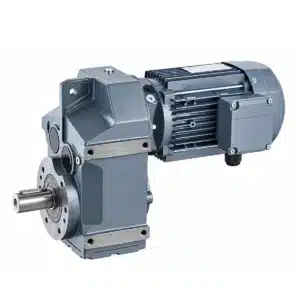
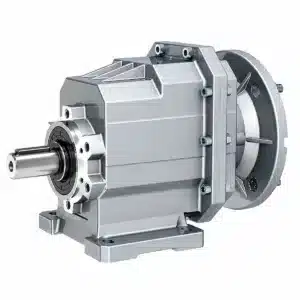
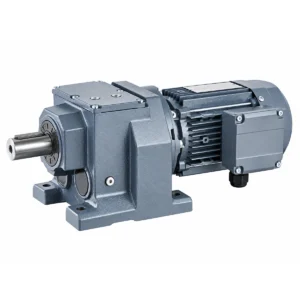
NMRV Worm Gear Reducers · Double Reduction Gearboxes · KKM Helical-Hypoid Gear Units · R Series Helical Gearboxes · K Series Helical-Bevel Gearboxes · S Series Helical-Worm Gearboxes · F Series Parallel-Shaft Helical Gearboxes · TRC Compact Helical Gearboxes
KB Transmission Star gearboxes are manufactured and supplied by Taizhou Ubuty Co., Ltd.
Manufacturing and Quality Control
Our gearbox manufacturing and inspection process includes:
Housing Machining
Precision machining of gearbox housings, bearing seats and mounting interfaces.
Transmission Component Inspection
Gear and worm components are checked before assembly.
Gearbox Assembly
Controlled assembly helps maintain correct bearing, shaft and transmission-component alignment.
Lubrication
Lubricant is selected according to gearbox configuration and operating requirements.
Operational Testing
Gearboxes undergo rotational and operational checks before final inspection.
Export Packaging
Finished gearboxes are packed for industrial export and international transportation.
Frequently Asked Questions
What is a double reduction gearbox?
A double reduction gearbox uses two sequential reduction stages. In an NMRV double worm gearbox, the first worm reducer drives the second worm reducer to produce a much higher total reduction ratio.
How is the total reduction ratio calculated?
The total ratio is calculated by multiplying both gearbox ratios:
iₜ = i₁ × i₂
For example:
30 × 60 = 1,800:1
What reduction ratios are available?
Standard NMRV double reduction gearbox configurations are available with total ratios from approximately 100:1 to 5,000:1, depending on gearbox combination, motor power and operating requirements.
Can I combine any two NMRV gearboxes?
No. The nominal ratio can be calculated mathematically, but motor power, output torque, radial load, service factor and mechanical compatibility must be verified for the selected gearbox combination.
Are double worm gearboxes self-locking?
Some configurations can resist back-driving, but self-locking should never be assumed. Gear geometry, efficiency, lubrication, vibration, temperature and loading conditions all affect irreversibility.
For safety-critical applications, use an independently rated brake.
How do I select a double reduction gearbox?
Provide the following information:
- Motor power
- Motor speed
- Required output speed
- Required total ratio
- Required output torque
- Operating hours per day
- Starts per hour
- Driven machine
- Mounting position
Our engineers can then select a suitable NMRV double-stage configuration.
Can you replace an existing double reduction gearbox?
Yes. Send us the gearbox model, nameplate photo, dimensions, motor power and ratio. We can evaluate performance and installation compatibility.
Is a double worm gearbox suitable for continuous operation?
Yes, when correctly selected. However, service factor and thermal performance must be considered carefully.
For applications where high efficiency and continuous-duty thermal performance are the main priorities, an S Series helical-worm or another higher-efficiency gearbox architecture may be more suitable.
Get the Right Double Reduction Gearbox for Your Application
Tell us your motor power, required reduction ratio, output torque, application and quantity using the inquiry form below. If you are replacing an existing gearbox, you can also provide its model number and dimensional requirements.
Our engineering team will review your specifications and recommend a suitable configuration before quotation.
Request a Double Reduction Gearbox Quote
Tell us your gearbox requirements. Our team will assist with model selection and factory quotation.