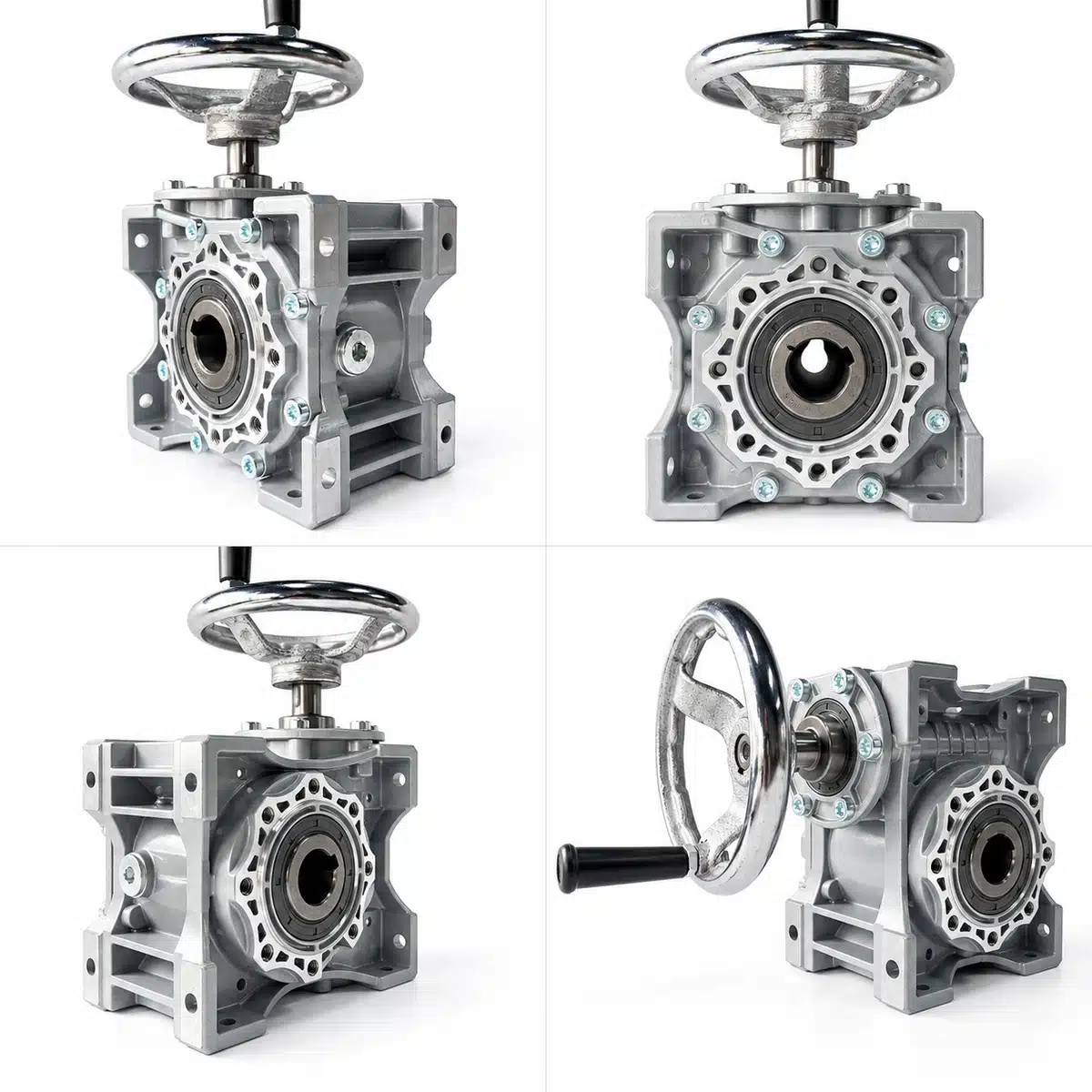
Understanding Worm Gearbox Efficiency: A Comprehensive Industrial Guide
Understanding worm gearbox efficiency is critical for industrial applications where energy consumption and operational costs directly impact the bottom line. While worm gearboxes are renowned for their compact design and self-locking capabilities, their efficiency typically ranges from 50% to 90%.
As a leading manufacturer, we provide this guide to help B2B clients optimize worm gear reducer efficiency through better design selection and maintenance.
Typical Efficiency Ranges and Design Factors
The efficiency of a worm gear reducer refers to the ratio of output power to input power. Unlike helical gears that reach 98%, the sliding contact in worm gearing generates higher friction. However, several factors influence where a unit falls on the performance spectrum.
1. The Impact of Reduction Ratios
The reduction ratio is the primary driver of worm gear reducer efficiency. There is an inverse relationship between the two:
- Low Ratios (5:1 to 15:1): Often utilize multi-start worms, achieving 85-92% efficiency.
- High Ratios (40:1 to 100:1): Typically use single-start worms, resulting in 50-70% efficiency.
2. Manufacturing Precision and Materials
Design quality significantly separates premium units from standard ones.
- Materials: Hardened steel worms paired with bronze worm wheels (specifically aluminum or phosphor bronze) offer the best friction reduction.
- Surface Finish: Precision-ground worms with a surface roughness of Ra 0.2-0.4 microns minimize heat and friction losses.
3. Operating Load Factors
Maximum worm gearbox efficiency is usually achieved when operating at 50-75% of the rated capacity. At light loads (below 25%), “no-load losses” like oil churning and seal friction become disproportionately high, dragging down performance.
Technical Factors Affecting Performance
Lead Angle and Self-Locking
The lead angle is the most significant design parameter. Larger lead angles (found in multi-start worms) reduce sliding friction and improve worm gear reducer efficiency.
Note: Increasing the lead angle reduces the “self-locking” feature. Lead angles below 5° provide reliable braking, while those above 10° generally allow back-driving.
Operating Temperature
Optimal efficiency occurs between 50°C and 70°C. Cold starts increase lubricant viscosity, leading to a 10-20% efficiency drop until the unit warms up. Conversely, temperatures exceeding 90°C thin the oil too much, causing metal-to-metal contact.
The Role of Lubrication in Maximizing Efficiency
Proper lubrication is the “lifeblood” of worm gearbox efficiency. Because these gears slide rather than roll, they are highly sensitive to oil quality.
- Synthetic vs. Mineral Oil: Synthetic lubricants (especially PAG – Polyalkylene Glycol) can improve worm gear reducer efficiency by 3-8% compared to mineral oils due to lower friction coefficients.
- Oil Levels: Overfilling causes “churning losses,” while underfilling leads to starvation and wear.
- Contamination: Abrasive particles act as sandpaper on the bronze wheel. We recommend using breather filters and performing oil changes after the initial 500-hour break-in period.
How to Improve Worm Gearbox Efficiency
To maximize your ROI, follow these systematic optimization strategies:
1. Optimal Sizing and Selection
Avoid “oversizing.” A gearbox running at 30% load is far less efficient than a smaller unit running at 70%. If high efficiency is the only priority and you don’t need self-locking, consider a helical-worm combination.
2. Precision Installation
- Alignment: Misaligned shafts increase bearing loads and friction. Use precision alignment tools during setup.
- Rigidity: Ensure mounting bases are rigid to prevent vibration-induced losses.
3. Operational Best Practices
- VFD Integration: Using Variable Frequency Drives allows for soft starts, reducing mechanical stress and initial friction spikes.
- Thermal Management: In extreme environments, use external cooling or insulation to keep the lubricant within its “sweet spot” (50-70°C).
Conclusion
While worm gearbox efficiency is inherently lower than some other gear types, its unique benefits—compactness, high single-stage reduction, and quiet operation—remain unmatched for conveyors, elevators, and packaging equipment.
By selecting the right worm gear reducer efficiency parameters and maintaining strict lubrication protocols, industrial users can significantly reduce energy waste and extend equipment life. Contact our technical team for a detailed efficiency analysis tailored to your specific application.