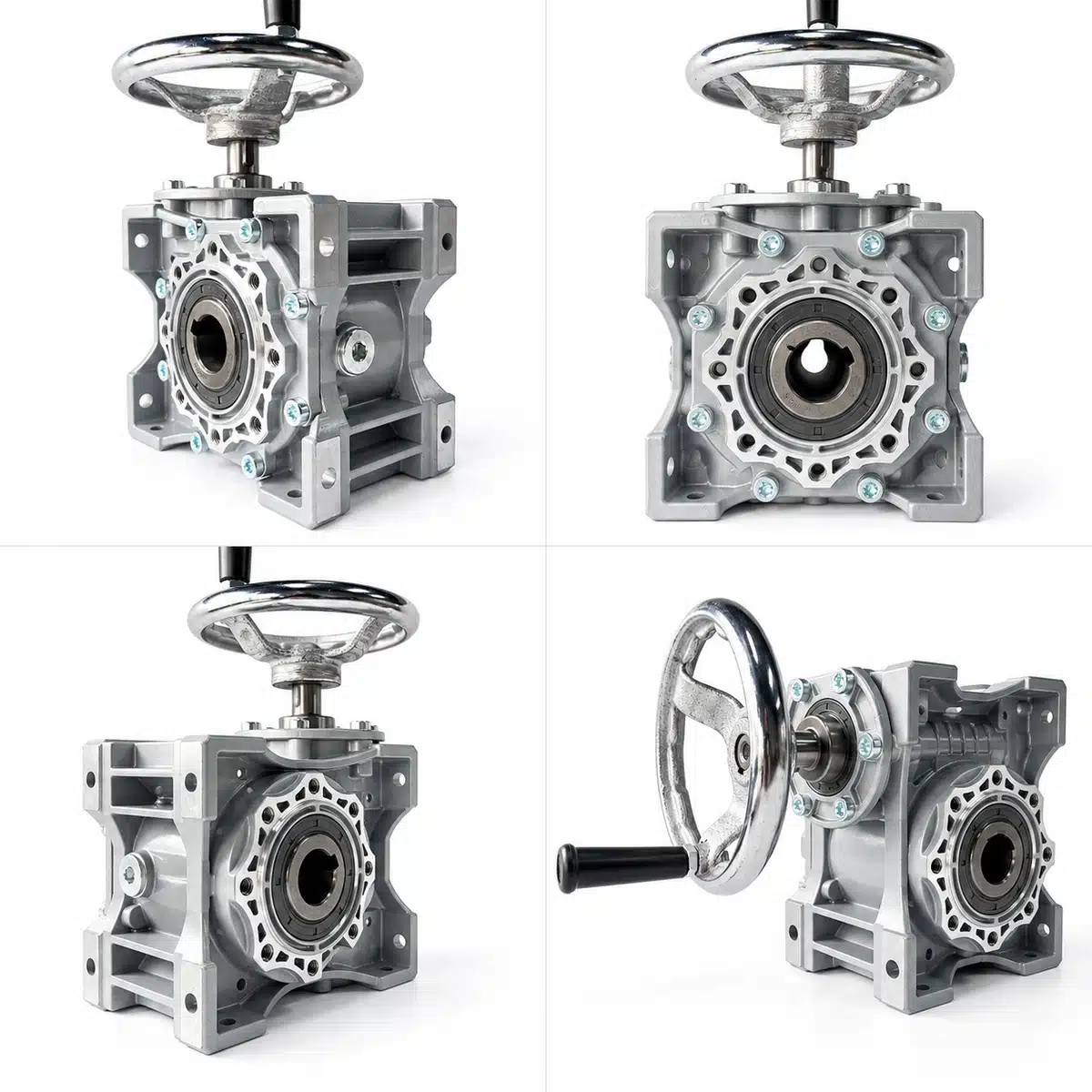
Helical Gearbox for Conveyor Systems: Selection and Sizing Guide
Key Takeaways
| Selection Factor | R Series (Inline) | K Series (Right-Angle) |
|---|---|---|
| Best conveyor type | Horizontal belt, roller | Inclined, chain, screw |
| Efficiency | 94-96% | 93-95% |
| Max single-stage ratio | 74.84:1 | 197.37:1 |
| Self-locking | No | No |
| Typical service factor | 1.5-2.0× | 1.5-2.0× |
| Cost vs. worm gear | +20-35% upfront | +30-45% upfront |
| Energy vs. worm gear | 15-25% savings/year | 14-23% savings/year |
| Choose when | Inline motor acceptable | Right-angle motor needed |
Bottom line: Helical gearboxes cost more upfront than worm gear reducers but typically recover the premium in energy savings within 18-36 months on conveyors running more than 12 hours per day.
Table of Contents
- Why Conveyor Engineers Specify Helical Gearboxes
- Quick Selection Guide by Conveyor Type
- R Series vs. K Series: Which for Your Conveyor?
- Step-by-Step Sizing Procedure
- Service Factor Table for Conveyor Applications
- Helical vs. Worm Gear for Conveyors: Cost Analysis
- Mounting Configuration Guide
- Installation and Commissioning
- Maintenance for Conveyor Helical Gearboxes
- FAQ: Helical Gearbox for Conveyor
1. Why Conveyor Engineers Specify Helical Gearboxes
A distribution center in the Netherlands ran 48 worm gear reducers on their sortation conveyor system. Annual electricity bill for those drives: €38,400. After replacing with helical gearboxes — same torque output, same conveyor speeds — their annual drive energy cost dropped to €29,100. Saving: €9,300 per year. Total replacement investment including installation: €22,800. Full payback in 29 months.
The physics is straightforward. Worm gears convert 20-40% of motor input power directly to heat through sliding friction. Helical gears lose 4-6% through rolling contact. On a conveyor running 18 hours per day, that efficiency gap compounds into significant operating cost over equipment lifecycle.
But energy savings are not the only reason to specify helical gearboxes for conveyors. Three additional factors drive specification decisions:
Load capacity per frame size: Helical gearboxes deliver 30-50% higher torque in the same housing footprint compared to equivalent worm gear units. For conveyors being upgraded to carry heavier loads, helical often eliminates the need for larger frame size — saving space and installation cost.
Service life: Helical gears run steel-on-steel (hardened gear teeth mesh with hardened pinion). Worm gears run steel-on-bronze (hardened worm meshes with softer bronze wheel). Bronze wheels wear progressively. Well-maintained helical gearboxes routinely achieve 80,000-100,000 hours. Worm gears typically require worm wheel replacement at 30,000-50,000 hours.
Thermal performance: On continuous conveyor duty, worm gearboxes often require cooling fans to manage heat. Helical gearboxes running at 94-96% efficiency generate substantially less heat — most operate within thermal limits without auxiliary cooling, simplifying installation and reducing energy overhead.
2. Quick Selection Guide by Conveyor Type
| Conveyor Type | Recommended | Ratio Range Needed | Key Consideration |
|---|---|---|---|
| Horizontal belt, inline motor | R Series | 15:1-50:1 | Space for inline motor |
| Horizontal belt, perpendicular motor | K Series | 15:1-50:1 | Space constraint |
| Inclined belt (>15°) | K Series | 20:1-80:1 | Brake required — no self-lock |
| Chain conveyor | K Series | 40:1-100:1 | High shock loads |
| Roller conveyor, light | R Series | 10:1-40:1 | Hollow shaft option |
| Roller conveyor, heavy | K Series | 20:1-60:1 | Higher torque density |
| Screw/auger conveyor | K Series | 30:1-100:1 | Axial thrust loads |
| Bucket elevator | K Series | 50:1-150:1 | Brake required |
| Reversing conveyor | Either | Application specific | Service factor 2.0× min |
3. R Series vs. K Series: Which for Your Conveyor?
Both R Series (inline helical) and K Series (helical-bevel right-angle) deliver helical gear efficiency on conveyor drives. The selection between them follows directly from installation geometry.
R Series: When Inline Motor Mounting Works
The R Series positions motor and output shaft on the same axis. Motor extends behind the gearbox along the conveyor direction.
Works well for:
- Horizontal belt conveyors with space behind the drive pulley
- Roller conveyors where motor-inline geometry is acceptable
- Applications where lower unit cost matters (R Series costs 28-31% less than K Series same frame)
Typical R Series conveyor specifications:
- Frame sizes R37 through R107
- Ratios 10:1 to 74:1
- Torque 400 Nm to 14,000 Nm
- Efficiency 94-96%
K Series: When Right-Angle Motor Mounting Is Required
The K Series positions motor perpendicular to the output shaft. Motor mounts beside or above the conveyor, not behind it.
Required for:
- Space-constrained installations (motor cannot extend behind drive)
- Inclined conveyors above 15° (better geometry, higher torque density)
- Chain conveyors requiring ratios above 74:1 (K Series achieves 197:1 single unit)
- Screw conveyors with axial thrust loads
K Series advantages over R Series:
- Higher torque density: 20-35% more torque in same frame size
- Wider ratio range: up to 197:1 vs. 74:1 for R Series
- Better combined load handling (radial + axial)
Critical Safety Note for Both Types
Neither R Series nor K Series helical gearboxes self-lock. Both can back-drive when power is cut. This is fundamental to helical gear geometry — not a design deficiency.
For inclined conveyors, bucket elevators, and any application where back-driving creates safety risk or product damage: install a dedicated mechanical backstop or spring-set brake regardless of gearbox type. This is a safety requirement, not optional.
4. Step-by-Step Sizing Procedure
Step 1: Define Conveyor Operating Parameters
Collect these values before opening a catalog:
| Parameter | Where to Find It |
|---|---|
| Belt speed (m/s) | Process requirement |
| Drive pulley diameter (mm) | Machine drawing |
| Total conveyor load — belt + material (kg) | Process calculation |
| Conveyor length (m) | Machine drawing |
| Inclination angle (degrees) | Machine drawing |
| Friction coefficient (μ) | Conveyor type (see table) |
| Motor speed (RPM) | Motor nameplate |
| Operating hours per day | Production schedule |
Friction coefficients by conveyor type:
| Conveyor Type | μ |
|---|---|
| Roller conveyor, light load | 0.02-0.03 |
| Roller conveyor, heavy load | 0.03-0.05 |
| Belt on slider bed | 0.05-0.08 |
| Chain conveyor | 0.05-0.07 |
| Screw conveyor | 0.20-0.40 |
Step 2: Calculate Required Output Speed
n₂ = (v × 60) / (π × D)Where:
- v = Belt speed (m/s)
- D = Drive pulley diameter (m)
Example:
- Belt speed: 1.2 m/s
- Pulley diameter: 400mm = 0.4m
n₂ = (1.2 × 60) / (π × 0.4) = 72 / 1.257 = 57.3 RPMStep 3: Calculate Reduction Ratio
i = n₁ / n₂Example:
- Motor speed: 1,450 RPM
- Required output: 57.3 RPM
i = 1,450 / 57.3 = 25.3Nearest standard ratio: 28.37:1
Actual output speed with 28.37:1:
n₂_actual = 1,450 / 28.37 = 51.1 RPMActual belt speed: (51.1 × π × 0.4) / 60 = 1.07 m/s — check if acceptable for process. If not, adjust pulley diameter or use VFD.
Step 4: Calculate Load Torque
For belt and roller conveyors:
F_total = (m_belt + m_material) × g × (μ × cosθ + sinθ)
T₂ = F_total × r_pulley
Example — horizontal conveyor:
- Belt mass: 600 kg (total both sides)
- Maximum material: 900 kg on belt at one time
- Friction: μ = 0.03
- Inclination: θ = 0°
- Pulley radius: 0.20m
F_total = (600 + 900) × 9.81 × (0.03 × 1.0 + 0)
F_total = 14,715 × 0.03 = 441 N

T₂ = 441 × 0.20 = 88 Nm
Example — inclined conveyor (12°):
F_total = 1,500 × 9.81 × (0.03 × cos12° + sin12°)
F_total = 14,715 × (0.029 + 0.208)
F_total = 14,715 × 0.237 = 3,488 N

T₂ = 3,488 × 0.20 = 698 Nm
Note: The 12° incline raises torque requirement from 88 Nm to 698 Nm — 7.9× higher. Inclination angle is the dominant variable in conveyor torque calculation.
Step 5: Apply Service Factor
See full service factor table in Section 5. Design torque = running torque × service factor.
Step 6: Select Frame Size
From catalog: select smallest frame where rated torque ≥ design torque.
Target utilization: 70-85% of rated torque. Above 85% leaves insufficient margin for load variations. Below 50% is over-specified unless harsh environment justifies it.
Step 7: Verify Thermal Rating
For conveyors running more than 12 hours per day, verify thermal power rating:
P_thermal_catalog ≥ P_motor_inputIf thermal rating is insufficient, upsize one frame or specify synthetic lubricant (PAO/PAG oil improves thermal capacity 8-15%).
Step 8: Calculate and Verify Overhung Load
This step is skipped most often and causes the most bearing failures.
F_radial = 2.0 to 2.5 × (T_design / r_pulley)Use 2.5× for V-belt drives, 2.0× for flat belt, 3.0× for chain.
Verify F_radial against catalog overhung load rating at actual shaft mounting distance. If exceeded, options include larger pulley diameter, next frame size, or external bearing support.
Step 9: Specify Motor Power
P_motor = (T₂ × n₂) / (9,550 × η)Select next standard motor size above calculated value with minimum 20% margin.
R Series efficiency for motor sizing:
- 2-stage (ratio <20:1): use η = 0.95
- 3-stage (ratio 20-74:1): use η = 0.93
5. Service Factor Table for Conveyor Applications
Service factor is the multiplier applied to running torque to determine design torque for gearbox frame size selection. It accounts for starting loads, shock, duty cycle, and operating conditions that exceed steady-state analysis.
Base Service Factor by Application
| Conveyor Application | Hours/Day | Load Type | Service Factor |
|---|---|---|---|
| Light belt conveyor | <8 | Uniform | 1.25-1.50 |
| Standard belt conveyor | 8-16 | Mixed | 1.50-1.75 |
| Heavy belt conveyor | >16 | Mixed | 1.75-2.00 |
| Chain conveyor, standard | 8-16 | Moderate shock | 1.75-2.00 |
| Chain conveyor, heavy | >16 | Heavy shock | 2.00-2.25 |
| Reversing conveyor | Any | Any | 2.00-2.25 |
| Inclined belt, >15° | 8-16 | Mixed | 1.75-2.25 |
| Screw conveyor, light | 8-16 | Uniform | 1.75-2.00 |
| Screw conveyor, heavy | >16 | Heavy | 2.25-2.50 |
| Bucket elevator | Any | Shock | 2.00-2.50 |
| Roller conveyor, light | <16 | Uniform | 1.25-1.50 |
| Sortation conveyor | >16 | Cyclic + reversing | 2.25-2.50 |
Incremental Service Factor Additions
| Condition | Add |
|---|---|
| Frequent starts (>30/hour) | +0.25 |
| Reversing operation | +0.25 |
| Ambient temperature >40°C | +0.25 |
| VFD, full torque below 20% rated speed | +0.25 |
| Shock loads or impact events | +0.25 to +0.50 |
| Critical application (no backup conveyor) | +0.25 |
Service Factor Calculation Example
Chain conveyor, food processing, 20 hrs/day, reversing, 45 starts/hour:
| Factor | Value |
|---|---|
| Base (heavy shock, >16 hrs) | 2.00 |
| Reversing | +0.25 |
| Frequent starts | +0.25 |
| Total service factor | 2.50 |
Running torque 380 Nm × 2.50 = 950 Nm design torque
Frame size selected for 950 Nm — not 380 Nm.
6. Helical vs. Worm Gear for Conveyors: Cost Analysis
Initial Cost Comparison
| Frame Size | Worm Gear (NMRV equiv.) | Helical Gearbox | Helical Premium |
|---|---|---|---|
| Small (~100 Nm) | $280-340 | $380-460 | +35-38% |
| Medium (~400 Nm) | $520-620 | $720-870 | +38-40% |
| Large (~1,000 Nm) | $920-1,100 | $1,280-1,540 | +39-41% |
Helical gearboxes cost 35-41% more upfront. On a single unit, this premium is $140-$440 depending on size.
Energy Cost Comparison (Annual)
Application: 5.5 kW motor, conveyor running 18 hrs/day, 300 days/year (5,400 hrs/year), electricity at $0.12/kWh
| Gearbox Type | Efficiency | Power Loss | Annual Energy Waste | Annual Cost |
|---|---|---|---|---|
| Worm gear (30:1) | 72% | 1.54 kW | 8,316 kWh | $998 |
| Helical R Series (30:1) | 95% | 0.29 kW | 1,566 kWh | $188 |
| Annual savings | — | — | 6,750 kWh | $810 |
Payback Analysis
| Premium paid | Annual saving | Payback |
|---|---|---|
| $380 (medium unit) | $810/year | 5.6 months |
| $440 (large unit) | $810/year | 6.5 months |
At 18 hours/day continuous operation, helical gearbox payback is typically under 12 months on energy savings alone.
10-Year Total Cost of Ownership
Scenario: 10 conveyor drives, 5.5 kW each, 5,400 hrs/year
| Cost Element | Worm Gear (10 units) | Helical (10 units) |
|---|---|---|
| Initial purchase | $9,200 | $12,800 |
| Energy (10 years) | $99,800 | $18,800 |
| Maintenance | $8,400 | $5,600 |
| Replacements | $4,600 | $2,560 |
| 10-year total | $122,000 | $39,760 |
| Savings | — | $82,240 |
10-year TCO savings: $82,240 on 10 units — $8,224 per gearbox.
When Worm Gear Remains the Right Choice
Helical is not always the better answer:
- Conveyors running <8 hours/day: Payback exceeds 3 years, worm may be preferred
- Applications requiring self-locking: Worm gear provides backdrive resistance (verify with manufacturer — not guaranteed)
- Very tight budget constraints: Worm gear lower initial outlay
- Low-power drives (<1.5 kW): Energy savings minimal in absolute terms
For any conveyor running continuously 12+ hours per day, helical gearbox economics are almost always superior over equipment lifecycle.
7. Mounting Configuration Guide
R Series Conveyor Mounting Options
B3 Foot mount (most common for conveyors):
- Gearbox feet bolt to fixed base or conveyor frame
- Motor extends inline behind gearbox
- Requires axial space behind drive pulley
- Standard oil level, full torque rating
B5 Flange mount:
- Gearbox mounts to vertical end plate
- Eliminates separate gearbox base
- Common for conveyor end frames
- Verify face perpendicularity <0.02mm/100mm
Hollow shaft with torque arm:
- Output bore mounts directly on conveyor shaft
- Torque arm reacts housing rotation to fixed structure
- Eliminates shaft coupling and alignment
- Best for roller conveyors and space-constrained installations
- Shaft surface finish required: Ra 1.6 µm minimum
K Series Conveyor Mounting Options
Same standard options as R Series plus:
Torque arm mount (K Series advantage):
- Gearbox floats on conveyor shaft
- Motor perpendicular — above or beside conveyor
- Particularly compact along conveyor axis
- No separate gearbox base required
Oil Level by Mounting Position
Critical and frequently overlooked. Each mounting position requires different oil fill quantity.
Always specify mounting orientation when ordering. Manufacturer sets oil level for specified orientation before shipment. Changing orientation in the field without adjusting oil level causes bearing starvation in upper positions.
Horizontal (B3 standard): Fill to center of sight glass or level plug. Vertical output down (V5): Reduced fill — consult catalog. Vertical output up (V6): Increased fill — consult catalog.
Clearance Requirements
Minimum clearances for adequate thermal performance:
- All sides: 100mm minimum
- Top: 150mm (for heat rise convection)
- Input end: Adequate for motor removal
Enclosed gearboxes without airflow run significantly hotter. On continuous conveyor duty, inadequate ventilation can push a thermally adequate unit into thermal overload.
8. Installation and Commissioning
Installation Checklist
Pre-installation: ☐ Verify mounting surface flatness ±0.05mm ☐ Check mounting hole pattern against gearbox dimensions ☐ Confirm motor adapter flange matches motor frame ☐ Verify oil type and quantity for specified mounting position ☐ Check conveyor shaft dimensions (for hollow shaft mount)
Mechanical installation: ☐ Position gearbox on mounting surface ☐ Insert mounting bolts finger-tight ☐ Check soft foot — all four feet within 0.02mm ☐ Shim as required to eliminate soft foot ☐ Torque bolts in star pattern: 30% → 60% → 100% of specification ☐ Install motor — verify pilot fit ☐ Align motor and gearbox: parallel ±0.05mm, angular ±0.08° ☐ Install coupling and drive components
Commissioning: ☐ Fill oil to correct level for mounting position ☐ Verify breather is installed and free ☐ Run no-load 15 minutes — check for noise and vibration ☐ Run 50% load 1 hour — monitor temperature ☐ Run 75-100% load 2 hours — temperature should stabilize ☐ Target stabilized temperature: 55-75°C housing surface ☐ Check for oil leaks after first 4 hours ☐ Record baseline temperature and noise level
Break-in period:
- First 200 hours: Monitor closely
- First oil change at 200 hours — removes break-in wear particles
- This first oil change is critical for long-term reliability
Alignment Requirements
Misalignment is the leading cause of premature bearing failure in conveyor gearbox applications.
Target alignment values:
- Parallel offset: <0.05mm
- Angular misalignment: <0.08°
Use laser alignment tools for continuous-duty conveyor drives. Dial indicator methods are adequate for lower-duty applications. “Close enough by eye” is not a specification.
Overhung Load Verification
Before commissioning, confirm the calculated overhung load is within the catalog rating for the actual mounting distance. Check by:
- Measuring actual shaft extension from housing face to belt/sprocket centerline
- Recalculating allowable load at this distance: F_allowed = F_catalog × (d_ref / d_actual)
- Verifying F_calculated ≤ F_allowed
If marginal, add a pillow block bearing beyond the drive element to transfer radial load away from gearbox output bearing.
9. Maintenance for Conveyor Helical Gearboxes
Maintenance Schedule
| Task | Interval | Purpose |
|---|---|---|
| Visual inspection | Daily | Leak detection, unusual noise |
| Oil level check | Weekly | Prevent low oil starvation |
| Temperature monitoring | Weekly | Trend analysis, detect problems early |
| Mounting bolt torque check | Monthly | Prevent loosening from vibration |
| Breather cleaning | Monthly | Prevent pressure buildup |
| Coupling inspection | Quarterly | Detect wear, misalignment |
| Vibration measurement | Quarterly | Bearing condition trending |
| Alignment verification | Annually | Confirm no settling or movement |
| Oil change — mineral | 4,000-6,000 hrs | Remove degraded oil and wear particles |
| Oil change — synthetic | 10,000-15,000 hrs | Extended interval with quality oil |
| Bearing assessment | 20,000 hrs | Proactive replacement evaluation |
Oil Selection
| Application | Oil Grade | Notes |
|---|---|---|
| Standard conveyor, ambient 15-40°C | ISO VG 220 | Most common |
| Heavy load, high ambient >40°C | ISO VG 320 | Higher viscosity |
| Food processing | ISO VG 220, NSF H1 | Food-grade synthetic required |
| Low temperature <0°C | ISO VG 150 or synthetic | Maintains viscosity |
Synthetic oil recommendation: For conveyors running >16 hours/day continuously, PAO or PAG synthetic oil provides better thermal stability, longer change intervals (10,000-15,000 hours vs. 4,000-6,000 for mineral), and 8-15°C lower operating temperature. The higher oil cost pays back in extended maintenance intervals and cooler operation.
Temperature Monitoring Protocol
Establish operating temperature baseline at commissioning. Measure at the same location on the housing (mark the spot) after 4 hours of operation.
Action thresholds:
| Reading | Action |
|---|---|
| Baseline ±5°C | Normal |
| Baseline +10°C | Investigate — check oil level, ventilation, load |
| Baseline +15°C | Stop and inspect — potential overload or lubrication failure |
| Above 85°C absolute | Stop immediately — oil and seal damage threshold |
Temperature trending over time is more useful than single measurements. A gradual 15°C rise over six months indicates developing bearing wear or oil degradation before catastrophic failure.
10. FAQ: Helical Gearbox for Conveyor
Q: What is the best helical gearbox for a belt conveyor?
For horizontal belt conveyors with adequate installation space, R Series inline helical gearboxes deliver the best combination of efficiency (94-96%), cost, and simplicity. Select frame size based on design torque (running torque × service factor), verify thermal rating for duty cycle, and confirm overhung load within catalog limits. For inclined belt conveyors above 15° or space-constrained installations where the motor must mount perpendicular, K Series helical-bevel is the correct specification. Both types require a mechanical backstop or brake on inclined applications — neither self-locks.
Q: How do I calculate the torque required for a conveyor gearbox?
Calculate resistance force first: F = (m_belt + m_material) × g × (μ × cosθ + sinθ). Then output torque: T₂ = F × r (where r is drive pulley radius in meters). This gives running torque. Multiply by service factor (1.5-2.5 depending on application) to get design torque for frame size selection. For a horizontal belt conveyor with 1,500 kg total load, μ = 0.03, and 200mm pulley radius: F = 441 N, T₂ = 88 Nm. Apply service factor 1.5 for standard duty: design torque = 132 Nm. Select gearbox rated at 132 Nm minimum.
Q: Do helical gearboxes self-lock on inclined conveyors?
No. Neither R Series inline helical nor K Series helical-bevel gearboxes self-lock at any ratio. Both can back-drive under load when power is disconnected. This is a fundamental characteristic of helical gear geometry. Always install a dedicated mechanical backstop (for one-direction conveyors) or spring-set brake (for applications requiring holding in either direction) on inclined conveyors. Do not rely on gearbox internal friction to hold inclined loads under any circumstances — this is a safety requirement, not a design preference.
Q: Is a helical gearbox better than a worm gearbox for conveyors?
For continuous duty conveyors running 12+ hours per day, helical gearboxes are almost always the better long-term choice. The 20-25% higher efficiency reduces energy costs by $600-$1,000 per drive per year (5.5 kW motor, 18 hrs/day). The initial cost premium (35-41% higher) typically pays back in 6-18 months through energy savings. Helical gearboxes also last significantly longer — 80,000-100,000 hours vs. 30,000-50,000 hours for worm — because steel-on-steel gear contact wears less than steel-on-bronze. For conveyors running less than 8 hours per day or requiring self-locking capability, worm gearboxes may be more appropriate.
Q: What service factor should I use for a conveyor helical gearbox?
Service factor depends on conveyor type, daily operating hours, and load characteristics. Standard belt conveyor, 8-16 hrs/day: 1.50-1.75. Heavy belt or chain conveyor, >16 hrs/day: 1.75-2.00. Reversing conveyor: 2.00-2.25. Add 0.25 for frequent starts above 30/hour, add 0.25 for reversing operation, add 0.25 for ambient temperature above 40°C. Always apply service factor to running torque before selecting frame size. The most common cause of premature conveyor gearbox failure is selecting on running torque without service factor.
Q: What is the typical efficiency of a helical gearbox on a conveyor?
R Series inline helical gearboxes achieve 94-96% overall efficiency for most conveyor ratios (3-stage configurations at high ratios approach 93%). K Series helical-bevel achieves 93-95%. Both compare favorably to worm gearboxes at equivalent conveyor ratios: worm at 30:1 typically achieves 70-78%, worm at 50:1 achieves 62-70%. The efficiency advantage of helical translates directly to lower motor power draw, lower operating temperature, and reduced heat generation — all of which extend gearbox service life and reduce facility energy costs.
Q: How do I select between R Series and K Series for my conveyor?
Start with shaft orientation. If the motor can mount inline behind the drive pulley along the conveyor direction, R Series is typically the better choice — lower cost (28-31% less than K Series), slightly higher efficiency, simpler installation. If the motor must mount perpendicular to the conveyor axis due to space constraints, K Series is required. For inclined conveyors above 15°, K Series is preferred for geometric and torque density reasons. For chain conveyors requiring ratios above 74:1, K Series is necessary — R Series maximum single-unit ratio is 74.84:1.
Q: What causes helical gearbox failures on conveyors?
Four causes account for the majority of premature failures. First, undersized selection — using running torque without service factor, resulting in a gearbox operating at 120-150% of rated torque under normal start-stop and shock conditions. Second, overhung load exceeded — calculating with simplified F = T/r instead of F = 2.5 × (T/r), underestimating actual bearing radial load by 2-3×. Third, thermal overload on continuous duty — verifying mechanical torque rating but not thermal power rating, running the gearbox above its continuous heat dissipation capacity. Fourth, misalignment — not using laser alignment tools, allowing residual misalignment that creates cyclic bearing loading. Correct specification and proper installation eliminate these failure modes.
Published by KB Transmission Star— KKM Helical Hypoid Gearbox Manufacturer Taiwan Design. China Manufacturing. Global Delivery.
— Helical Gearbox Manufacturer