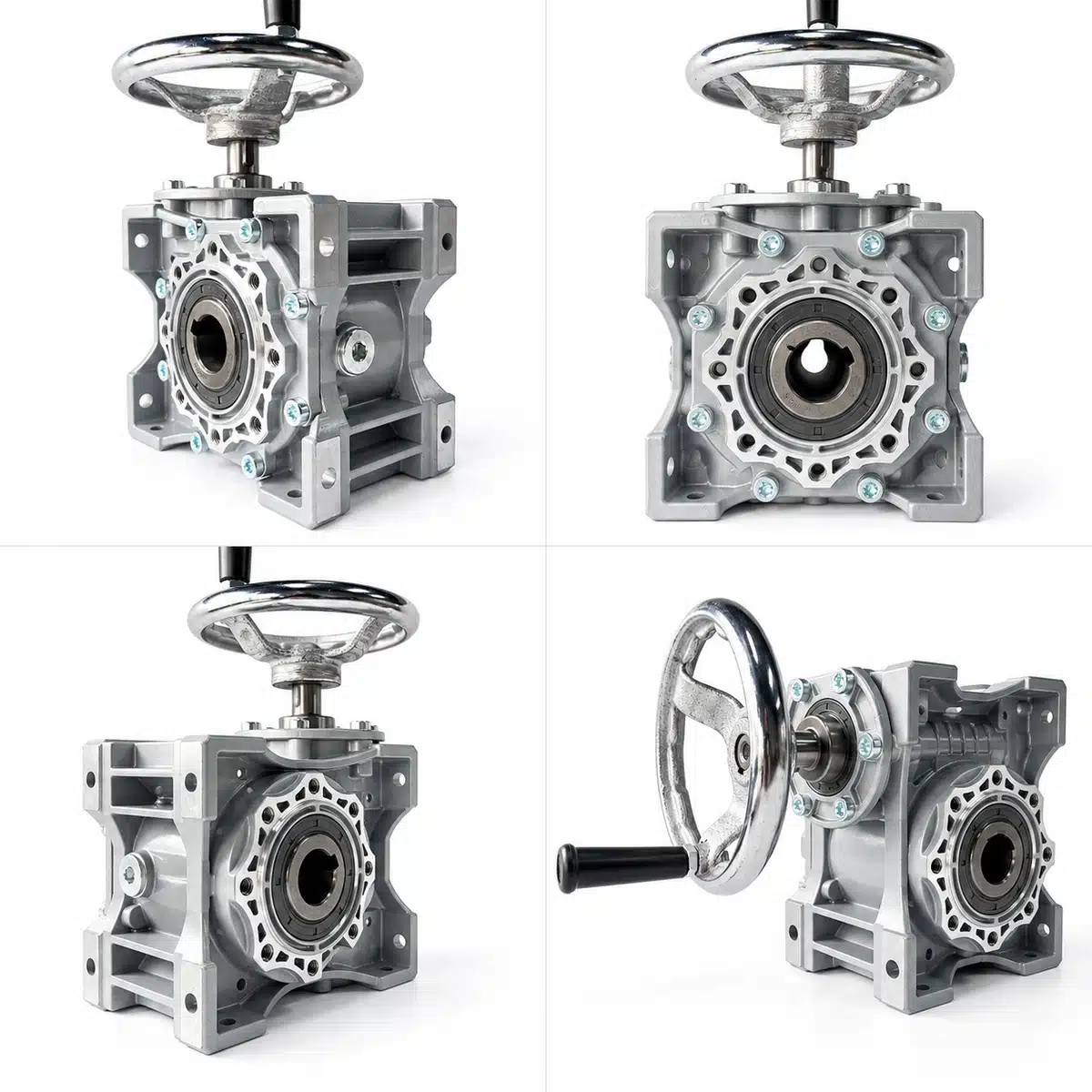
Helical Gearbox Efficiency: Why 94-97% Matters for Industrial Operations
Key Takeaways
| Gearbox Type | Typical Efficiency | Power Loss (7.5 kW input) | Annual Energy Waste (6,000 hrs) |
|---|---|---|---|
| Helical (R/K Series) | 94-97% | 0.23-0.45 kW | 1,380-2,700 kWh |
| Worm gear (30:1) | 70-78% | 1.65-2.25 kW | 9,900-13,500 kWh |
| Worm gear (60:1) | 55-65% | 2.63-3.38 kW | 15,780-20,280 kWh |
Bottom line: On a single 7.5 kW drive running 6,000 hours per year, switching from worm gear to helical saves $1,000-$2,100 annually in electricity alone. Across a facility with 20 drives, that’s $20,000-$42,000 per year — every year, for the life of the equipment.
Table of Contents
- The Real Cost of Gearbox Inefficiency
- Why Helical Gears Are More Efficient Than Worm Gears
- R Series Efficiency by Ratio and Load
- Energy Cost Calculator: Your Facility Savings
- The Hidden Benefits of High Efficiency
- When Efficiency Justifies the Higher Price
- Maintaining Peak Efficiency Over Time
- FAQ: Helical Gearbox Efficiency
1. The Real Cost of Gearbox Inefficiency
A corrugated packaging plant in Ohio audited their drive systems in 2022 as part of an energy reduction initiative. They ran 32 worm gear reducers on conveyor and processing lines — average 5.5 kW motors, average 18 hours per day, 300 days per year.
The audit result was straightforward:
- Total annual drive energy consumption: $127,000
- Estimated consumption with helical gearboxes: $89,000
- Potential annual savings: $38,000
They replaced 12 of the highest-running units first. Actual measured savings after 12 months: $14,200 on those 12 drives alone — tracking within 3% of the engineering estimate. Payback period on the $16,800 investment: 14 months.
The remaining 20 worm units continue wasting approximately $23,800 per year in recoverable energy. The physics does not change. Every month of delayed replacement costs $1,983 in electricity that delivers zero productive work — it simply heats the gearbox housing and the surrounding air.
Gearbox efficiency is not a technical abstraction. It is a direct, measurable, ongoing operating cost.
2. Why Helical Gears Are More Efficient Than Worm Gears
The efficiency difference between helical and worm gears is fundamental to their geometry — not a manufacturing quality issue.
Helical Gears: Rolling Contact
Helical gear teeth engage progressively along a helix angle. The dominant contact mode is rolling — similar to two cylinders rolling against each other. Friction in rolling contact is inherently low.
R Series helical characteristics:
- Rolling contact: 85-95% of mesh engagement
- Sliding contact: 5-15% (at tooth tips and roots only)
- Friction coefficient: 0.02-0.04
- Heat generation: Low
- Efficiency: 96-98% per gear stage
Multi-stage overall efficiency:
- 2-stage R Series: 96% × 98% = 94-96% overall
- 3-stage R Series: 96% × 97% × 98% = 93-95% overall
Worm Gears: Sliding Contact
Worm gear teeth engage through a screw-thread sliding against wheel teeth. The dominant contact mode is sliding — similar to a screw turning against a nut. Friction in sliding contact is inherently high.
Worm gear characteristics:
- Sliding contact: >90% of mesh engagement
- Rolling contact: <10%
- Friction coefficient: 0.03-0.08 (lubricated)
- Heat generation: High
- Efficiency: Highly ratio-dependent
Worm gear efficiency by ratio:
| Ratio | Lead Angle | Typical Efficiency |
|---|---|---|
| 10:1 | Large | 80-90% |
| 20:1 | Moderate | 75-85% |
| 30:1 | Moderate | 70-78% |
| 50:1 | Small | 60-70% |
| 60:1 | Small | 55-65% |
| 100:1 | Very small | 45-55% |
Key physics: As worm gear ratio increases, lead angle decreases, sliding velocity increases, and efficiency drops. Helical gear efficiency remains nearly constant regardless of ratio because the contact mode doesn’t change.
Visual Comparison
Where does the lost power go?
On a 7.5 kW motor at 30:1 ratio:
Worm gear (72% efficient):
- Useful output: 5.4 kW
- Heat generated: 2.1 kW — equivalent to a portable space heater running continuously
- Housing temperature: 80-95°C
R Series helical (95% efficient):
- Useful output: 7.1 kW
- Heat generated: 0.4 kW — barely warm to touch
- Housing temperature: 55-68°C
The worm gear converts 28% of motor input directly to heat. The R Series converts 5%. This is not a defect — it is physics. Sliding friction generates more heat than rolling friction, regardless of manufacturing quality.
3. R Series Efficiency by Ratio and Load
Helical gearbox efficiency is not perfectly constant — it varies with ratio, load, speed, and lubrication. Understanding these variations helps predict actual operating cost.
Efficiency vs. Ratio
| Ratio Range | Stages | Typical Efficiency |
|---|---|---|
| 3.66-7.30:1 | 2 | 96-97% |
| 7.30-20:1 | 2 | 95-96% |
| 20-40:1 | 3 | 94-95% |
| 40-74:1 | 3 | 93-94% |
Observation: R Series efficiency remains within a 3-4% band across the entire ratio range. Compare this to worm gears where efficiency swings 35-45% between low and high ratios. This consistency makes helical gearbox energy consumption predictable and budgetable.
Efficiency vs. Load
| Load (% of rated) | Typical Efficiency | Notes |
|---|---|---|
| 10-25% | 89-92% | No-load losses dominate |
| 25-50% | 92-95% | Improving |
| 50-75% | 94-96% | Optimal operating range |
| 75-100% | 94-96% | Peak efficiency sustained |
| >100% | 93-95% | Slight decrease, heat increases |
Practical implication: Lightly loaded gearboxes run at lower efficiency. An R Series unit operating at 20% load runs at approximately 90% efficiency rather than 95%. This is still dramatically better than a worm gear at any load — but it means oversized gearboxes waste more energy than correctly sized ones.
Design recommendation: Target 65-85% torque utilization for the best balance of efficiency, thermal performance, and reliability margin.
Efficiency vs. Lubrication
| Lubricant Type | Efficiency Impact | Operating Temperature Effect |
|---|---|---|
| Mineral oil (standard) | Baseline | Baseline |
| PAO synthetic | +0.5-1.0% | -8 to -12°C |
| PAG synthetic | +1.0-2.0% | -10 to -15°C |
| Degraded oil (old, contaminated) | -2 to -5% | +15 to +25°C |
Fresh synthetic oil delivers measurable efficiency improvement. Degraded oil measurably reduces efficiency. On continuous duty drives, oil condition directly affects operating cost.
4. Energy Cost Calculator: Your Facility Savings
Per-Drive Annual Savings Formula
Annual savings = P × H × C × (1/η_worm - 1/η_helical)Where:
- P = Motor output power (kW)
- H = Annual operating hours
- C = Electricity cost ($/kWh)
- η_worm = Worm gear efficiency (decimal)
- η_helical = Helical gear efficiency (decimal)
Quick Reference Savings Table
Assumptions: $0.12/kWh electricity, 30:1 ratio
| Motor Power | 4,000 hrs/yr | 6,000 hrs/yr | 8,000 hrs/yr |
|---|---|---|---|
| 2.2 kW | $283 | $424 | $565 |
| 4.0 kW | $514 | $770 | $1,027 |
| 5.5 kW | $707 | $1,060 | $1,413 |
| 7.5 kW | $963 | $1,445 | $1,927 |
| 11 kW | $1,413 | $2,119 | $2,826 |
| 15 kW | $1,927 | $2,890 | $3,853 |
| 22 kW | $2,826 | $4,239 | $5,652 |
Facility-Wide Calculation Example
Scenario: Food processing plant with 25 drives
| Drive Group | Qty | Motor (kW) | Hours/yr | Annual Savings |
|---|---|---|---|---|
| Conveyor lines | 12 | 5.5 | 6,500 | $12,720 |
| Mixer drives | 4 | 11 | 7,000 | $8,476 |
| Packaging lines | 6 | 4.0 | 5,500 | $4,620 |
| Material handling | 3 | 7.5 | 4,000 | $2,889 |
| Total | 25 | — | — | $28,705/year |
Investment for helical upgrade: $38,000 (including installation) Payback period: 16 months 10-year net savings: $249,050
Electricity Price Sensitivity
Savings scale linearly with electricity cost:
| Electricity Rate | Savings Factor |
|---|---|
| $0.08/kWh | 0.67× table values |
| $0.10/kWh | 0.83× table values |
| $0.12/kWh | 1.00× (table baseline) |
| $0.15/kWh | 1.25× table values |
| $0.20/kWh | 1.67× table values |
| $0.25/kWh | 2.08× table values |
In regions with electricity above $0.15/kWh (much of Europe, Japan, parts of US), helical gearbox payback periods shorten to 8-12 months.
5. The Hidden Benefits of High Efficiency
Energy savings dominate the business case, but three additional benefits compound the economic advantage of helical gearbox efficiency.
Lower Operating Temperature
Every watt of power loss becomes heat. Less loss means a cooler gearbox.
Thermal cascade effects:
| Consequence of Lower Temperature | Quantified Benefit |
|---|---|
| Oil life extended | 2-3× longer change intervals |
| Seal life extended | 2× longer before replacement |
| Bearing life extended | L10 life increases 15-25% |
| No cooling fan required | Save $180-420 installation + $30-60/yr power |
Estimated annual maintenance savings from cooler operation: $120-$280 per drive.
This is separate from and additional to the energy savings calculated above.
Smaller Motor Sizing
Higher gearbox efficiency means less input power is needed to deliver the same output.
Example — 5.5 kW output required:
| Gearbox | Efficiency | Input Required | Motor Selected |
|---|---|---|---|
| Worm (30:1) | 72% | 7.64 kW | 7.5 kW (tight) or 11 kW |
| R Series (30:1) | 95% | 5.79 kW | 7.5 kW (comfortable) |
With worm gear, the motor runs near capacity. With helical, the motor runs at 77% — cooler, longer-lived, with starting torque margin. In some cases, helical efficiency allows one frame size smaller motor — saving $200-$600 per drive on motor cost alone.
Sustainability and Carbon Reporting
For companies reporting Scope 2 emissions (purchased electricity), drive system efficiency directly impacts carbon intensity.
Per drive, per year (5.5 kW, 6,000 hrs):
| Gearbox | Energy Waste | CO₂ (at 0.4 kg/kWh) |
|---|---|---|
| Worm | 8,580 kWh | 3,432 kg CO₂ |
| Helical | 1,740 kWh | 696 kg CO₂ |
| Reduction | 6,840 kWh | 2,736 kg CO₂ |
Per 25-drive facility: 68 tonnes CO₂ reduction per year.
For companies with net-zero commitments or carbon pricing exposure ($50-$100/tonne CO₂), this represents an additional $3,400-$6,800 per year in avoided carbon cost — on top of electricity savings.
6. When Efficiency Justifies the Higher Price
Helical gearboxes cost 30-45% more than worm gear equivalents. The efficiency advantage justifies this premium in specific operating conditions.
Payback Period by Operating Hours
5.5 kW drive, 30:1 ratio, $0.12/kWh, helical premium $420:
| Daily Hours | Annual Savings | Payback | Recommendation |
|---|---|---|---|
| 4 hours | $236 | 21 months | Consider — borderline |
| 8 hours | $471 | 11 months | Yes — clear payback |
| 12 hours | $707 | 7 months | Definitely |
| 16 hours | $942 | 5 months | Strongly recommended |
| 24 hours | $1,413 | 4 months | No question |
Decision Framework
Specify helical gearbox when:
- Operating >8 hours/day (payback <12 months)
- Motor power >3 kW (absolute savings justify premium)
- Continuous duty application (thermal advantages compound)
- Electricity cost >$0.10/kWh
- Multiple drives in facility (aggregate savings justify qualification effort)
- Sustainability reporting or carbon targets exist
Worm gear may still be appropriate when:
- Operating <4 hours/day (payback >24 months)
- Motor power <1.5 kW (absolute savings small)
- Self-locking required (helical does not self-lock — verify worm self-locking with manufacturer)
- Budget strictly limits initial purchase
- Single unit, non-critical application
Priority Replacement Strategy
For facilities with mixed worm and helical installations, prioritize helical upgrade on:
- Highest running hours first — 24/7 drives deliver fastest payback
- Highest power motors second — larger motors waste more absolute energy
- Hottest-running worm gearboxes third — high temperature indicates high losses and pending failure
- Newest worm gearboxes last — extract remaining mechanical life before replacing
7. Maintaining Peak Efficiency Over Time
Helical gearbox efficiency degrades gradually if maintenance is neglected. Three factors preserve the 94-97% efficiency rating over equipment lifecycle.
Lubrication Condition
Fresh oil at correct viscosity: Peak efficiency. Degraded oil (oxidized, contaminated): 2-5% efficiency loss. Low oil level (bearing starvation): Catastrophic efficiency loss plus mechanical damage.
Maintain efficiency:
- Oil changes at manufacturer-specified intervals
- Use synthetic PAO or PAG for continuous duty (maintains viscosity longer)
- Monitor oil color weekly — dark or milky oil indicates degradation
Alignment
Properly aligned gearbox to motor and driven equipment: Peak efficiency. Misaligned by 0.10mm: +1-2% power loss from bearing side-loading. Severely misaligned (>0.25mm): +3-5% loss, accelerated bearing wear.
Maintain efficiency:
- Laser alignment at installation
- Re-verify annually
- Check after any maintenance involving motor removal
Operating Temperature
Within normal range (55-75°C housing): Peak efficiency. Elevated temperature (>85°C): Oil viscosity drops, friction increases, efficiency decreases.
Maintain efficiency:
- Ensure adequate ventilation (100mm clearance minimum)
- Keep cooling fins clean (dust insulates)
- Monitor and trend temperature (catch problems early)
- Investigate any temperature increase >10°C above baseline
Efficiency Degradation Timeline
| Condition | Efficiency Impact | When It Happens |
|---|---|---|
| Fresh installation, correct oil | Rated efficiency (94-97%) | Day 1 |
| Normal wear, proper maintenance | -0.5% from rated | After 20,000 hours |
| Neglected oil change | -2 to -3% from rated | After 8,000 hours overdue |
| Contaminated oil | -3 to -5% from rated | Variable |
| Bearing wear (end of life) | -2 to -4% from rated | After 50,000-80,000 hours |
| Misalignment developing | -1 to -3% from rated | Progressive |
Well-maintained R Series gearboxes operate within 1% of rated efficiency for 40,000+ hours. Efficiency degradation is almost entirely a maintenance issue, not an aging issue, until bearing end-of-life.
8. FAQ: Helical Gearbox Efficiency
Q: What is the typical efficiency of an R Series helical gearbox?
R Series inline helical gearboxes achieve 94-97% overall efficiency depending on the number of stages and reduction ratio. Two-stage configurations (ratios 3.66:1 to 20:1) achieve 95-97%. Three-stage configurations (ratios 20:1 to 74:1) achieve 93-95%. These values assume operation at 50-100% of rated load with proper lubrication. At light loads below 25%, efficiency drops to 89-92% because fixed losses (bearing friction, oil churning, seal drag) represent a larger proportion of total power. Peak efficiency occurs between 50-80% of rated torque.
Q: How much energy can I save by switching from worm gear to helical?
Savings depend on motor power, operating hours, and electricity cost. For a typical 5.5 kW drive running 6,000 hours per year at $0.12/kWh: switching from a 72% efficient worm gear (30:1) to a 95% efficient R Series helical saves approximately $1,060 per year in electricity. For a facility running 20 similar drives, annual savings reach $21,200. The helical gearbox costs approximately $400 more per unit than the worm equivalent — payback period is typically 5-14 months depending on operating hours. Savings continue for the full 50,000-80,000 hour service life of the helical unit.
Q: Does helical gearbox efficiency change with ratio?
Yes, but the variation is small compared to worm gears. R Series efficiency decreases approximately 1-3% across its full ratio range: from 96-97% at low ratios (5:1) to 93-94% at high ratios (74:1). This is because higher ratios require three gear stages instead of two, and each stage adds a small friction loss. Compare this to worm gears where efficiency drops 30-40% between low ratios (85-90% at 10:1) and high ratios (45-55% at 100:1). The near-constant efficiency of helical gears is one of their primary advantages in high-ratio applications.
Q: Why are worm gears less efficient than helical gears?
The fundamental difference is contact mechanics. Helical gears engage through rolling contact — gear teeth roll against each other with minimal sliding. Rolling friction is inherently low. Worm gears engage through sliding contact — the worm thread slides across the wheel teeth like a screw in a nut. Sliding friction is inherently high, typically 3-10× greater than rolling friction under similar conditions. This is physics, not manufacturing quality. The highest-quality worm gear from the best manufacturer still relies on sliding contact and will always be less efficient than a helical gear of comparable quality.
Q: Does lubricant type affect helical gearbox efficiency?
Yes, measurably. Synthetic PAO oil improves efficiency 0.5-1.0% over mineral oil. Synthetic PAG oil improves 1.0-2.0%. Degraded or contaminated oil reduces efficiency 2-5%. On a 7.5 kW continuous drive, switching from mineral to PAG synthetic saves approximately $50-$120 per year in energy — modest, but the synthetic oil also lasts 2-3× longer between changes, runs 10-15°C cooler, and extends bearing life. The combined economic benefit of synthetic lubricant in continuous duty applications typically justifies the 2-3× higher oil cost.
Q: How does operating temperature affect gearbox efficiency?
Higher temperature reduces oil viscosity, which decreases hydrodynamic film thickness between gear teeth and in bearings. This increases metal-to-metal contact and friction — reducing efficiency. A gearbox running at 90°C is typically 1-3% less efficient than the same unit at 65°C. More importantly, high temperature accelerates oil degradation, which further reduces efficiency over time. Maintaining low operating temperature through correct sizing, adequate ventilation, and quality lubrication preserves rated efficiency throughout service life. Temperature trending is the most effective single monitoring tool for efficiency maintenance.
Q: At what operating hours does helical gearbox efficiency advantage pay for itself?
For a typical 5.5 kW application at $0.12/kWh electricity, the helical gearbox premium of $350-$500 over worm gear equivalent pays back at approximately 2,000-4,000 operating hours — equivalent to 4-8 months at 16 hours per day. Below 2,000 hours per year (<6 hours per day average), payback extends beyond 24 months and the efficiency premium becomes harder to justify on economics alone. Above 4,000 hours per year, helical payback is under 12 months and the specification decision is straightforward on cost grounds alone — before considering the additional benefits of lower temperature, longer life, and reduced maintenance.
Q: Can I improve the efficiency of my existing worm gearbox without replacing it?
Marginally. Switching from mineral oil to PAG synthetic lubricant improves worm gear efficiency 2-5% by reducing sliding friction coefficient. Ensuring correct oil level and maintaining clean, fresh lubricant prevents the additional 5-10% degradation from neglected maintenance. However, these measures cannot overcome the fundamental sliding-contact limitation. A well-maintained worm gear with premium synthetic oil at 30:1 ratio achieves approximately 78-82% efficiency — still 13-17% below a standard helical unit. The only way to achieve 94-97% efficiency is to change from sliding contact (worm) to rolling contact (helical) gear geometry.
Published by KB Transmission Star— KKM Helical Hypoid Gearbox Manufacturer Taiwan Design. China Manufacturing. Global Delivery.
— Helical Gearbox Manufacturer