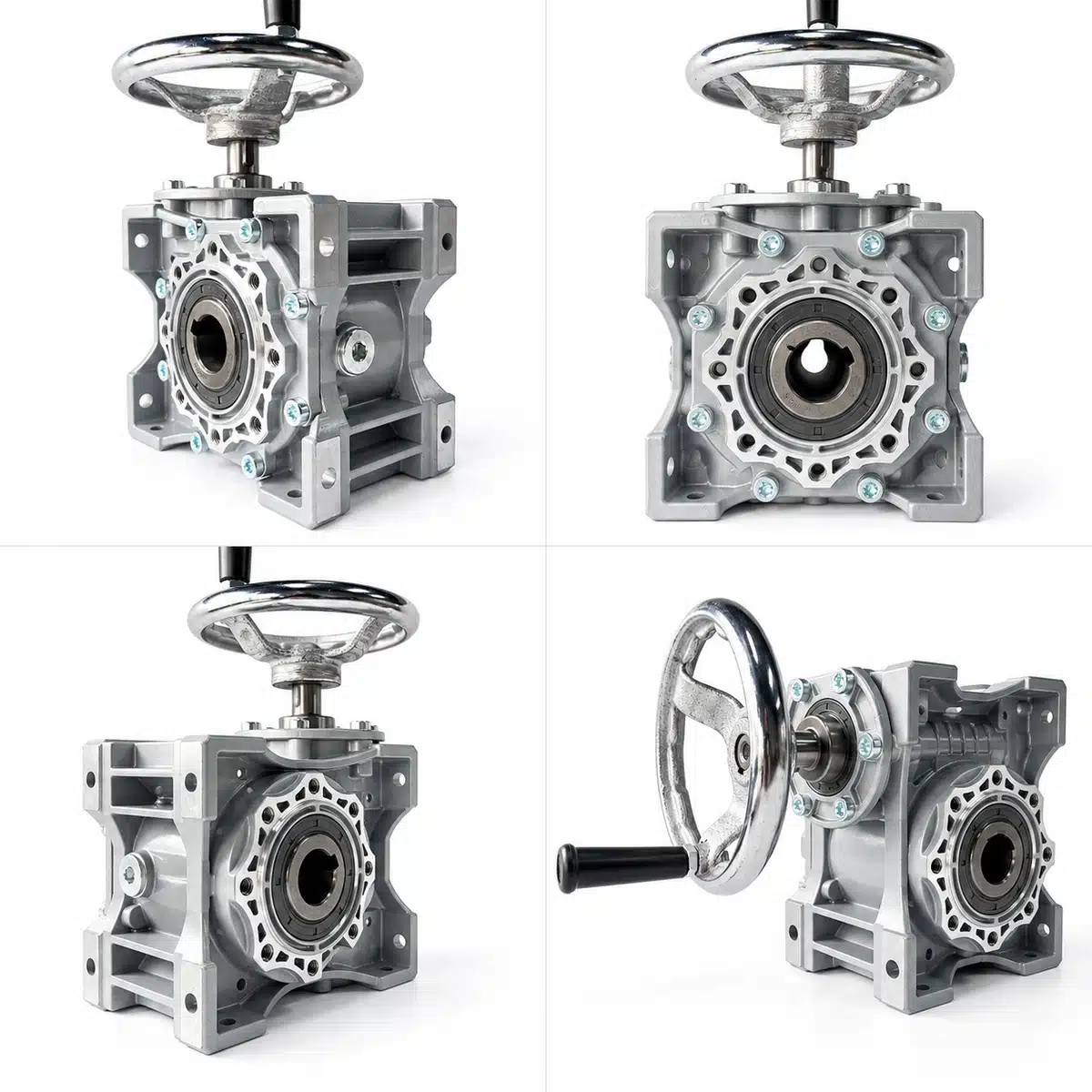
Right Angle Gearbox Guide: Worm vs. Bevel Selection for Industrial Applications
Space constraints cost money. A 200mm longer motor shaft requires wider conveyor frames, larger machine footprints, and higher shipping costs. For a 50-meter production line, this adds 10 cubic meters of floor space—at $200/sq-m annual facility cost, that’s $40,000 over a 10-year equipment lifecycle.
Right angle gearboxes solve this problem by redirecting power 90 degrees, allowing motors to mount parallel to driven equipment instead of inline. In 20 years manufacturing right angle gear reducers, we’ve supplied 28,000+ units across packaging, material handling, and automation sectors.
This guide provides the technical comparison, selection criteria, and application guidelines industrial engineers need to specify right angle gearboxes that optimize space utilization while meeting performance requirements.
Why Right-Angle Configuration Matters
Primary advantage: Space efficiency
Inline gearbox configuration:
- Motor and gearbox aligned on same axis
- Total length: Motor + coupling + gearbox + coupling = 600-1,200mm typical
- Requires longitudinal clearance
- Limits machine compactness
Right-angle gearbox configuration:
- Motor mounts perpendicular to output
- Length along output axis: Gearbox only = 180-400mm typical
- 60-70% length reduction
- Motor positioned parallel to machine frame
Real example: Conveyor drive comparison (5.5 kW, 30:1 reduction)
Inline helical:
- Motor: 350mm
- Coupling: 80mm
- Gearbox: 420mm
- Total axial length: 850mm
Right-angle worm:
- Gearbox with integral motor adapter: 240mm axial
- Motor positioned 90°, outside conveyor width
- Space savings: 610mm (72%)
Additional Benefits of Right-Angle Design
Simplified mounting:
- Hollow shaft option mounts directly on driven shaft
- Eliminates coupling alignment
- Reduces installation time 40-60%
- Fewer components to maintain
Improved safety:
- Motor positioned outside operator access zones
- Rotating components less exposed
- Guard design simplified
- Meets machinery directive requirements easier
Flexible positioning:
- Motor can mount above, below, or beside driven equipment
- Adapts to space constraints
- Cable routing simplified
- Maintenance access improved
Worm Gear vs. Bevel Gear: Technical Comparison
Two right angle gearbox technologies dominate industrial applications. Understanding their fundamental differences is critical for proper selection.
Worm Gear Right-Angle Reducers
Operating principle:
- Worm (screw thread) meshes with worm wheel (gear)
- Primarily sliding contact (>90%)
- High reduction in single stage
- Compact design
Mechanical characteristics:
Efficiency:
- Varies significantly by ratio: 50-90%
- Lower ratios (5:1-15:1): 80-90%
- Medium ratios (20:1-40:1): 70-80%
- High ratios (50:1-100:1): 50-70%
- See efficiency discussion in previous guides for detail
Torque capacity:
- Moderate for frame size
- Bronze wheel limits peak loads
- Service factor 1.5-2.0 recommended
Speed capability:
- Input: Up to 3,000 RPM typical
- Output: Limited by sliding velocity
- Not ideal for high-speed output applications
Noise:
- Quiet operation: 62-72 dB(A) typical
- Sliding mesh dampens vibration
- Good for noise-sensitive environments
Cost:
- Lower initial cost
- Standard manufacturing processes
- Wide availability
Bevel/Helical-Bevel Right-Angle Reducers
Operating principle:
- Spiral bevel gears mesh at 90°
- Primarily rolling contact (60-80%)
- Moderate reduction per stage
- Precision manufacturing required
Mechanical characteristics:
Efficiency:
- Consistently high: 94-97% per stage
- Two-stage: 88-94% overall
- Minimal variation by ratio
- Lower heat generation
Torque capacity:
- High for frame size
- Both gears hardened steel
- Better shock load tolerance
- Service factor 1.25-1.5 adequate
Speed capability:
- Input: Up to 5,000 RPM possible
- Output: Higher speeds achievable
- Better for high-speed applications
Noise:
- Moderate: 68-76 dB(A) typical
- Gear mesh frequency audible
- Acceptable for most applications
Cost:
- Higher initial investment
- Precision grinding required
- Premium positioning
Performance Comparison Table
| Characteristic | Worm Gear | Bevel Gear | Advantage |
|---|---|---|---|
| Efficiency (typical) | 65-85% | 94-97% | Bevel +15-30% |
| Single-stage ratio | 5:1 to 100:1 | 3:1 to 5:1 | Worm (simplicity) |
| Torque density | Moderate | High | Bevel +30-50% |
| Noise level | 62-72 dB | 68-76 dB | Worm quieter |
| Operating temp | Higher | Lower | Bevel cooler |
| Initial cost | Lower | Higher | Worm -30-50% |
| Lifecycle cost* | Higher | Lower | Bevel (energy) |
| Backdrive resistance | Yes (ratios >50:1) | No | Worm (safety) |
| Precision capability | Standard | Higher | Bevel (backlash) |
*Lifecycle cost includes energy consumption over 10 years
Energy Cost Analysis
Application: 7.5 kW motor, 30:1 reduction, 6,000 hrs/year, $0.12/kWh
Worm gear option:
- Efficiency: 72%
- Input power required: 7.5 kW
- Power delivered: 5.4 kW
- Power lost: 2.1 kW
- Annual energy waste: 12,600 kWh
- Annual cost: $1,512
- 10-year energy cost: $15,120
Bevel gear option:
- Efficiency: 95% (two-stage)
- Input power required: 7.5 kW
- Power delivered: 7.1 kW
- Power lost: 0.4 kW
- Annual energy waste: 2,400 kWh
- Annual cost: $288
- 10-year energy cost: $2,880
Energy savings: $12,240 over 10 years
However, bevel gear costs $800-1,200 more initially
- Payback period: 9-12 months
- Net 10-year savings: $11,000-11,440
For continuous-duty applications, bevel gear’s efficiency advantage creates significant lifecycle savings.
Application-Based Selection Guide
When to Choose Worm Gear Right-Angle Reducers
Ideal applications:
Low to medium duty cycle (<12 hrs/day):
- Energy savings less significant
- Lower initial cost important
- Worm gear economical choice
High reduction ratios needed (>40:1):
- Single-stage worm simplicity
- Compact vs. multi-stage bevel
- Lower complexity
Noise-sensitive environments:
- Food processing facilities
- Pharmaceutical manufacturing
- Office-adjacent production
- Worm’s quiet operation advantage
Self-locking required:
- Inclined conveyors (verify with manufacturer)
- Vertical lifts (add brake for safety)
- Position holding applications
- Note: See earlier safety warnings about relying on self-locking
Budget-constrained projects:
- Initial capital limited
- Energy costs low
- Simple replacement needs
Example applications:
- Light-duty conveyors (food, packaging)
- Mixer drives (intermittent)
- Positioning tables (low speed)
- Fan drives (constant load)
When to Choose Bevel Gear Right-Angle Reducers
Ideal applications:
Continuous operation (>16 hrs/day):
- Energy savings compound quickly
- ROI on higher cost in 1-2 years
- Lower operating temperature important
High-power applications (>5 kW):
- Energy waste proportional to power
- Savings justify premium cost
- Better thermal management needed
High-speed output required:
- Output >100 RPM
- Worm sliding velocity limits speed
- Bevel handles higher speeds
Precision positioning:
- Lower backlash available
- Better repeatability
- CNC and automation equipment
Harsh thermal environments:
- High ambient temperatures
- Limited cooling
- Bevel’s lower heat generation critical
Long service life priority:
- Lower wear rates
- Extended maintenance intervals
- Total cost of ownership focus
Example applications:
- High-speed conveyors
- Continuous mixers (chemical processing)
- Pumps and compressors
- Machine tool drives
- Automated production lines
Technical Specifications for Selection
Housing Materials
Aluminum alloy (die-cast):
Advantages:
- Lightweight (40% lighter than iron)
- Excellent heat dissipation
- Corrosion resistant
- Good for washdown environments
Applications:
- Food and pharmaceutical
- Light to medium duty
- Mobile equipment
- Weight-sensitive installations
Typical power range: 0.18-7.5 kW
Cast iron (ductile):
Advantages:
- High strength and rigidity
- Better shock absorption
- Lower cost per strength
- Proven durability
Applications:
- Heavy industry
- High shock loads
- Outdoor installations
- Mining and aggregate
Typical power range: 3-75+ kW
Output Shaft Configurations
Solid shaft output:
- Standard configuration
- Accepts sprockets, pulleys, couplings
- Requires alignment to driven equipment
- Most versatile
Hollow shaft output:
- Mounts directly on driven shaft
- Eliminates coupling and alignment
- Shrink disc or keyway attachment
- Faster installation
Torque arm mounting:
- Hollow shaft with torque arm
- Reaction torque to machine frame
- No separate gearbox mounting
- Clean, compact installation
Double output shafts:
- Drives two loads from one input
- Synchronized outputs
- Special applications
Mounting Positions
Standard mounting designations (IEC):
B3: Foot mounted, horizontal shafts B5: Flange mounted, any orientation B14: Small flange mounted V5/V6: Vertical shaft orientations
Worm gears:
- All positions available
- Oil level adjusts by position
- Verify rating for mounting
Bevel gears:
- All positions available
- Less oil level variation
- Generally more flexible
Backlash Specifications
Standard commercial:
- Worm: 15-25 arcmin
- Bevel: 8-15 arcmin
Precision (low-backlash):
- Worm: 8-12 arcmin
- Bevel: 4-8 arcmin
Ultra-precision:
- Worm: 4-6 arcmin (special)
- Bevel: 2-4 arcmin (available)
Cost premium for precision:
- Low-backlash: +20-30%
- Ultra-precision: +40-60%
Specify based on actual positioning requirements, not arbitrarily.
Maintenance and Reliability
Service Life Expectations
Worm gear reducers:
- Typical life: 25,000-40,000 hours
- Worm wheel (bronze) wears progressively
- Rebuild at 30,000-50,000 hours
- Rebuild cost: 40-60% of new
Bevel gear reducers:
- Typical life: 50,000-80,000 hours
- Both gears hardened steel
- Bearing replacement at intervals
- Can exceed 100,000 hours
Maintenance Requirements
Worm gear:
- Oil change: 2,500-5,000 hours (mineral), 8,000-12,000 (synthetic)
- Temperature monitoring important
- Seal inspection critical
- Worm wheel wear assessment
Bevel gear:
- Oil change: 5,000-10,000 hours (mineral), 15,000-20,000 (synthetic)
- Less thermal stress
- Bearing condition monitoring
- Gear inspection (less frequent)
Common Failure Modes
Worm gear:
- Overheating (most common)
- Worm wheel wear
- Seal failure (oil leaks)
- Bearing failure (secondary to heat)
Bevel gear:
- Bearing fatigue
- Gear tooth pitting (rare with proper oil)
- Seal wear
- Misalignment damage
Sizing and Selection Process
Step 1: Define requirements
- Output torque needed: ___ Nm
- Output speed required: ___ RPM
- Input speed available: ___ RPM
- Duty cycle: ___ hours/day
- Application environment: ___
Step 2: Calculate reduction ratio Ratio = Input speed / Output speed
Step 3: Determine gearbox type
- High ratio (>40:1) → Consider worm
- High efficiency priority → Consider bevel
- Continuous duty → Favor bevel
- Budget limited → Consider worm
Step 4: Apply service factor
- Worm gear: 1.5-2.0×
- Bevel gear: 1.25-1.5×
Required torque = Load torque × Service factor
Step 5: Select frame size
- Catalog rated torque > Required torque
- Verify thermal rating for duty cycle
- Check mounting configuration available
Step 6: Verify details
- Mounting position
- Shaft configuration
- Precision requirements
- Environmental protection
OEM Customization Options
Standard modifications:
- Special paint colors
- Extended shaft lengths
- Non-standard motor adapters
- Stainless hardware
- Custom nameplate data
Advanced customization:
- Special flanges
- Modified gear ratios
- Integrated sensors/encoders
- Special sealing
- Material changes
Development support:
- Application engineering
- Custom design collaboration
- Prototype development
- Testing and validation
- Production support
Quality Standards and Certification
Manufacturing standards:
- ISO 9001:2015 certified facility
- DIN/ISO gear quality standards
- CE marking available
- RoHS compliant
Testing procedures:
- No-load run test (all units)
- Load testing (sample basis)
- Noise measurement
- Dimensional inspection
- Material certification
Documentation:
- Test certificates
- Material certifications
- CAD drawings (2D/3D)
- Installation manuals
- Maintenance guides
Conclusion: Making the Right Choice
Right angle gearbox selection requires balancing multiple factors:
Choose worm gear when:
- Budget is primary concern
- High single-stage ratio needed (>40:1)
- Quiet operation critical
- Duty cycle <12 hours/day
- Backdrive resistance beneficial
Choose bevel gear when:
- Continuous operation (>16 hrs/day)
- Energy efficiency priority
- High-power application (>5 kW)
- Long service life critical
- High-speed output needed
Key decision factors:
Economic:
- Worm: Lower initial cost, higher operating cost
- Bevel: Higher initial cost, lower operating cost
- Payback typically 9-24 months for continuous duty
Technical:
- Worm: 65-85% efficiency, quieter, simpler
- Bevel: 94-97% efficiency, higher capacity, longer life
Application:
- Match technology to duty cycle and requirements
- Don’t over-specify (cost) or under-specify (reliability)
For technical consultation:
- Contact our application engineering team
- Provide: power, speeds, torque, duty cycle, environment
- Receive: Recommendations, models, pricing, delivery
Our engineering team specializes in right angle gearbox applications and can provide detailed analysis for your specific requirements.