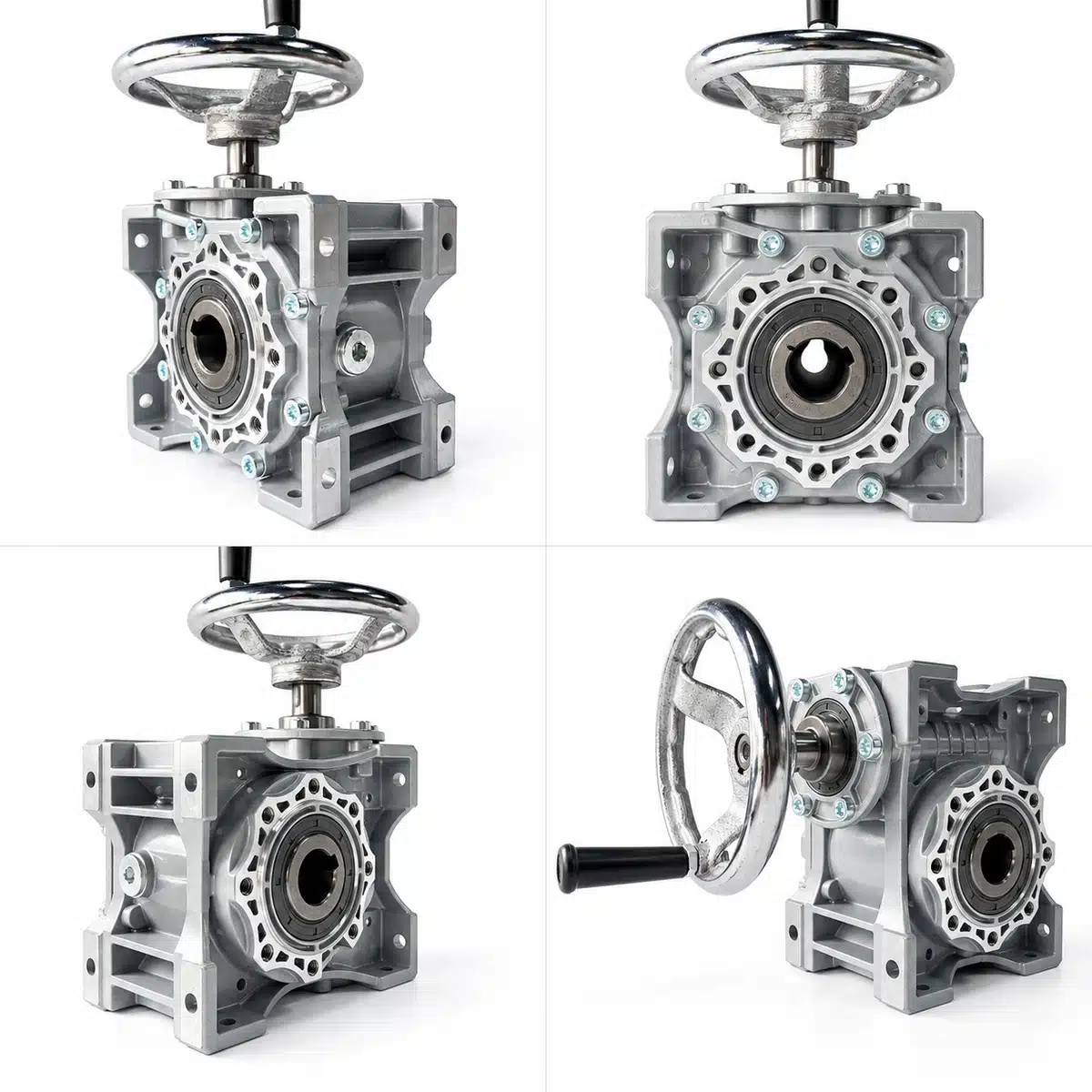
Selecting the right worm gear reducer for conveyor systems is essential for reliable material handling, consistent conveyor speed, and long equipment service life. Whether you are designing a packaging conveyor, food-processing line, or industrial transfer system, the gearbox must deliver sufficient output torque while meeting the application’s service factor, shaft loading, and thermal requirements.
NMRV worm gear reducers provide compact right-angle transmission, multiple reduction ratios, and flexible mounting configurations. They are widely used in OEM conveyor machinery where space, installation convenience, and dependable speed reduction are important.
This engineering guide explains how to calculate conveyor gearbox speed, reduction ratio, torque, motor power, and radial load. It also provides practical NMRV gearbox selection examples to help engineers and procurement teams evaluate suitable configurations.
1. Why Use an NMRV Worm Gear Reducer for Conveyors?
An NMRV worm gear reducer transmits power through a worm shaft and worm wheel, providing speed reduction between perpendicular shafts.
Typical conveyor applications include:
- Packaging and labeling conveyors
- Light-duty belt conveyors
- Roller conveyors in manufacturing facilities
- Food-processing and packaging machinery
- Assembly-line transfer equipment
- Sorting and material-handling systems
- Auxiliary conveyor drives
Compact Right-Angle Design
The right-angle transmission arrangement allows the motor to be positioned alongside the conveyor, helping reduce the installation space required for the drive system.
Multiple Reduction Ratios
NMRV gearboxes are available in various reduction ratios, making it possible to match standard electric motors to the required conveyor output speed.
Flexible Mounting Options
Depending on the gearbox model, NMRV reducers can be supplied with hollow output shafts, solid shaft arrangements, motor adapters, and mounting accessories.
Convenient OEM Integration
Standardized gearbox configurations simplify equipment design, assembly, maintenance, and replacement planning.
Explore our NMRV Worm Gear Reducer product range for available gearbox sizes and configurations.
2. What Information Is Required to Select a Conveyor Gearbox?
Before selecting a worm gear reducer, collect the main operating and installation parameters.
| Parameter | Required Information |
|---|---|
| Conveyor type | Belt, roller, chain, or other |
| Conveyor speed | Required belt or roller speed |
| Drive pulley | Effective pitch diameter |
| Motor power | Rated power in kW |
| Motor speed | Actual operating speed in rpm |
| Conveyor load | Driving force or required output torque |
| Duty cycle | Operating hours per day |
| Starting frequency | Starts per hour |
| Load characteristics | Uniform, moderate shock, or heavy shock |
| Mounting arrangement | Foot, flange, or shaft mounting |
| Output connection | Hollow shaft, solid shaft, or coupling |
| Operating environment | Temperature, moisture, dust, and ventilation |
For gearbox replacement projects, the existing gearbox nameplate and dimensional drawing are also important.
A matching gearbox frame designation does not automatically guarantee mechanical interchangeability.
3. How to Calculate Conveyor Gearbox Output Speed
The required gearbox output speed depends on conveyor belt speed and drive pulley diameter.
For a directly driven belt conveyor:
Output speed (rpm) = (60 × Belt speed) / (π × Pulley diameter)
n2 = (60 × v) / (π × D)
Where:
- n2 = Output speed (rpm)
- v = Conveyor belt speed (m/s)
- D = Effective drive pulley diameter (m)
Calculation Example
Assume:
- Conveyor speed: 0.50 m/s
- Drive pulley diameter: 400 mm (0.40 m)
n2 = (60 × 0.50) / (3.1416 × 0.40)
Required output speed = 23.87 rpm
If an additional chain, belt, or gear transmission is installed between the gearbox and pulley, its transmission ratio must also be considered.
4. How to Calculate the Required Gearbox Reduction Ratio
The gearbox reduction ratio is calculated as:
Reduction ratio = Motor speed / Gearbox output speed
i = n1 / n2
Where:
- i = Reduction ratio
- n1 = Motor operating speed (rpm)
- n2 = Gearbox output speed (rpm)
Example
Motor operating speed: 1,400 rpm
Required output speed: 23.87 rpm
i = 1,400 / 23.87 = 58.65
A nominal 60:1 reduction ratio is a suitable starting point for evaluation.
At 1,400 rpm input:
n2 = 1,400 / 60 = 23.33 rpm
The resulting conveyor belt speed is approximately 0.489 m/s.
Why Motor Speed Matters
The same gearbox reduction ratio can produce different output speeds when connected to motors with different operating speeds.
For example, a 60:1 gearbox driven by a two-pole motor operates at approximately twice the output speed of a similar gearbox driven by a four-pole motor at the same supply frequency.
Always calculate the reduction ratio using the motor’s actual operating speed.
5. How to Calculate Required Conveyor Output Torque
Output torque is one of the most important parameters in conveyor gearbox selection.
For a pulley-driven conveyor:
Required running torque (Nm) = Tangential driving force (N) × Pulley radius (m)
M2,req = F × r
Where:
- M2,req = Required running output torque (Nm)
- F = Effective tangential driving force (N)
- r = Drive pulley radius (m)
The driving force should account for conveyor resistance, material load, inclination, acceleration, and relevant mechanical losses.
Calculation Example
Assume:
- Effective tangential driving force: 1,600 N
- Pulley radius: 0.20 m
M2,req = 1,600 × 0.20
Required running torque = 320 Nm
For a more detailed explanation, see our Worm Gear Reducer Torque Calculation Guide.
6. How to Apply the Gearbox Service Factor
Conveyor gearboxes operate under different load conditions.
A packaging conveyor running intermittently may require a different gearbox selection from a continuously operating material-handling conveyor with frequent starts.
The required application service factor depends on:
- Daily operating hours
- Starting frequency
- Load characteristics
- Acceleration requirements
- Ambient temperature
- Operating conditions
Duty Conditions for the Worked Example
The worked example below represents a frequent start-stop conveyor, such as an indexing packaging line, with these assumed conditions:
- Load classification: B — moderate shock
- Daily operating time: 8 hours
- Starting, braking, or speed-change cycles: 100 per hour
- Ambient temperature: below 30°C
The KB NMRV catalog duty-factor chart indicates a required service factor of approximately 1.5 for these conditions. The chart includes starts, braking operations, and speed changes in its cycle-frequency definition. This is an illustrative operating scenario, not a default service factor for all belt conveyors. Recalculate the factor for the actual duty and environment.
For preliminary sizing:
Required design torque = Running torque × Required application service factor
M2d = M2,req × fs,req
Where:
- M2d = Required design output torque
- M2,req = Required running output torque
- fs,req = Required application service factor
Example
Required running torque: 320 Nm
Required application service factor: 1.5
M2d = 320 × 1.5
Required design torque = 480 Nm
The selected gearbox must provide sufficient nominal torque capacity for this requirement.
Understanding the NMRV Catalog Service Factor
The service factor shown in an NMRV gearbox performance table represents the relationship between the gearbox’s nominal torque capacity and the output torque associated with the listed motor configuration.
Approximate nominal gearbox torque capacity = Catalog output torque × Catalog service factor
M2n ≈ M2 × fs,cat
Where:
- M2n = Approximate nominal gearbox torque capacity
- M2 = Output torque associated with the listed motor configuration
- fs,cat = Catalog service factor
This distinction is important because the catalog service factor is based on the specified motor and gearbox combination, while the application service factor is determined by the actual conveyor load and operating conditions.
Effective Service Factor Under Actual Load
For a specific conveyor application:
Effective service factor = Nominal gearbox torque capacity / Actual required running torque
fs,eff = M2n / M2,req
The effective service factor must meet or exceed the service factor required by the application.
This approach allows engineers to compare gearbox capacity against the actual operating load rather than relying only on the catalog service factor of the motor combination.
Notation used throughout this guide: M2,req = required running output torque; M2 = catalog output torque for the listed motor/gearbox combination; M2n = approximate nominal gearbox torque capacity; M2d = required design torque (M2,req × fs,req); fs,cat = catalog service factor; fs,req = required application service factor; and fs,eff = effective service factor under actual load.
7. NMRV Worm Gear Reducer Selection Table for Conveyors
The following NMRV gearbox configurations illustrate how gearbox size, motor power, reduction ratio, output torque, and service factor affect conveyor drive selection.
All configurations in this table use four-pole motors with a nominal 1,400 rpm input speed.
| NMRV Gearbox / Motor | Motor Power | Ratio | Output Speed | Output Torque M2 | Radial Load Fr2 | Catalog Service Factor |
|---|---|---|---|---|---|---|
| NMRV090 / 90L4 | 1.5 kW | 60:1 | 23.3 rpm | 417 Nm | 6,163 N | 0.8 |
| NMRV105 / 90L4 | 1.5 kW | 60:1 | 23.3 rpm | 442 Nm | 7,787 N | 1.2 |
| NMRV110 / 90L4 | 1.5 kW | 60:1 | 23.3 rpm | 442 Nm | 7,787 N | 1.4 |
| NMRV110 / 90S4 | 1.1 kW | 60:1 | 23.3 rpm | 324 Nm | 7,787 N | 1.9 |
Technical note: The performance values apply to the motor and gearbox combinations shown. The radial-load values are subject to the applicable shaft load-position requirements. Final selection must also satisfy the application’s thermal, mechanical, and installation requirements.
Why NMRV090 has a catalog service factor below 1.0: Its listed 417 Nm output torque at the 1.5 kW motor operating point exceeds the gearbox’s approximate nominal capacity of 417 × 0.8 = 333.6 Nm. The motor/gearbox combination should not be interpreted as providing a service factor of 1.0 or greater at full listed torque. At the example load of 320 Nm, its effective service factor is only about 1.04, below the required 1.5. Using a smaller motor does not increase the gearbox’s nominal torque capacity. See our NMRV technical specifications and service-factor guidance.
1.1 kW configuration caution: NMRV110 / 90S4 is included as a catalog comparison. Despite its high mechanical service factor, the example load leaves almost no estimated steady-state motor-power margin. Part-load gearbox efficiency may be lower than the efficiency implied at the catalog rating point; therefore, this 1.1 kW configuration cannot be confirmed suitable without verifying the actual efficiency, starting torque, acceleration, overload, and operating duty.
Motor Mounting Compatibility
The listed configurations use the following motor interface arrangements:
| NMRV Configuration | Motor Interface |
|---|---|
| NMRV090 / 90L4 | 90B5/B14 |
| NMRV105 / 90L4 | 90B5 |
| NMRV110 / 90L4 | 90B5 |
| NMRV110 / 90S4 | 90B5 |
Motor flange dimensions, input shaft dimensions, and gearbox mounting arrangements should be confirmed before ordering.
8. Conveyor Gearbox Selection Example: NMRV090 vs. NMRV105 vs. NMRV110
Consider a packaging conveyor with frequent starting and stopping. The mechanical sizing uses the following illustrative operating requirements; the service factor corresponds to the duty conditions specified in Section 6:
| Parameter | Value |
|---|---|
| Belt speed | 0.50 m/s |
| Drive pulley diameter | 400 mm |
| Motor operating speed | 1,400 rpm |
| Required running torque M2,req | 320 Nm |
| Required application service factor fs,req | 1.5 |
| Candidate reduction ratio | 60:1 |
Step 1: Calculate Required Output Speed
Output speed = (60 × Belt speed) / (π × Pulley diameter)
n2 = (60 × 0.50) / (3.1416 × 0.40)
Required output speed = 23.87 rpm
Step 2: Calculate Reduction Ratio
Reduction ratio = Motor speed / Required output speed
i = 1,400 / 23.87 = 58.65
A standard 60:1 ratio provides:
Output speed = 1,400 / 60 = 23.33 rpm
This is close to the required conveyor speed.
Step 3: Calculate Required Design Torque
Required design torque = Running torque × Required application service factor
M2d = M2,req × fs,req
M2d = 320 × 1.5
Required design torque = 480 Nm
Step 4: Compare NMRV Gearbox Torque Capacity
The approximate nominal torque capacity can be estimated from the gearbox performance data:
M2n ≈ M2 × fs,cat
| Gearbox | Catalog Output Torque M2 | Catalog Service Factor fs,cat | Nominal Torque Capacity M2n | Torque Check |
|---|---|---|---|---|
| NMRV090 | 417 Nm | 0.8 | 334 Nm | Not sufficient |
| NMRV105 | 442 Nm | 1.2 | 530 Nm | Meets requirement |
| NMRV110 | 442 Nm | 1.4 | 619 Nm | Meets requirement |
The conveyor requires a design torque of 480 Nm.
NMRV090: Its nominal torque capacity is approximately 334 Nm, below the required 480 Nm. It does not meet the design torque requirement.
NMRV105: Its nominal torque capacity is approximately 530 Nm, exceeding the required 480 Nm. It meets the preliminary torque requirement.
NMRV110: Its nominal torque capacity is approximately 619 Nm, providing additional torque capacity. It also meets the preliminary torque requirement.
Step 5: Calculate the Effective Service Factor Under Actual Load
The effective service factor is calculated as:
fs,eff = M2n / M2,req
| Gearbox | Nominal Torque Capacity M2n | Running Torque M2,req | Effective Service Factor fs,eff |
|---|---|---|---|
| NMRV090 | 334 Nm | 320 Nm | 1.04 |
| NMRV105 | 530 Nm | 320 Nm | 1.66 |
| NMRV110 | 619 Nm | 320 Nm | 1.93 |
The required application service factor is 1.5.
Both NMRV105 and NMRV110 meet this requirement, while NMRV090 does not.
Step 6: Calculate Required Motor Power
Output power (kW) = Required running torque (Nm) × Output speed (rpm) / 9550
P2 = (M2,req × n2) / 9550
P2 = (320 × 23.33) / 9550
Required mechanical output power = 0.782 kW
The gearbox input power depends on transmission efficiency:
P1 = P2 / η
The catalog performance values imply an efficiency of approximately 68% for NMRV090 and approximately 72% for NMRV105/110 at the listed 1.5 kW, 60:1 operating points, calculated from ηimplied = M2 × n2 / (9550 × P1). These efficiencies are inferred from catalog data, not explicitly stated efficiency ratings.
For an illustrative 72% efficiency at the 320 Nm application load:
P1 ≈ 0.782 / 0.72 = 1.086 kW
However, 72% is inferred at the 442 Nm catalog rating point, whereas the conveyor requires only 320 Nm. Worm-gear efficiency may be lower at partial load. Therefore, 1.086 kW is an optimistic preliminary estimate rather than a guaranteed motor-power requirement.
A 1.1 kW motor would have virtually no steady-state power margin under this estimate, and actual demand could exceed its rated power. It should not be approved for this application on the basis of this estimate alone. Verify part-load efficiency, starting and acceleration torque, motor duty rating, and thermal conditions. A 1.5 kW motor offers more nominal power margin, but final suitability still requires these checks.
Step 7: Verify Radial Load, Thermal Capacity, and Installation
Before final selection, confirm:
- Permissible radial and axial shaft loads
- Actual load application position
- Motor starting and acceleration requirements
- Thermal suitability for the specified running periods and start-stop duty
- Gearbox mounting dimensions
- Motor flange and shaft compatibility
- Lubrication and operating environment
Selection Recommendation
For this frequent start-stop conveyor example, NMRV105 and NMRV110 are both suitable candidates based on the preliminary torque and service-factor calculations.
NMRV105 meets the required torque capacity with a smaller effective service-factor margin.
NMRV110 provides additional torque capacity and may be preferred where greater mechanical reserve is desirable.
The final choice should be based on shaft loading, thermal performance, installation dimensions, and operating conditions.
For application-specific selection, explore our NMRV worm gear reducers or contact our engineering team.
9. How to Calculate Output Shaft Radial Load
Output shaft radial load is an important consideration when a worm gear reducer drives external transmission components such as chain sprockets, belt pulleys, or gears.
Excessive radial load can reduce bearing life and cause premature shaft or seal damage, even when the gearbox has sufficient torque capacity.
Direct-Drive vs. Chain-Drive Conveyor Arrangements
Two common conveyor drive arrangements should be distinguished.
Direct-drive conveyor: The gearbox is connected directly to the conveyor drum shaft. The load transmitted to the gearbox bearings depends on the drum support, coupling, and bearing arrangement.
Chain-drive conveyor: A sprocket is mounted on the gearbox output shaft and connected by a chain to another sprocket on the conveyor drum shaft. Chain tension creates a radial load on the gearbox output shaft.
The following calculation applies to the second arrangement.
Radial Load Calculation Formula
For an external transmission element, radial load can be estimated using:
Fr = (2000 × M × fz) / d0
Where:
- Fr = Calculated radial load (N)
- M = Actual torque transmitted by the gearbox output shaft (Nm)
- fz = Transmission-element load coefficient
- d0 = Pitch diameter of the sprocket, pulley, or gear mounted on the gearbox output shaft (mm)
The coefficient depends on the transmission element and operating conditions.
Example: Conveyor Driven Through a Chain and Sprocket
Consider a conveyor where the gearbox drives the conveyor drum through a 1:1 chain transmission. For this simplified example, chain losses are neglected and the gearbox output torque is taken as 320 Nm.
Assume:
- Gearbox output torque: 320 Nm
- Sprocket tooth count: 16 teeth
- Chain pitch: 38.1 mm
- Sprocket pitch diameter: d0 = 38.1 / sin(180° / 16) ≈ 195.3 mm
- Chain-sprocket coefficient: fz = 1.25 (13–19 teeth in the catalog table)
- Sprocket centerline position: x = 60 mm, measured from the output shaft shoulder
The estimated radial load is:
Fr = (2000 × 320 × 1.25) / 195.3 ≈ 4,096 N
This pitch diameter refers to the sprocket mounted on the gearbox output shaft, not the 400 mm conveyor drive pulley in the belt-speed example. The two dimensions describe different drive components.
The position x = 60 mm is an illustrative sprocket-centerline location, not a universal mounting dimension. Confirm the actual output shaft extension, sprocket hub width, key engagement, and load position against the dimensional drawing before using this calculation for a real installation.
How to Interpret Catalog Radial Load Values
NMRV performance tables provide configuration-specific radial load values, commonly identified as Fr2.
The permissible radial load also depends on where the external transmission element is positioned along the output shaft.
The load-position correction relationship is:
FxL = (Fr2 × a) / (b + x)
Where:
- FxL = Permissible radial load at the specified position
- Fr2 = Applicable radial load value from the selected gearbox performance table
- a, b = Gearbox-specific correction constants
- x = Distance from the output shaft shoulder to the centerline of the applied radial load (mm)
The catalog Fr2 value applies when the load acts at the midpoint of the output shaft extension (x = L/2). The catalog output-shaft sketch explicitly identifies this reference position. The calculated external radial load must not exceed the permissible load at the actual installation position.
NMRV Radial Load Reference Data
| NMRV Size | a (mm) | b (mm) | Fr,max (N) |
|---|---|---|---|
| NMRV063 | 120 | 95 | 6,270 |
| NMRV075 | 131 | 101 | 7,380 |
| NMRV090 | 162 | 122 | 8,180 |
| NMRV105 | 176 | 136 | 12,000 |
| NMRV110 | 176 | 136 | 12,000 |
Understanding Fr2 and Fr,max
Fr2 is the configuration-specific radial load value shown in the gearbox performance table.
Fr,max is the general maximum reference value listed for the gearbox frame in the radial-load section. It should not replace the applicable Fr2 value when evaluating a specific motor, reduction ratio, and operating configuration.
Use the configuration-specific Fr2 value and the appropriate shaft-position correction method. Any additional limits stated in the gearbox technical specifications must also be respected.
Corrected Radial Load at the Sprocket Centerline
For the assumed x = 60 mm position and the applicable 1.5 kW, 60:1 catalog configurations:
| Gearbox | Catalog Fr2 | Correction | Permissible load FxL | Calculated load Fr | Preliminary radial-load check |
|---|---|---|---|---|---|
| NMRV090 | 6,163 N | 6163 × 162 / (122 + 60) |
≈ 5,486 N | ≈ 4,096 N | Below limit |
| NMRV105 | 7,787 N | 7787 × 176 / (136 + 60) |
≈ 6,992 N | ≈ 4,096 N | Below limit |
| NMRV110 | 7,787 N | 7787 × 176 / (136 + 60) |
≈ 6,992 N | ≈ 4,096 N | Below limit |
The radial-load check passes for all three configurations under these illustrative assumptions. Nevertheless, NMRV090 still fails the separate service-factor requirement, and the result does not establish the suitability of the complete shaft/hub installation. Check actual shaft dimensions, hub position, and any axial loading before final approval.
Important Installation Considerations
For chain-drive conveyors, verify:
- Sprocket pitch diameter
- Chain tension and load coefficient
- Sprocket position on the output shaft
- Permissible radial and axial loads
- Shaft and bearing arrangement
- Starting and shock loads
For direct-drive conveyors, evaluate the actual drum bearing arrangement and load path rather than applying the external sprocket formula to the conveyor drum diameter.
Proper radial-load assessment helps protect gearbox bearings and improves conveyor drive reliability.
10. How to Calculate Conveyor Motor Power
The mechanical power required at the gearbox output is:
Output power (kW) = Required running torque (Nm) × Output speed (rpm) / 9550
P2 = (M2,req × n2) / 9550
Where:
- P2 = Output power (kW)
- M2,req = Required running output torque (Nm)
- n2 = Output speed (rpm)
Using the previous example:
P2 = (320 × 23.33) / 9550
Required output power = 0.782 kW
The required gearbox input power is:
Input power = Output power / Gearbox efficiency
P1 = P2 / η
Where η represents gearbox transmission efficiency.
Because worm gearbox efficiency varies with ratio, speed, load, and operating conditions, the efficiency of the selected configuration should be used when determining motor power. For the NMRV105/110 1.5 kW, 60:1 catalog operating points, an efficiency of approximately 72% is implied by the listed torque, speed, and input motor power; it is not a separately published efficiency rating. Efficiency at the 320 Nm partial-load point may be lower. The illustrative 1.086 kW input-power estimate therefore does not establish that a 1.1 kW motor is adequate.
The motor must also provide sufficient starting torque and acceleration capability.
11. Thermal Performance for Conveyor Operating Duty
Worm gear reducers generate heat during operation because part of the input power is lost through friction and other mechanical losses.
The approximate power loss is:
Power loss = Input power − Output power
Ploss = P1 − P2
Preliminary Power-Loss Example
For the illustrative 320 Nm, 23.33 rpm conveyor operating point:
- Estimated output power: 0.782 kW
- Assumed efficiency: 72%, implied by catalog data at the higher 442 Nm rating point
- Estimated input power: 1.086 kW
- Estimated transmission power loss:
1.086 − 0.782 ≈ 0.304 kW, or approximately 304 W
This is an illustrative running-condition loss estimate, not a verified thermal rating. The 72% efficiency applies at the catalog rating point; part-load efficiency may be lower, so actual input power and heat generation can be higher than estimated. A thermal-capacity comparison requires the permissible thermal rating or manufacturer verification for the actual gearbox, mounting position, ambient temperature, ventilation, lubrication, and operating cycle.
Thermal performance depends on:
- Input power and operating speed
- Reduction ratio
- Gearbox efficiency
- Ambient temperature
- Daily operating hours
- Housing ventilation
- Lubrication conditions
- Load variation
While running, the gearbox must satisfy both mechanical and thermal requirements; frequent starts and stops also affect duty selection and heat generation.
A gearbox that provides sufficient output torque may still require additional thermal evaluation under demanding operating conditions.
12. Can an NMRV Worm Gearbox Prevent Back-Driving?
Some worm gear reducers can resist back-driving under certain conditions, but self-locking is not guaranteed by reduction ratio alone.
Back-driving characteristics depend on worm geometry, efficiency, lubrication, wear, temperature, and external loading.
For inclined conveyors or equipment where reverse movement could create a safety risk, an appropriately engineered brake or backstop should be used.
A worm gearbox should not be treated as the sole safety device for load holding.
13. NMRV Worm Gearbox vs. Helical-Hypoid Gearbox
Both gearbox types can be used for right-angle conveyor drives, but their operating characteristics differ.
| Factor | NMRV Worm Gearbox | Helical-Hypoid Gearbox |
|---|---|---|
| Shaft arrangement | Right-angle | Right-angle |
| Compact installation | Yes | Yes |
| Efficiency | Depends on ratio and operating conditions | Often advantageous in efficiency-sensitive applications |
| Continuous-duty suitability | Requires thermal verification | Requires thermal verification |
| Mounting compatibility | Depends on configuration | Depends on configuration |
| Back-driving | Must be evaluated | Must be evaluated |
For compact conveyors with moderate power requirements, an NMRV worm gear reducer may be a practical solution.
For applications where operating efficiency and heat generation are major considerations, a helical-hypoid gearbox may provide an alternative.
Learn more about our KKM Helical-Hypoid Gear Units.
14. Conveyor Gearbox Installation and Maintenance
Correct installation helps reduce premature wear and unplanned downtime.
Before Installation
Verify:
- Gearbox model and reduction ratio
- Motor connection
- Output shaft or hollow-bore dimensions
- Mounting position
- Shaft alignment
- Lubrication requirements
- External shaft loads
During Commissioning
Check:
- Conveyor rotation direction
- Motor current
- Unusual noise or vibration
- Operating temperature
- Oil leakage
- Conveyor belt tracking
- Starting and stopping behavior
Routine Maintenance
Inspect the gearbox for:
- Lubricant leakage
- Seal damage
- Loose mounting bolts
- Abnormal bearing noise
- Excessive vibration
- Changes in operating temperature
Maintenance intervals should follow the manufacturer’s instructions and actual operating conditions.
For additional information, read our Worm Gearbox Maintenance Guide.
15. Frequently Asked Questions
What size worm gear reducer do I need for a conveyor?
The required size depends on conveyor speed, output torque, service factor, shaft loading, duty cycle, and installation requirements. Select the gearbox using the performance data for the specific motor and reduction ratio.
How do I calculate the gearbox ratio for a conveyor?
Divide the motor’s actual operating speed by the required gearbox output speed. For a belt conveyor, output speed can be calculated from belt speed and drive pulley diameter.
Can I select an NMRV gearbox using motor power alone?
No. Motor power must be considered together with output torque, reduction ratio, service factor, shaft loads, and thermal requirements.
Why do NMRV gearboxes with the same ratio have different output speeds?
The output speed depends on the motor’s operating speed. Two-pole and four-pole motors can produce different output speeds with the same gearbox reduction ratio.
What is the service factor of an NMRV gearbox?
The catalog service factor represents the relationship between the gearbox’s nominal torque capacity and the output torque associated with a specified motor configuration.
For actual applications, fs,eff = M2n / M2,req, where M2n ≈ M2 × fs,cat is the approximate nominal gearbox torque capacity and M2,req is the required running output torque. The effective factor must meet the application-specific fs,req.
How do I calculate radial load on a gearbox output shaft?
Radial load can be calculated from transmitted torque, transmission-element pitch diameter, and the applicable load coefficient. The result must be checked against the permissible load at the actual shaft position, measured from the shaft shoulder to the sprocket or pulley centerline. The catalog Fr2 value applies at x = L/2; use the load-position correction formula when x differs.
Can NMRV worm gear reducers operate continuously?
Yes, when the selected configuration satisfies the application’s mechanical, thermal, lubrication, and operating-duty requirements.
Are NMRV worm gear reducers self-locking?
Some configurations may resist back-driving, but self-locking must not be assumed. Safety-critical applications require an appropriate braking or backstop system.
Can I replace another manufacturer’s gearbox with an NMRV reducer?
Yes, an NMRV worm gear reducer may be used as a replacement when the reduction ratio, output torque, mounting dimensions, shaft connection, motor interface, and operating requirements are compatible.
However, matching the gearbox frame size alone does not guarantee direct interchangeability.
For detailed compatibility considerations, read our Motovario NMRV Equivalent Gearbox Guide.
Is an NMRV or helical-hypoid gearbox better for conveyors?
NMRV worm gear reducers are practical for many compact right-angle drives. Helical-hypoid gearboxes may be advantageous where efficiency and continuous operation are major priorities. The best choice depends on the application.
16. Request Conveyor Gearbox Selection & Quotation
KB Transmission Star supplies NMRV worm gear reducers for OEM machinery manufacturers, industrial distributors, and equipment replacement applications.
Our engineering team can help evaluate your conveyor’s speed, torque, mounting, and operating requirements to identify a suitable gearbox configuration.
For faster selection, please provide:
- Conveyor type and application
- Required belt or roller speed
- Drive pulley or sprocket diameter
- Motor power and operating speed
- Required output torque or conveyor load
- Operating hours and starting frequency
- Mounting arrangement
- Output shaft or hollow-bore dimensions
- Operating environment
- Required quantity and destination country
For replacement projects, please include the existing gearbox nameplate and dimensional drawings.
Request Conveyor Gearbox Selection & Quote
KB Transmission Star — Industrial Gearbox Manufacturer
For detailed specifications, available reduction ratios, mounting options, and technical drawings, explore our NMRV Worm Gear Reducer range.