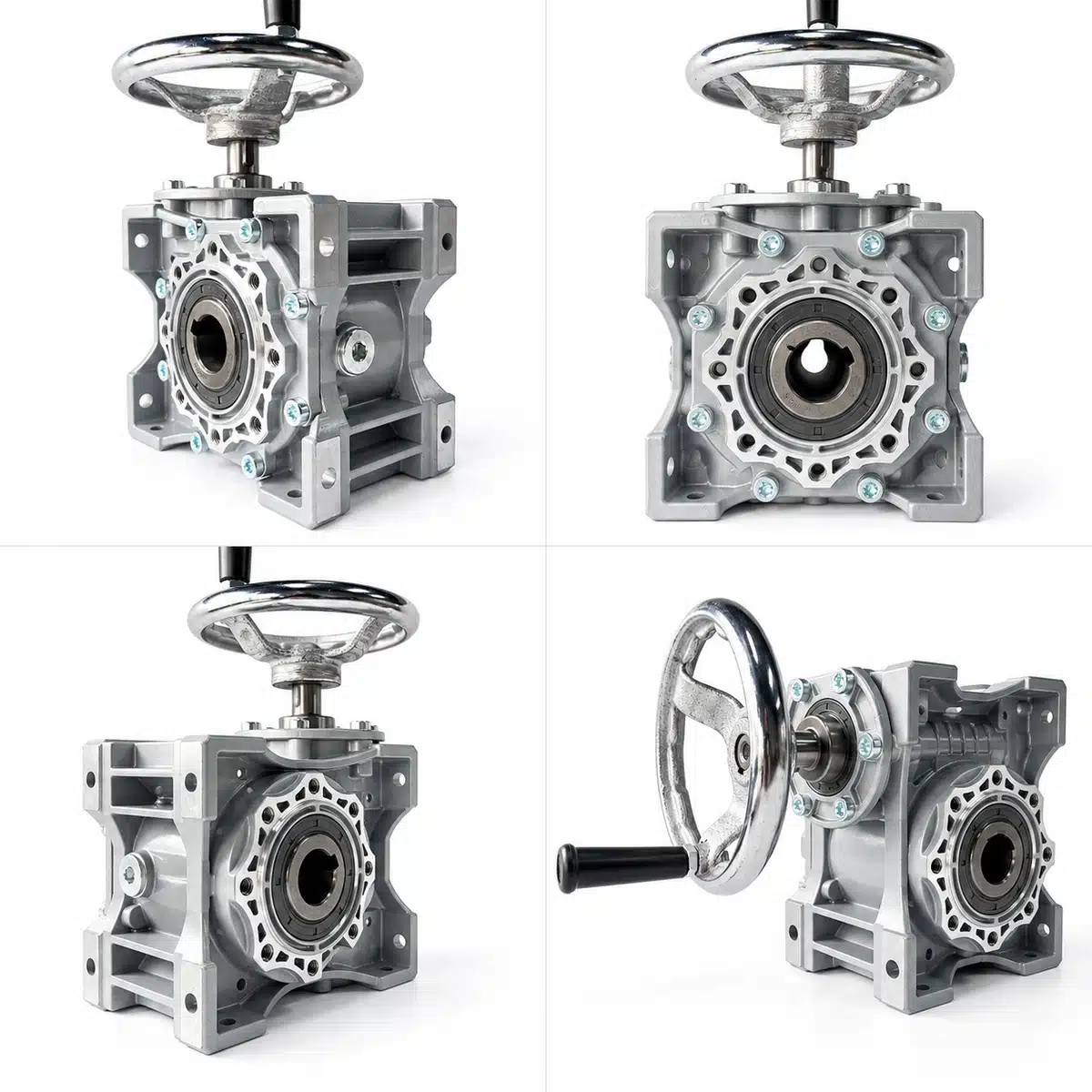
R Series vs. K Series Gearbox: How to Choose for Your Conveyor System?
Key Takeaways
| R Series | K Series | |
|---|---|---|
| Best for | Inline horizontal conveyors | Inclined, heavy-duty, space-constrained |
| Shaft orientation | Inline (parallel) | 90° right angle |
| Max single-unit ratio | 74.84:1 | 197.37:1 |
| Efficiency | 94-96% | 93-95% |
| Torque density | Standard | +20-35% higher |
| Noise | 68-75 dB(A) | 70-78 dB(A) |
| Unit cost | Baseline | +28-31% |
| Choose when | Space allows inline motor | Motor must mount perpendicular |
Bottom line: Start with R Series. Switch to K Series only when shaft orientation, ratio, or torque density requirements eliminate the inline option.
Table of Contents
- What Is the Difference Between R Series and K Series?
- Quick Decision Table: Which Gearbox for Which Conveyor?
- R Series: Technical Overview
- K Series: Technical Overview
- Head-to-Head Performance Comparison
- Application-Specific Selection Guide
- Energy Cost Analysis
- Service Factor: What Most Engineers Get Wrong
- Common Specification Mistakes
- Mounting Configuration Guide
- Maintenance Requirements
- FAQ: R Series vs. K Series Gearbox
1. What Is the Difference Between R Series and K Series?
Specifying the wrong gearbox for a conveyor drive costs more than the price difference between two models. A food processing facility learned this firsthand: they installed R Series inline helical gearboxes on a 14° inclined conveyor without accounting for the inclination angle and variable load profile. Eighteen months later, three of twelve units required premature rebuilds at $2,400 each — not because the gearboxes were defective, but because K Series was the correct specification for that geometry.
The R Series and K Series are the two most common helical gearbox configurations in industrial conveyor applications. Both deliver 94-97% efficiency. Both handle continuous duty. Both come in overlapping frame sizes and accept the same motor configurations. The differences — shaft orientation, torque density, ratio range, and cost — determine which belongs on each drive point.
The single most important difference:
- R Series = inline shaft (motor and output on the same axis)
- K Series = right-angle shaft (motor perpendicular to output)
Everything else follows from this geometric fact.
2. Quick Decision Table: Which Gearbox for Which Conveyor?
| Conveyor Type | Recommended | Key Reason |
|---|---|---|
| Horizontal belt, adequate axial space | R Series | Lower cost, inline geometry fits |
| Horizontal belt, motor must be perpendicular | K Series | Geometry requirement |
| Inclined conveyor >15° | K Series | Better mounting geometry, higher torque density |
| Inclined conveyor <15° | R Series preferred | Lower cost if space allows |
| Chain conveyor, ratio >74:1 | K Series | R Series cannot achieve in single unit |
| Chain conveyor, ratio <60:1 | R Series | Lower cost, adequate performance |
| Roller conveyor, light duty | R Series | Lower cost |
| Roller conveyor, heavy duty | K Series | Torque density, mounting flexibility |
| Screw / auger conveyor | K Series | Motor positioning, axial load handling |
| Bucket elevator | K Series | Geometry, high reduction available |
| Reversing conveyor | Either | Verify 2.0× service factor minimum |
3. R Series: Technical Overview
The R Series is a parallel-shaft inline helical gear reducer. Input and output shafts run on the same axis — motor drives in one end, output comes out the other end in the same direction.
How It Works
Multiple stages of helical gears arranged in series. Each stage provides a portion of the total reduction. All shafts run parallel to each other. Two stages for lower ratios, three stages for higher ratios.
R Series Technical Specifications
| Parameter | Specification |
|---|---|
| Efficiency | 94-96% overall |
| Noise | 68-75 dB(A) at rated load |
| Ratio range | 3.66:1 to 74.84:1 |
| Torque range | 10 Nm (R17) to 18,000 Nm (R137) |
| Backlash | 8-15 arcmin standard |
| Service life | 50,000-80,000 hours |
R Series Model Range
| Model | Max Torque (Nm) | Typical Application |
|---|---|---|
| R17 | 85 | Light automation, small drives |
| R27 | 200 | Small conveyors, packaging |
| R37 | 400 | Packaging lines, light conveyors |
| R47 | 600 | Medium belt conveyors |
| R57 | 1,000 | Standard industrial belt drives |
| R67 | 2,000 | Heavy belt conveyors |
| R77 | 3,500 | Industrial conveyor drives |
| R87 | 6,000 | Heavy industrial applications |
| R97 | 10,000 | Mining support conveyors |
| R107 | 14,000 | Heavy mining applications |
| R137 | 18,000 | Bulk material handling |
R Series Physical Geometry
Motor extends behind gearbox in line with the output shaft. Long axis runs along the drive direction. Compact cross-section perpendicular to the drive axis. Best suited where axial length is available and inline motor positioning is acceptable.
R Series is the correct first choice when application geometry permits — lower unit cost, slightly higher efficiency, simpler installation, and fewer components.
4. K Series: Technical Overview
The K Series is a helical-bevel right-angle gear reducer. It combines helical gear stages with a spiral bevel gear stage, redirecting the output shaft 90 degrees to the input.
How It Works
One spiral bevel stage handles the 90° direction change. One or two helical stages provide the additional reduction. Input and output shafts are perpendicular. The bevel stage delivers higher torque density than an equivalent inline helical configuration in the same housing size.
K Series Technical Specifications
| Parameter | Specification |
|---|---|
| Efficiency | 93-95% overall |
| Noise | 70-78 dB(A) at rated load |
| Ratio range | 5.36:1 to 197.37:1 |
| Torque range | 10 Nm (K17) to 50,000 Nm (K187) |
| Backlash | 8-15 arcmin standard |
| Service life | 50,000-80,000 hours |
K Series Advantages Over R Series
- Motor mounts perpendicular — fits beside or under conveyor frame where inline motor is not possible
- Higher torque density: +20-35% in same frame size
- Extended ratio range: up to 197:1 in single unit versus 74:1 for R Series
- Better handles combined radial and axial loads
- Torque arm mounting option eliminates shaft alignment requirement
K Series Unit Cost Premium
K Series costs 28-31% more than equivalent R Series frame size. This premium is justified when the application requires right-angle mounting, high reduction ratio, or higher torque density. It is not justified when R Series meets all application requirements — in that case it represents unnecessary spend.
5. Head-to-Head Performance Comparison
Technical Performance
| Parameter | R Series | K Series | Advantage |
|---|---|---|---|
| Efficiency | 94-96% | 93-95% | R Series (+1-2%) |
| Noise | 68-75 dB(A) | 70-78 dB(A) | R Series (quieter) |
| Max ratio (single unit) | 74.84:1 | 197.37:1 | K Series |
| Torque density | Baseline | +20-35% | K Series |
| Radial load capacity | Standard | Higher | K Series |
| Axial load capacity | Limited | Better | K Series |
| Self-locking | No | No | Neither |
Installation and Cost
| Parameter | R Series | K Series |
|---|---|---|
| Motor position | Inline behind gearbox | Perpendicular to output shaft |
| Axial length | Longer | Shorter |
| Cross-section | Smaller | Larger |
| Mounting options | B3, B5, B14, hollow shaft | B3, B5, B14, hollow shaft, torque arm |
| Weight (same torque class) | Lighter | +15-25% heavier |
| Unit cost | Baseline | +28-31% |
Unit Cost Comparison by Frame Size
| Frame Size | R Series | K Series | K Series Premium |
|---|---|---|---|
| Size 37 | $320-380 | $420-500 | +31% |
| Size 47 | $480-560 | $620-720 | +29% |
| Size 57 | $720-840 | $920-1,080 | +28% |
| Size 67 | $1,050-1,250 | $1,350-1,600 | +28% |
| Size 77 | $1,600-1,900 | $2,050-2,400 | +28% |
| Size 87 | $2,400-2,850 | $3,100-3,650 | +29% |
| Size 97 | $3,600-4,200 | $4,600-5,400 | +29% |
10-Year Total Cost of Ownership
Scenario: 7.5 kW motor, 6,000 hours/year, $0.12/kWh
| Cost Element | R Series | K Series |
|---|---|---|
| Unit purchase | $1,100 | $1,450 |
| 10-year energy | $2,660 | $3,240 |
| Maintenance | $800 | $900 |
| 10-year total | $4,560 | $5,590 |
| Difference per drive | Baseline | +$1,030 |
For a 20-conveyor facility, specifying K Series where R Series suffices adds $20,600 in unnecessary lifecycle cost with no performance gain. Correct application-specific specification directly impacts facility operating budget.
6. Application-Specific Selection Guide
Horizontal Belt Conveyors
Application characteristics:
- Constant speed operation
- Moderate starting torque (1.5-2.0× running torque)
- Drive pulley at conveyor end
- Motor positioned above or beside conveyor frame
R Series fits when:
- Adequate axial space is available behind the drive pulley
- Motor can mount inline with conveyor axis
- Ratio requirement is below 60:1
K Series required when:
- Motor must mount perpendicular due to space constraints
- Dual-drive configuration (both ends driven)
- Belt wider than 1,200mm with higher torque demand
Worked example:
- Conveyor: 800mm wide, 40m long, aggregate material
- Belt speed: 1.2 m/s, required torque: 620 Nm
- Motor: 7.5 kW, 1400 RPM, drive pulley: 400mm diameter
R67 with 30:1 → 800 Nm rated, $1,100 ✓ K67 with 28:1 → 900 Nm rated, $1,450
R Series saves $350 per drive (32%) with equivalent performance in this application.
Inclined Conveyors
Application characteristics:
- Gravity component increases drive load significantly
- Higher starting torque required (2.0-2.5× running torque)
- Back-driving risk when power is disconnected
- Inclination angles typically 10-25°
⚠️ Critical safety requirement: Neither R Series nor K Series helical gearboxes self-lock at any ratio. Both can back-drive under load when power is cut. Always install a dedicated mechanical backstop or spring-set brake on inclined conveyors. Never rely on gearbox internal friction to hold an inclined load.
K Series preferred above 15° inclination:
- 90° shaft configuration positions motor above conveyor centerline — better geometry on steep inclines
- Higher torque density handles the gravity component of the load
- Ratios up to 197:1 available without adding stages
Correct specification example:
- Conveyor: 18° incline, required torque 840 Nm including gravity component
- K77 with 50:1: 1,100 Nm rated, motor mounts cleanly above conveyor frame ✓
- Mechanical backstop installed as separate safety device
R Series at 18° inclination creates awkward motor positioning and geometry disadvantage. K Series is the correct specification for this application.
Chain Conveyors
Application characteristics:
- Higher starting torque from chain inertia and product weight
- Low output speeds typically required (10-50 RPM)
- High reduction ratios needed
- Shock loads from chain engagement
R Series limitation: Maximum single-unit ratio of 74.84:1. Applications requiring output speeds below 25 RPM typically need an additional reduction stage — adding complexity, length, and cost.
K Series advantage: Single unit achieves up to 197:1 reduction. Reaches 15 RPM output directly from 1400 RPM motor without additional stages.
Worked example:
- Required output: 15 RPM from 1400 RPM motor = 93:1 ratio required
- K87 with 97:1: single compact unit, 1,500 Nm rated ✓
- R Series approach: Two-stage combination required — larger, more complex, higher installed cost
K Series is the clear specification for chain conveyors requiring ratios above 74:1 or output speeds below 25 RPM.
Roller Conveyors
Application characteristics:
- Multiple drive points along conveyor length
- Space extremely limited at each drive point
- Shaft-mount (hollow output shaft) common
- Wide range of load levels
R Series hollow shaft: Long hollow shaft accommodates roller shaft directly. Inline mounting keeps the unit compact along the roller axis. Lower cost for light-duty sections. Preferred where conveyor shaft runs inline with motor position.
K Series hollow shaft: Motor mounts perpendicular — fits in tight spaces between rollers or above the roller frame. Better for heavily loaded sections. Torque arm mounting eliminates alignment requirement where shaft access is restricted.
Selection rule: Light duty with adequate inline space → R Series. Heavy duty or motor-perpendicular geometry required → K Series.
Screw and Auger Conveyors
Application characteristics:
- High axial thrust loads on gearbox output shaft
- Continuous 24/7 duty cycles common
- Often in contaminated environments (food, chemical, agricultural)
- High torque at low speed required
K Series preferred for most configurations:
- Perpendicular mounting keeps motor above the contamination zone
- Output shaft handles combined radial and axial thrust loads effectively
- Compact, smooth housing easier to clean in food-grade applications
- Better suited for viscous material drive requirements
R Series limitation: Inline configuration positions motor directly behind conveyor end — often placing it in the contaminated zone. Axial thrust loads require special bearing arrangements not standard in R Series.
K Series is the recommended specification for screw and auger conveyors in most installation configurations.
7. Energy Cost Analysis
The 1-2% efficiency difference between R and K Series produces measurable cost differences in continuous operation. Over a 10-year period this difference is real but manageable — it should inform specification decisions but not override application requirements.
Annual Energy Comparison
Application: 7.5 kW motor, 6,000 hours/year, $0.12/kWh
| Metric | R Series (95%) | K Series (94%) |
|---|---|---|
| Annual energy loss | 2,220 kWh | 2,700 kWh |
| Annual energy cost | $266 | $324 |
| 10-year energy cost | $2,660 | $3,240 |
| 10-year difference | Baseline | +$580 |
Practical Implication
K Series costs $350-400 more to purchase and $580 more to operate over 10 years — approximately $1,000 higher lifecycle cost per drive unit. This is the correct trade-off when K Series is required by the application. It is unnecessary cost when R Series would serve equally well.
For facilities running 20+ conveyor drives continuously, choosing K Series where R Series would suffice costs $18,000-$20,000 more over the equipment lifecycle. Correct specification is a budget decision, not just a technical one.
8. Service Factor: What Most Engineers Get Wrong
Never select a gearbox based on running torque alone. Service factor accounts for startup conditions, cyclic loads, shock loads, and duty cycle severity. Selecting on nameplate running torque without applying service factor is the single most common cause of premature gearbox failure on conveyors.
Conveyor Service Factor Table
| Application | Hours/Day | Service Factor |
|---|---|---|
| Light belt conveyor | <8 | 1.25-1.50 |
| Standard belt conveyor | 8-16 | 1.50-1.75 |
| Heavy belt conveyor | 16-24 | 1.75-2.00 |
| Chain conveyor | 8-16 | 1.75-2.00 |
| Reversing conveyor | Any | 2.00-2.25 |
| Inclined conveyor | 8-16 | 1.75-2.25 |
| Screw conveyor | 16-24 | 2.00-2.50 |
Calculation Example
- Application: Standard belt conveyor, 16 hours/day
- Measured load torque: 480 Nm
- Service factor: 1.75
- Required gearbox rating: 480 × 1.75 = 840 Nm
R77 rated 1,100 Nm at 30:1 → 31% margin above requirement ✓ K67 rated 900 Nm at 28:1 → 7% margin → consider K77 for better safety margin ✓
Always apply service factor to load torque before selecting frame size. Never select a gearbox rated at exactly the running torque requirement.
9. Common Specification Mistakes
Mistake 1: Specifying K Series for Every Conveyor
K Series handles everything R Series handles, plus more. This leads engineers to default to K Series to “be safe.” On a 50-conveyor facility, this adds $17,500-$20,000 in unnecessary cost versus correct application-specific specification. Correct specification is not conservative — it is accurate.
Fix: Use R Series where geometry and ratio allow. Reserve K Series for applications that genuinely require right-angle mounting, high ratio, or higher torque density.
Mistake 2: Ignoring Service Factor
Selecting on running torque without service factor is the most common cause of premature gearbox failure. A 500 Nm running load on a 16-hour chain conveyor requires 1,000 Nm gearbox rating (2.0× service factor), not 500 Nm. The gearbox selected on running torque alone will fail predictably.
Fix: Always multiply load torque by the appropriate service factor before selecting frame size. If unsure of service factor, contact the manufacturer’s engineering team.
Mistake 3: Underestimating Inclined Conveyor Load
Engineers frequently calculate friction resistance only and ignore the gravity component. On an 18° incline, sinθ = 0.309 — gravity adds 31% to what the horizontal calculation shows.
Correct formula:
F_total = (m_belt + m_material) × g × (μ × cosθ + sinθ)
T_required = F_total × r_pulley × service_factor
Fix: Always include both friction and gravity components in inclined conveyor load calculations. Then apply inclined service factor (1.75-2.25).
Mistake 4: Assuming Self-Locking on Inclined Conveyors
Neither R Series nor K Series helical gearboxes self-lock at any ratio. Both can back-drive under load when power is disconnected. This is not a design flaw — it is fundamental to helical gear geometry. Assuming self-locking on an inclined conveyor is a safety risk.
Fix: Install a dedicated mechanical backstop or spring-set brake on every inclined conveyor. This is a safety requirement, not an optional upgrade, regardless of gearbox type.
Mistake 5: Using Simplified Overhung Load Formula
Using F = T/r underestimates actual radial load by 2-3×. Belt tension on both sides of the drive pulley adds to the radial force — the simplified formula ignores this entirely.
Correct formula:
F_radial = 2.0 to 2.5 × (T / r)Fix: Calculate actual radial load using the correct formula. Verify the result against the manufacturer’s catalog overhung load rating at the actual shaft mounting distance from the housing face.
10. Mounting Configuration Guide
Available Mounting Options
| Mount Type | R Series | K Series | Best Application |
|---|---|---|---|
| B3 Foot mount | ✓ | ✓ | Standard fixed installation |
| B5 Flange mount | ✓ | ✓ | Vertical plate or frame mounting |
| B14 Small flange | ✓ | ✓ | Compact installations |
| Hollow shaft | ✓ | ✓ | Direct shaft mount, roller conveyors |
| Torque arm | — | ✓ | Floating mount, eliminates alignment |
Hollow Shaft Installation Requirements
- Conveyor shaft surface finish: Ra 1.6 µm minimum
- Shaft diameter tolerance: h6 or j6
- Shrink disc preferred over keyway for heavy-load or reversing applications
- Torque arm anchor point must handle full rated output torque
Torque Arm Mounting (K Series)
The gearbox floats on the conveyor shaft. The torque arm connects the gearbox housing to a fixed structure and reacts the full output torque. This configuration eliminates the need for a separate gearbox mounting base, accommodates shaft deflection under load, and reduces installation time significantly. Recommended for conveyors where rigid base mounting is difficult or where vibration is present in the drive train.
Oil Fill by Mounting Orientation
Both R and K Series use ISO VG 220 (standard duty) or ISO VG 320 (high load or high ambient temperature). K Series mounting orientation affects the required oil fill quantity — verify the correct level for the actual installed orientation, not just the horizontal specification. Incorrect oil level in a non-horizontal mounting is a common source of premature bearing failure.
11. Maintenance Requirements
Both R and K Series share similar maintenance requirements. The one additional task for K Series is periodic inspection of the bevel gear tooth contact pattern, particularly in high-load conveyor applications.
Maintenance Schedule Comparison
| Task | Interval | R Series | K Series |
|---|---|---|---|
| Visual inspection | Daily | ✓ | ✓ |
| Oil level check | Weekly | ✓ | ✓ |
| Temperature monitoring | Weekly | ✓ | ✓ |
| Mounting bolt check | Monthly | ✓ | ✓ |
| Oil change — mineral | 4,000-6,000 hrs | ✓ | ✓ |
| Oil change — synthetic | 10,000-15,000 hrs | ✓ | ✓ |
| Bevel gear contact check | 10,000 hrs | — | ✓ |
| Bearing assessment | 20,000 hrs | ✓ | ✓ |
| Overhaul assessment | 50,000 hrs | ✓ | ✓ |
K Series additional maintenance: Bevel gear stage requires tooth contact pattern inspection at 10,000-hour intervals. In high-load continuous conveyor applications this adds approximately 2-3 hours labor per inspection cycle.
Expected service life (properly maintained): Both series: 50,000-80,000 hours. With synthetic oil and disciplined maintenance: 80,000-100,000+ hours achievable.
Spare Parts Standardization
For facilities running both R and K Series, oil inventory can be standardized — both use the same ISO VG grade. Bearings partially interchange within the same frame size but verify before assuming compatibility. For facilities running 20+ units of either series, maintaining one or two complete spare units in critical sizes eliminates the longest lead time risk in a breakdown scenario.
12. FAQ: R Series vs. K Series Gearbox
Q: What is the main difference between R Series and K Series gearboxes?
The fundamental difference is shaft orientation. R Series is an inline parallel-shaft helical gearbox — motor and output shaft run on the same axis. K Series is a right-angle helical-bevel gearbox — output shaft is 90 degrees to the input. R Series fits horizontal inline drives where axial space is available. K Series fits applications where the motor must mount perpendicular to the driven shaft, where ratio requirements exceed 74:1, or where higher torque density is needed in a constrained frame size.
Q: Which gearbox is better for conveyor systems — R Series or K Series?
Neither is universally better — the correct choice depends entirely on application geometry and load requirements. R Series is better for horizontal belt conveyors where inline motor mounting is acceptable: it costs 28-31% less and runs 1-2% more efficiently. K Series is better for inclined conveyors, chain conveyors requiring ratios above 74:1, and space-constrained installations where the motor must mount perpendicular. For most standard horizontal belt conveyors with adequate installation space, R Series is the optimal specification.
Q: Can R Series replace K Series on the same conveyor?
In some cases yes, in others no. R Series can replace K Series on horizontal belt conveyors if axial space is available for inline motor mounting and the ratio requirement is below 74:1. R Series cannot replace K Series when: the motor must mount perpendicular to the conveyor shaft, the ratio requirement exceeds 74:1, the application is a screw or auger conveyor with significant axial thrust loads, or the inclination geometry requires right-angle mounting. Always verify shaft orientation requirements before substituting one series for the other.
Q: Which gearbox should I use for an inclined conveyor?
K Series is the recommended specification for inclined conveyors above 15°. The 90° shaft configuration positions the motor better on steep inclines, and K Series provides higher torque density for the increased gravity load component. Regardless of gearbox type, always install a dedicated mechanical backstop or spring-set brake on inclined conveyors — neither R Series nor K Series helical gearboxes self-lock at any ratio. Both can back-drive when power is cut.
Q: Is K Series more efficient than R Series?
No — R Series is slightly more efficient. R Series achieves 94-96% overall efficiency versus 93-95% for K Series. The bevel gear stage in K Series introduces slightly higher friction than helical-only gearing. Over 10 years of continuous operation on a 7.5 kW drive, this efficiency difference costs approximately $580 more in energy with K Series. This is an acceptable trade-off when K Series is required by the application. It is an unnecessary cost when R Series would serve equally well.
Q: What gearbox should I use for a chain conveyor?
For chain conveyors requiring output speeds below 25 RPM or reduction ratios above 74:1, K Series is the correct specification. K Series achieves up to 197:1 reduction in a single unit, reaching typical chain conveyor speeds without additional reduction stages. For chain conveyors with ratios below 60:1 and adequate axial installation space, R Series is viable and lower cost. Always apply service factor 1.75-2.0× to account for chain engagement shock loads, regardless of which series is selected.
Q: How much more does K Series cost compared to R Series?
K Series costs approximately 28-31% more than R Series for equivalent frame size. Example: R67 runs $1,050-1,250 versus K67 at $1,350-1,600. Over a 10-year lifecycle including energy costs, the K Series premium reaches approximately $1,000 per drive unit. For a 20-conveyor facility, specifying K Series where R Series adequately serves the application adds approximately $20,000 in unnecessary lifecycle cost. Correct specification has a direct impact on facility operating budget.
Q: Do R Series or K Series gearboxes self-lock on inclined conveyors?
No. Neither R Series nor K Series helical gearboxes provide self-locking capability at any ratio. Both can back-drive under load when power is disconnected. This is a critical safety consideration for inclined conveyor applications. Always install a dedicated mechanical backstop or spring-set brake as the primary safety device on any inclined conveyor. Do not rely on gearbox internal friction to hold inclined loads under any circumstances.
Q: What is the maximum ratio available in R Series vs. K Series?
R Series maximum ratio: 74.84:1 in a single unit. K Series maximum ratio: 197.37:1 in a single unit. For applications requiring ratios above 74:1, K Series eliminates the need for a two-stage combination drive, simplifying installation and reducing component count. For applications requiring ratios above 200:1, two-stage gearbox combinations of either series are available.
Q: Can I use the same oil in R Series and K Series gearboxes?
Yes. Both R and K Series use standard industrial gear oil — ISO VG 220 for standard duty, ISO VG 320 for heavy load or high ambient temperature applications. This allows oil inventory standardization across both series in the same facility. Mineral oil change intervals: 4,000-6,000 hours. Synthetic oil change intervals: 10,000-15,000 hours. Verify the correct fill level for the actual mounting orientation when installing K Series in non-horizontal positions.
Q: Which gearbox has a longer service life — R Series or K Series?
Both deliver comparable service life when correctly specified and properly maintained: 50,000-80,000 hours under standard industrial conditions, with 80,000-100,000+ hours achievable using synthetic oil and disciplined maintenance. Service life is more directly affected by correct specification (proper service factor, adequate torque margin) and maintenance discipline than by the choice between R and K Series. An undersized gearbox of either series will fail prematurely; a correctly sized unit of either series will run reliably for decades.
Ready to Specify?
For conveyor drive sizing assistance, cross-reference to your current gearbox models, CAD drawings, or volume pricing, contact our engineering team directly. We provide selection verification, dimensional documentation, and technical support for both R and K Series at no charge for qualified projects.
Provide the following for fastest response:
- Conveyor type and dimensions
- Belt or chain speed required (m/s or RPM)
- Drive pulley or sprocket diameter
- Load (belt weight + material weight + product weight)
- Conveyor angle (if inclined, in degrees)
- Operating hours per day
- Motor specification (kW and RPM)
Response within 24 hours for standard applications. Contact Us Now.