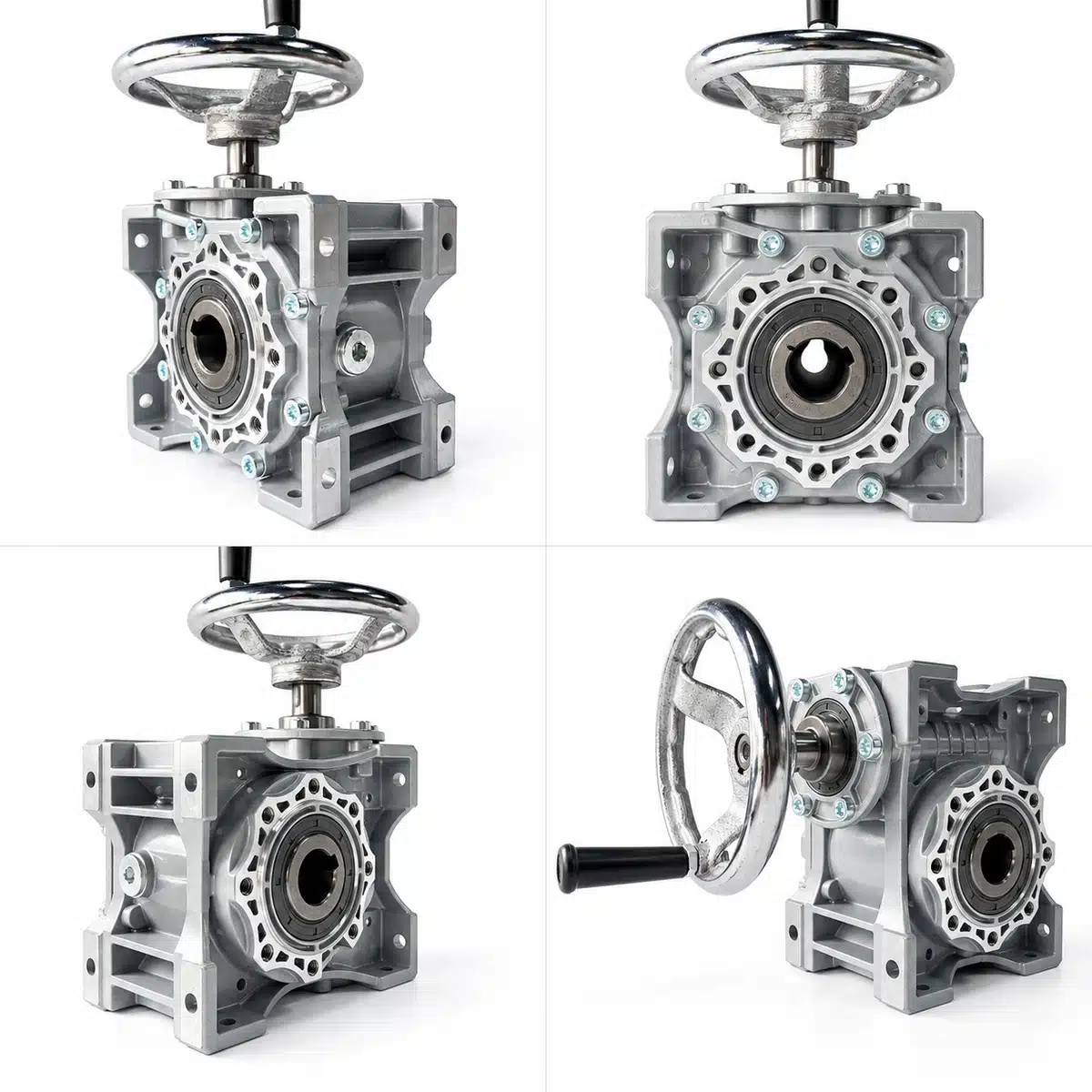
How to Select an R Series Helical Gearbox: Engineering Guide for Industrial Applications
Key Takeaways
| Selection Step | Critical Parameter | Common Mistake |
|---|---|---|
| Define load | Output torque + service factor | Using running torque only |
| Calculate ratio | Motor RPM ÷ Output RPM | Ignoring actual output speed |
| Verify thermal rating | Continuous duty kW | Selecting on torque alone |
| Check overhung load | F = 2.0-2.5 × (T/r) | Using simplified F = T/r |
| Specify mounting | B3, B5, B14, hollow shaft | Wrong orientation for oil level |
| Confirm frame size | Catalog rated torque > Design torque | Under-specifying for cost savings |
Bottom line: Most R Series gearbox failures trace back to two errors — ignoring service factor and underestimating overhung load. Get these two calculations right and frame size selection becomes straightforward.
Table of Contents
- Why R Series Gearbox Selection Goes Wrong
- R Series Overview: What You Are Selecting
- Step 1: Define Your Load Requirements
- Step 2: Calculate Reduction Ratio
- Step 3: Apply Service Factor
- Step 4: Select Frame Size from Catalog
- Step 5: Verify Thermal Rating
- Step 6: Calculate and Verify Overhung Load
- Step 7: Specify Mounting Configuration
- Step 8: Confirm Motor Interface
- Complete Worked Example
- R Series Model Specifications Reference
- Common Selection Mistakes and How to Avoid Them
- FAQ: R Series Helical Gearbox Selection
1. Why R Series Gearbox Selection Goes Wrong
A distribution center in the Netherlands installed 24 R Series gearboxes on their sortation conveyor system in 2021. Fourteen months later, seven units showed premature bearing wear. The gearboxes were correctly sized for running torque. The engineer had not applied service factor for the frequent start-stop cycle — 45 starts per hour on a reversing sortation conveyor. The actual design torque requirement was 2.2× the running torque. Every unit was undersized by that factor from day one.
Replacing seven gearboxes plus labor, lost production, and expedited freight cost €31,000. The correct units would have cost €4,200 more upfront.
This is the pattern we see repeatedly in failure analysis: not defective gearboxes, but incorrectly specified ones. R Series helical gearboxes are reliable when correctly selected. The selection process has eight steps. Skipping or approximating any of them shifts the failure risk from the gearbox to the specification.
This guide walks through each step with engineering calculations, real examples, and the specific checks that prevent the most common failure modes.
2. R Series Overview: What You Are Selecting
The R Series is a parallel-shaft inline helical gear reducer. Understanding the mechanical design informs every selection decision.
Gear Arrangement
Multiple stages of helical gears in series. All shafts parallel. Input shaft axis coincides with output shaft axis. Standard configurations:
- 2-stage: Ratios 3.66:1 to approximately 20:1
- 3-stage: Ratios approximately 20:1 to 74.84:1
Helical gear advantages driving R Series selection:
- Higher efficiency than worm gears: 94-96% overall
- Lower noise: 68-75 dB(A) at rated load
- Higher load capacity per unit size than spur gears
- Smooth, continuous tooth engagement
R Series Standard Frame Sizes
| Model | Max Output Torque | Ratio Range | Weight |
|---|---|---|---|
| R17 | 85 Nm | 3.66-74.84 | 2.5 kg |
| R27 | 200 Nm | 3.66-74.84 | 5.2 kg |
| R37 | 400 Nm | 3.66-74.84 | 8.8 kg |
| R47 | 600 Nm | 3.66-74.84 | 14.5 kg |
| R57 | 1,000 Nm | 3.66-74.84 | 24.0 kg |
| R67 | 2,000 Nm | 3.66-74.84 | 38.0 kg |
| R77 | 3,500 Nm | 3.66-74.84 | 62.0 kg |
| R87 | 6,000 Nm | 3.66-74.84 | 98.0 kg |
| R97 | 10,000 Nm | 3.66-74.84 | 155.0 kg |
| R107 | 14,000 Nm | 3.66-74.84 | 230.0 kg |
| R137 | 18,000 Nm | 3.66-74.84 | 380.0 kg |
Key Design Specifications
| Parameter | R Series Specification |
|---|---|
| Efficiency | 94-96% overall |
| Max input speed | 3,000 RPM (standard) |
| Noise | 68-75 dB(A) |
| Thermal rating | See catalog by model and ratio |
| Backlash | 8-15 arcmin standard |
| Lubrication | Splash (standard) / Forced (large sizes) |
| Seals | Double-lip NBR standard, Viton option |
| Housing | Cast iron (standard), aluminum option (smaller sizes) |
| Service life | 50,000-80,000 hours (properly maintained) |
What R Series Does NOT Provide
- Self-locking: Cannot hold inclined loads when power is cut
- Right-angle output: Inline only (use K Series for 90° output)
- Ratios above 74.84:1 in single unit (use two-stage combination or K Series)
- High overhung load tolerance without verification (calculate every time)
3. Step 1: Define Your Load Requirements
Before opening a catalog, define four parameters from the application. Guessing any of them propagates error through every subsequent step.
Parameter 1: Required Output Torque (T₂)
Output torque is the mechanical load the gearbox must transmit to the driven equipment.
For conveyor and linear drives:
T₂ = F × rWhere:
- F = Total resistance force (N)
- r = Drive pulley or sprocket radius (m)
Resistance force calculation:
F = (m_load + m_belt) × g × (μ × cosθ + sinθ)Where:
- m_load = Material/product mass (kg)
- m_belt = Belt/chain mass (kg)
- g = 9.81 m/s²
- μ = Rolling friction coefficient (0.02-0.05 for roller conveyors)
- θ = Inclination angle (0° for horizontal)
For mixer and agitator drives:
T₂ = P × 9,550 / n₂Where:
- P = Required power (kW)
- n₂ = Output shaft speed (RPM)
- 9,550 = Conversion constant
For pump drives:
T₂ = (P × 9,550) / (n₂ × η_pump)Parameter 2: Required Output Speed (n₂)
Determine exact output speed from the driven equipment requirement:
- Belt conveyor: Calculate from belt speed and pulley diameter
- Chain conveyor: Calculate from chain speed and sprocket pitch diameter
- Mixer: Specify from process requirements
- Pump: Specify from pump curve
Formula:
n₂ = (v × 60) / (π × D)Where:
- v = Belt or surface speed (m/s)
- D = Pulley or sprocket diameter (m)
Parameter 3: Available Motor Speed (n₁)
Standard industrial motor speeds:
- 2-pole: 2,800-2,900 RPM (50 Hz), 3,450-3,550 RPM (60 Hz)
- 4-pole: 1,400-1,450 RPM (50 Hz), 1,720-1,750 RPM (60 Hz)
- 6-pole: 930-960 RPM (50 Hz), 1,140-1,160 RPM (60 Hz)
Use nameplate speed, not synchronous speed. Slip reduces actual speed 2-5%.
Parameter 4: Duty Cycle
Define the operating pattern:
- Hours of operation per day
- Starts per hour
- Load pattern (constant, cyclic, shock)
- Reversing operation (yes/no)
- Ambient temperature
These four parameters feed directly into Steps 2 through 6. Do not estimate — measure or calculate from equipment specifications.
4. Step 2: Calculate Reduction Ratio
Basic Ratio Calculation
i = n₁ / n₂Where:
- i = Reduction ratio
- n₁ = Input (motor) speed (RPM)
- n₂ = Required output speed (RPM)
Example:
- Motor: 1,450 RPM (4-pole, 50 Hz)
- Required output: 48 RPM
- Ratio: 1,450 / 48 = 30.2:1
Selecting Standard Ratio
R Series standard ratios available: 3.66, 4.39, 5.19, 6.14, 7.30, 8.68, 10.29, 12.18, 14.43, 17.06, 20.16, 23.83, 28.37, 33.45, 39.37, 46.54, 55.00, 65.23, 74.84
Select the nearest standard ratio. Then calculate actual output speed to verify it meets application requirements.
Continuing example:
- Nearest standard ratio: 30.03 is not listed → use 28.37 or 33.45
- With 28.37:1: n₂ = 1,450 / 28.37 = 51.1 RPM
- With 33.45:1: n₂ = 1,450 / 33.45 = 43.4 RPM
Which is acceptable? Depends on process tolerance. For belt conveyors ±10% is typically acceptable. For synchronized lines, tighter tolerance may be required.
Speed Tolerance Consideration
If neither standard ratio provides acceptable output speed:
- Use variable frequency drive (VFD) to fine-tune motor speed
- Consider non-standard ratio (available on request, MOQ applies)
- Recheck pulley/sprocket diameter to achieve required ratio with standard option
VFD approach: If standard ratio gives n₂ = 51.1 RPM but 48 RPM is required: Motor speed needed = 48 × 28.37 = 1,362 RPM VFD setting = 1,362 / 1,450 × 50 Hz = 47 Hz
This is a common and effective solution for precise speed requirements.
5. Step 3: Apply Service Factor
This is the step most commonly skipped or underestimated. Service factor multiplies the calculated running torque to account for real operating conditions that exceed steady-state analysis.
Service Factor Definition
T_design = T₂_running × f_sWhere:
- T_design = Design torque for gearbox selection
- T₂_running = Calculated running torque
- f_s = Service factor
The gearbox must be selected based on T_design, not T₂_running.
Service Factor Table
Base service factor by operating hours and load type:
| Daily Operation | Uniform Load | Moderate Shock | Heavy Shock |
|---|---|---|---|
| <2 hours/day | 0.80 | 1.00 | 1.25 |
| 2-10 hours/day | 1.00 | 1.25 | 1.50 |
| 10-16 hours/day | 1.25 | 1.50 | 1.75 |
| >16 hours/day | 1.50 | 1.75 | 2.00 |
Application-specific service factors:
| Application | Service Factor Range |
|---|---|
| Belt conveyor, smooth load | 1.25-1.50 |
| Belt conveyor, mixed load | 1.50-1.75 |
| Chain conveyor | 1.75-2.00 |
| Reversing conveyor | 2.00-2.25 |
| Mixer, light viscosity | 1.25-1.50 |
| Mixer, high viscosity | 1.75-2.25 |
| Screw conveyor | 2.00-2.50 |
| Bucket elevator | 2.00-2.50 |
| Compressor | 1.50-2.00 |
| Pump, centrifugal | 1.25-1.50 |
| Pump, positive displacement | 1.75-2.25 |
Additional factors to add:
| Condition | Add to Service Factor |
|---|---|
| Frequent starts (>30/hour) | +0.25 |
| Reversing operation | +0.25 |
| Ambient temperature >40°C | +0.25 |
| Shock loads (impact) | +0.25 to +0.50 |
| VFD operation, full torque at low speed | +0.25 |
Service Factor Example
- Application: Chain conveyor, 18 hours/day
- Running torque: 480 Nm
- Base service factor (heavy shock, >16 hrs): 2.00
- Add for reversing: +0.25
- Total service factor: 2.25
- Design torque: 480 × 2.25 = 1,080 Nm
This is the torque used to select frame size — not 480 Nm.
6. Step 4: Select Frame Size from Catalog
With design torque calculated, frame size selection is straightforward: find the smallest frame size whose rated output torque exceeds design torque at the required ratio.
Selection Rule
T_rated (catalog) ≥ T_design (calculated)And verify:
T_rated ≥ 1.1 × T_design (recommended 10% margin minimum)Frame Size Selection Table
Example: Design torque = 1,080 Nm, ratio = 28.37:1
| Model | Rated Torque at 28:1 | Adequate? |
|---|---|---|
| R57 | 850 Nm | ✗ (79% of required) |
| R67 | 1,400 Nm | ✓ (130% of required) |
| R77 | 2,400 Nm | ✓ (222% of required — oversized) |
Select R67. Rated torque 1,400 Nm provides 30% margin above design torque of 1,080 Nm.
Torque Utilization
| Utilization % | Assessment |
|---|---|
| >100% | Undersized — do not use |
| 85-100% | Marginal — reconsider service factor |
| 70-85% | Acceptable — standard selection |
| 50-70% | Good margin — preferred for harsh environments |
| <50% | Oversized — evaluate cost vs. reliability trade-off |
Target 70-85% utilization for standard industrial applications. Higher utilization increases risk of underspecification if loads exceed estimates. Lower utilization increases cost unnecessarily.
7. Step 5: Verify Thermal Rating
This step is skipped most often on continuous-duty applications — and causes the most failures.
R Series helical gearboxes are more efficient than worm gears, but they still generate heat from friction losses. In continuous operation (>16 hours/day), thermal capacity limits the maximum power the gearbox can handle — and this limit is sometimes reached before the mechanical torque limit.
Why Thermal Rating Matters
Heat generation:
P_heat = P_input × (1 - η)For R Series at 95% efficiency with 7.5 kW input:
P_heat = 7.5 × (1 - 0.95) = 0.375 kW continuous heat generationThis heat must dissipate through the housing. If heat generation exceeds dissipation capacity, housing temperature rises until oil degrades, seals fail, and bearings lose lubrication film.
Thermal Rating Verification
From the manufacturer’s catalog, each model lists:
- Mechanical torque rating (peak torque capability)
- Thermal power rating (maximum continuous input power)
Check both — both limits apply.
Example verification:
- Selected: R67, ratio 28.37:1
- Application: 7.5 kW continuous input, 18 hours/day
- R67 thermal rating (catalog): 9.5 kW continuous
7.5 kW < 9.5 kW ✓ Thermally adequate
If thermal rating is insufficient:
| Solution | Cooling improvement | Cost |
|---|---|---|
| Upsize one frame | Larger housing area | +25-35% unit cost |
| Add cooling fan | 15-25°C temperature reduction | $150-400 |
| Synthetic oil (PAO/PAG) | 8-15°C temperature reduction | 2-3× oil cost |
| External oil cooler | 20-35°C temperature reduction | $800-2,500 |
| Reduce duty cycle | Allows cooling between cycles | Process change |
Temperature Monitoring
Establish baseline operating temperature after commissioning. Record after 4 hours continuous operation. Alert threshold: +15°C above baseline. Any increase above baseline trend indicates developing overload, misalignment, or lubrication problem.
Acceptable housing temperature range: 50-80°C. Above 85°C: investigate immediately.
8. Step 6: Calculate and Verify Overhung Load
Overhung load is the radial force applied to the gearbox output shaft by external components — pulleys, sprockets, gears, and couplings. It is the second most common cause of premature gearbox failure after service factor errors.
Why Simplified Formulas Underestimate
The simplified formula:
F = T / rOnly accounts for the torque-transmitting force on the tight side of the belt. It ignores:
- Belt tension on the slack side
- Dynamic loads during acceleration
- Belt wrap angle effects
- Starting loads
This underestimates actual radial load by 2-3×.
Correct Overhung Load Calculation
For belt drives:
F_radial = T1 + T2Where for a typical belt drive (T1/T2 ratio ≈ 2:1):
T2 = T / r
T1 = 2 × T / r
F_radial = 3 × T / r
In practice, use the engineering approximation:
F_radial = 2.0 to 2.5 × (T / r)- 2.0× for flat belts, well-tensioned, 180° wrap
- 2.5× for V-belts, timing belts, or dynamic loading
- 3.0× for chain drives or heavy shock
For chain drives:
F_radial = 2 × T / r (minimum)Chain drives create higher radial loads due to polygon effect. Use 2.5-3.0× for safety.
For gear drives (external gears on output shaft):
F_radial = T / (r × cos(α))Where α = pressure angle (typically 20°)
Worked Calculation
- Output torque: 1,080 Nm
- Drive pulley diameter: 400mm (radius = 0.2m)
- Drive type: V-belt
F_radial = 2.5 × (1,080 / 0.2) = 2.5 × 5,400 = 13,500 NNow verify against catalog overhung load rating.
Overhung Load Rating Verification
Catalog overhung load ratings are specified at a standard distance from the housing face (typically 50-75mm for smaller frames, up to 150mm for larger).
Load at actual mounting distance:
If catalog rates 12,000 N at 75mm from housing face, but actual pulley is at 120mm:
F_allowed at 120mm = F_catalog × (d_catalog / d_actual)
F_allowed = 12,000 × (75 / 120) = 7,500 N
Our calculated load: 13,500 N > 7,500 N ✗ Exceeds rating
Solutions for Excessive Overhung Load
Option 1: Increase pulley diameter
Larger r → smaller F_radial
500mm pulley: F = 2.5 × (1,080 / 0.25) = 10,800 N
Still exceeds rating at 120mm mounting distance. Try 600mm:
600mm pulley: F = 2.5 × (1,080 / 0.30) = 9,000 NCheck against catalog at 120mm — may now be acceptable.
Option 2: Upsize to next frame R77 has higher overhung load rating. Check catalog for R77 rating at 120mm.
Option 3: Add external bearing support Pillow block bearing on output shaft beyond the pulley. Gearbox output shaft carries no radial load — pillow block carries it all. This is the most reliable solution for very high overhung loads.
Option 4: Use hollow shaft mount Shrink disc mount on conveyor shaft eliminates overhung load entirely. Gearbox floats on shaft — radial load carried by conveyor shaft bearings.
9. Step 7: Specify Mounting Configuration
Mounting configuration affects oil level, thermal performance, and load distribution. Specifying the wrong orientation for a delivered gearbox can cause oil starvation in some bearing positions.
Standard Mounting Designations (IEC)
| Code | Description | Output Shaft | Notes |
|---|---|---|---|
| B3 | Foot mount | Horizontal | Standard, most common |
| B5 | Large flange | Any | Mounts to vertical plate |
| B14 | Small flange | Any | Compact flange mount |
| B6 | Foot mount | Vertical up | Oil level adjustment needed |
| B7 | Foot mount | Vertical down | Oil level adjustment needed |
| B8 | Foot mount | Horizontal (rotated 90°) |
Oil Level by Mounting Position
Oil level is critical and position-dependent. Manufacturers specify different fill quantities for different mounting orientations.
Common errors:
- Using horizontal fill quantity in vertical installation → oil starvation in upper bearings
- Over-filling vertical mount → oil leaks through upper shaft seal
Always specify mounting orientation on the purchase order. The manufacturer sets oil level for that orientation before shipment.
Mounting Selection Guide
B3 Foot mount:
- Most common for conveyor drives
- Motor inline behind gearbox
- Simple, stable, easy to align
- Use when floor or base mounting available
B5 Flange mount:
- Mounts directly to machine plate or frame
- No separate base required
- Common for conveyor end plates
- Verify face perpendicularity <0.02mm/100mm
Hollow shaft mount:
- Output shaft is hollow — conveyor shaft passes through
- Secured by keyway or shrink disc
- Torque arm reacts housing rotation
- Eliminates shaft coupling and alignment
- Ideal for roller conveyors, screw conveyors
Torque arm sizing for hollow shaft:
The torque arm must handle full rated output torque. Torque arm length and anchor point determine reaction force on the structure.
F_torque_arm = T_output / L_armWhere L_arm = distance from shaft centerline to anchor point (m)
For T = 1,080 Nm and L_arm = 0.5m:
F_torque_arm = 1,080 / 0.5 = 2,160 NStructure must handle 2,160 N at the anchor point.
10. Step 8: Confirm Motor Interface
The final selection step ensures the motor integrates correctly with the gearbox.
Motor Flange Compatibility
R Series accepts IEC standard motor flanges:
B5 (large flange) common sizes:
- IEC 63 B5: Pilot diameter 95mm
- IEC 71 B5: Pilot diameter 110mm
- IEC 80 B5: Pilot diameter 130mm
- IEC 90 B5: Pilot diameter 130mm (some 110mm)
- IEC 100/112 B5: Pilot diameter 180mm
- IEC 132 B5: Pilot diameter 230mm
B14 (small flange) common sizes:
- IEC 63 B14: Pilot diameter 75mm
- IEC 71 B14: Pilot diameter 85mm
- IEC 80 B14: Pilot diameter 100mm
- IEC 90 B14: Pilot diameter 115mm
Verify three dimensions:
- Pilot diameter (locating fit — should be close clearance)
- Bolt circle diameter and bolt count
- Bolt size
Shaft and Coupling Interface
If motor couples to gearbox input shaft (solid input shaft option):
Coupling selection:
- Flexible jaw coupling: Compensates ±0.5mm misalignment
- Disc coupling: High precision, low misalignment tolerance
- Rigid coupling: Only if alignment guaranteed <0.05mm
Alignment requirements:
- Parallel offset: <0.05mm (laser alignment recommended)
- Angular misalignment: <0.08°
Input shaft specification:
- Diameter and length (matches coupling bore)
- Keyway dimensions (DIN 6885)
- End treatment (threaded hole for retention)
VFD Compatibility
If motor driven by VFD, additional considerations apply:
Minimum speed: At low output speeds with VFD, the motor fan provides less cooling. Check motor thermal rating at reduced speed.
Torque at low speed: VFD allows full torque at low speed. If operated at full torque below 20% of rated speed continuously, apply additional service factor of 0.25.
Bearing currents: VFD creates shaft voltages that can cause bearing fluting. Use insulated bearings or shaft grounding ring on motors above 15 kW with VFD.
11. Complete Worked Example
Application: Belt conveyor, food processing facility
Given Data
- Belt speed: 0.8 m/s
- Drive pulley diameter: 350mm
- Total conveyor load (belt + product): 850 kg, 40m conveyor
- Friction coefficient: 0.03
- Conveyor angle: 5° upward
- Operating hours: 20 hours/day
- Motor available: 7.5 kW, 4-pole, 1,450 RPM (50Hz)
- Drive type: V-belt from gearbox to drive pulley
Step 1: Calculate Load Requirements
Resistance force:
F = 850 × 9.81 × (0.03 × cos5° + sin5°)
F = 8,339 × (0.03 × 0.996 + 0.087)
F = 8,339 × (0.030 + 0.087)
F = 8,339 × 0.117 = 976 N
Required output torque:
T₂ = F × r = 976 × 0.175 = 171 NmRequired output speed:
n₂ = (0.8 × 60) / (π × 0.35) = 48 / 1.100 = 43.6 RPMStep 2: Calculate Reduction Ratio
i = 1,450 / 43.6 = 33.26Nearest standard ratio: 33.45:1
Actual output speed: 1,450 / 33.45 = 43.3 RPM ✓ (within ±2% acceptable)
Step 3: Apply Service Factor
- Application: Belt conveyor, food processing
- Hours: 20/day → >16 hrs category
- Load type: Moderate shock (inclined, mixed product)
- Base service factor: 1.75
- Add for inclined (5°): +0.25
- Total service factor: 2.00
T_design = 171 × 2.00 = 342 NmStep 4: Select Frame Size
Required: 342 Nm at ratio 33.45:1
| Model | Rated Torque | Adequate? | Utilization |
|---|---|---|---|
| R37 | 280 Nm | ✗ | 122% — over |
| R47 | 450 Nm | ✓ | 76% — good |
| R57 | 700 Nm | ✓ | 49% — oversized |
Select R47 — 76% utilization, adequate margin.
Step 5: Verify Thermal Rating
- Selected: R47, ratio 33.45:1
- Motor power: 7.5 kW
- R47 thermal rating (continuous): 4.8 kW
7.5 kW > 4.8 kW ✗ Thermally inadequate at this frame size
Upsize to R57:
- R57 thermal rating (continuous): 7.2 kW
- 7.5 kW > 7.2 kW → still marginal
- Add synthetic oil: effective thermal capacity increase to ~8.5 kW ✓
Or upsize to R67:
- R67 thermal rating: 9.5 kW
- 7.5 kW < 9.5 kW ✓ comfortable margin
Decision: Select R67 (conservative for food processing, 20 hrs/day continuous duty)
Step 6: Calculate Overhung Load
- Output torque: 342 Nm (design torque)
- Pulley radius: 0.175m
- Drive type: V-belt
F_radial = 2.5 × (342 / 0.175) = 2.5 × 1,954 = 4,886 NR67 overhung load rating at 75mm: 8,500 N Actual mounting distance: 90mm
F_allowed at 90mm = 8,500 × (75 / 90) = 7,083 N4,886 N < 7,083 N ✓ Overhung load acceptable
Step 7: Mounting Configuration
- Foot mount B3 (horizontal, inline with conveyor)
- Oil level: Standard horizontal fill
- Verify base flatness: ±0.05mm
- Soft foot check required after installation
Step 8: Motor Interface
- Motor: 7.5 kW, IEC 132 frame, B5 flange
- R67 accepts IEC 132 B5 ✓
- Motor adapter ordered with gearbox
Final Selection Summary
| Parameter | Value |
|---|---|
| Model | R67 |
| Ratio | 33.45:1 |
| Actual output speed | 43.3 RPM |
| Rated torque | 1,400 Nm |
| Design torque | 342 Nm (24% utilization — appropriate for 20hr/day food processing) |
| Thermal rating | 9.5 kW (application: 7.5 kW — 79% utilization) |
| Overhung load | 4,886 N (rating: 7,083 N at actual mounting — 69% utilization) |
| Mounting | B3 foot mount, horizontal |
| Motor interface | IEC 132 B5 |
| Service factor applied | 2.00 |
12. R Series Model Specifications Reference
Torque Ratings by Model and Ratio (Nm)
| Model | 5:1 | 10:1 | 20:1 | 30:1 | 50:1 | 74:1 |
|---|---|---|---|---|---|---|
| R17 | 45 | 65 | 75 | 80 | 82 | 85 |
| R27 | 110 | 155 | 175 | 185 | 195 | 200 |
| R37 | 220 | 280 | 310 | 320 | 330 | 400 |
| R47 | 300 | 390 | 430 | 450 | 470 | 600 |
| R57 | 480 | 620 | 700 | 750 | 800 | 1,000 |
| R67 | 800 | 1,100 | 1,250 | 1,350 | 1,450 | 2,000 |
| R77 | 1,400 | 1,900 | 2,150 | 2,300 | 2,500 | 3,500 |
| R87 | 2,200 | 3,100 | 3,500 | 3,800 | 4,200 | 6,000 |
| R97 | 3,600 | 5,100 | 5,800 | 6,200 | 7,000 | 10,000 |
Indicative values — verify with manufacturer catalog for your specific ratio
Thermal Power Ratings (kW, continuous duty, 40°C ambient)
| Model | Thermal Rating |
|---|---|
| R17 | 0.8 kW |
| R27 | 1.5 kW |
| R37 | 2.5 kW |
| R47 | 4.8 kW |
| R57 | 7.2 kW |
| R67 | 9.5 kW |
| R77 | 14.0 kW |
| R87 | 20.0 kW |
| R97 | 30.0 kW |
Thermal ratings vary by ratio and mounting orientation — verify with catalog
13. Common Selection Mistakes and How to Avoid Them
Mistake 1: Selecting on Running Torque Without Service Factor
What happens: Gearbox appears correctly sized. Under cyclic or shock loading, actual peak torques exceed rated torque. Premature bearing and gear wear. Failure within 12-18 months.
How to avoid: Always calculate T_design = T_running × f_s before selecting frame size. If unsure of service factor, use the higher end of the applicable range.
Mistake 2: Ignoring Thermal Rating on Continuous Applications
What happens: Mechanical torque rating is satisfied. Thermal power rating is exceeded. Housing runs hot. Oil degrades within 1,000 hours. Seals harden and leak. Bearing failure follows.
How to avoid: Check thermal power rating against actual motor power input for any application running >12 hours/day. Both limits must be satisfied.
Mistake 3: Using F = T/r for Overhung Load
What happens: Calculated overhung load appears within catalog rating. Actual load is 2-3× higher due to belt tensions. Output shaft bearing fails at 8,000-15,000 hours instead of 50,000+.
How to avoid: Use F = 2.0-2.5 × (T/r) for belt drives. Verify at actual shaft mounting distance, not catalog reference distance.
Mistake 4: Wrong Mounting Orientation on Purchase Order
What happens: Gearbox delivered with oil level set for horizontal mount. Installed vertically. Upper bearing runs without adequate lubrication. Failure within 6,000 hours.
How to avoid: Specify mounting orientation on every purchase order. Manufacturer sets correct oil level for specified orientation before shipment.
Mistake 5: Selecting Ratio Without Checking Standard Availability
What happens: Engineer calculates required ratio of 35.7:1. Orders “35:1.” Manufacturer supplies 33.45:1 (nearest standard). Actual output speed 4.6% higher than specified. Process runs too fast. Rework required.
How to avoid: Check standard ratio list before finalizing specification. Calculate actual output speed with selected standard ratio. Verify against process tolerance.
Mistake 6: Under-specifying for “Cost Savings”
What happens: Engineer selects frame size at 92% torque utilization to save $180. Application has occasional 20% overloads. Gearbox runs at 110% of rated torque during peaks. Gear tooth fatigue failure at 18,000 hours.
How to avoid: Maintain minimum 15% torque margin (maximum 85% utilization) for standard applications. For harsh conditions or shock loads, 30% margin is prudent.
14. FAQ: R Series Helical Gearbox Selection
Q: What is the maximum ratio available in a single R Series gearbox unit?
The maximum standard ratio for a single R Series unit is 74.84:1. This covers the majority of industrial conveyor, mixer, and pump applications. For applications requiring ratios above 74:1, options include: two-stage R Series combination (R+R), using a K Series helical-bevel unit (available up to 197:1), or a three-stage custom configuration. Most common conveyor applications fall within the 20:1-50:1 range, well within single-stage R Series capability.
Q: How do I calculate the service factor for my application?
Start with the base service factor from the operating hours and load shock table (0.80 to 2.00). Then add incremental factors for specific conditions: +0.25 for reversing operation, +0.25 for frequent starts above 30/hour, +0.25 for ambient temperatures above 40°C, +0.25 for VFD at full torque below 20% speed. Total service factor should not normally exceed 2.50 for standard R Series — if your calculation exceeds this, contact the manufacturer’s engineering team for application-specific analysis.
Q: What is the difference between mechanical torque rating and thermal power rating?
Mechanical torque rating is the maximum torque the gear teeth and shafts can transmit without failure. Thermal power rating is the maximum continuous input power the housing can dissipate as heat without overheating the oil and seals. In short-duration or intermittent applications, mechanical rating governs. In continuous duty above 12 hours/day, thermal rating often becomes the binding constraint — particularly at higher ratios where efficiency is lower and more heat is generated per kW of input. Always check both limits.
Q: Can I use R Series on an inclined conveyor?
Yes, with important caveats. R Series does not self-lock — it cannot hold an inclined load when power is cut. Always install a dedicated mechanical backstop or spring-set brake on inclined conveyors regardless of gearbox type. For inclinations above 15°, K Series helical-bevel is often a better mechanical choice due to mounting geometry. For inclinations below 15° with adequate installation space, R Series is viable with proper brake installation and increased service factor (add 0.25 for inclined duty).
Q: What mounting positions are available for R Series, and do they affect performance?
R Series is available in all standard IEC mounting positions: B3 (foot horizontal), B5 (flange), B14 (small flange), B6/B7/B8 (vertical and rotated orientations). Mounting position affects oil level requirement — each position requires a different fill quantity to ensure all bearing positions are adequately lubricated. Always specify the intended mounting position when ordering. The manufacturer ships the unit with oil level set for the specified orientation. Changing orientation in the field without adjusting oil level is a common cause of premature bearing failure.
Q: How do I verify overhung load for a chain drive application?
For chain drives, use F_radial = 2.5 × (T/r) as the standard calculation — chain drives create higher radial loads than belt drives due to the polygon effect (discrete engagement of chain links with sprocket teeth creates load pulsation). Then check this value against the manufacturer’s catalog overhung load rating at your actual sprocket mounting distance from the housing face. If the calculated load exceeds the catalog rating at your mounting distance, options include upsizing the frame, adding a pillow block bearing beyond the sprocket, or using hollow shaft mount which eliminates the overhung load problem entirely.
Q: What oil does R Series require, and how often should it be changed?
R Series uses standard industrial gear oil — ISO VG 220 for most applications, ISO VG 320 for high-load or high-ambient-temperature conditions. Mineral oil change interval: 4,000-6,000 hours or 12 months, whichever comes first. Synthetic oil (PAO or PAG): 10,000-15,000 hours or 24-30 months. Reduce intervals by 30-50% for applications running above 80°C housing temperature, heavy continuous duty above 20 hours/day, dusty or contaminated environments, or frequent reversing operation. The first oil change after initial commissioning should be at 200 hours to remove break-in wear particles.
Q: What is the expected service life of an R Series gearbox?
Properly specified and maintained R Series gearboxes achieve 50,000-80,000 operating hours. With synthetic lubrication and disciplined maintenance, 80,000-100,000+ hours is achievable. Service life is more directly determined by correct specification (adequate service factor, torque margin, overhung load within rating) than by any other factor. An R Series unit specified at 95% torque utilization without service factor will fail at 15,000-25,000 hours. The same unit specified at 75% utilization with correct service factor will run to 60,000+ hours. Specification quality is the primary determinant of service life.
Q: Can R Series be used with a variable frequency drive (VFD)?
Yes, with considerations. When running at reduced speed, the motor fan provides less cooling — verify motor thermal rating at the minimum operating speed. At full torque below approximately 20% of rated speed continuously, add 0.25 to the service factor. For motors above 15 kW with VFD, use bearings with insulation or install a shaft grounding ring to prevent bearing damage from VFD-induced shaft currents. The R Series gearbox itself is fully VFD-compatible — the considerations apply primarily to the motor selection and installation.
Q: How do I determine if I need R Series or K Series for my application?
The primary decision factor is shaft orientation. R Series is inline — motor and output on the same axis. K Series is right-angle — motor perpendicular to output. If your application requires the motor to mount at 90° to the driven shaft, K Series is required. If inline mounting is acceptable, R Series is the preferred choice: lower unit cost (28-31% less than K Series), slightly higher efficiency, and simpler installation. Secondary factors favoring K Series: ratios above 74:1, very high torque density requirements, or applications with significant axial thrust loads on the output shaft.
Technical Support
For application-specific sizing verification, R Series cross-reference to your current gearbox models, CAD drawings, or volume pricing inquiry, contact our engineering team. We provide selection calculations, dimensional documentation, and technical support at no charge for qualified projects.
Information required for fastest response:
- Application type and description
- Required output torque and speed
- Motor specification (kW and RPM)
- Operating hours per day
- Load characteristics (uniform, cyclic, shock)
- Mounting orientation
- Environmental conditions
Response within 24 hours for standard applications. Contact Us Now.
KB Transmission Star— KKM Helical Hypoid Gearbox Manufacturer Taiwan Design. China Manufacturing. Global Delivery.