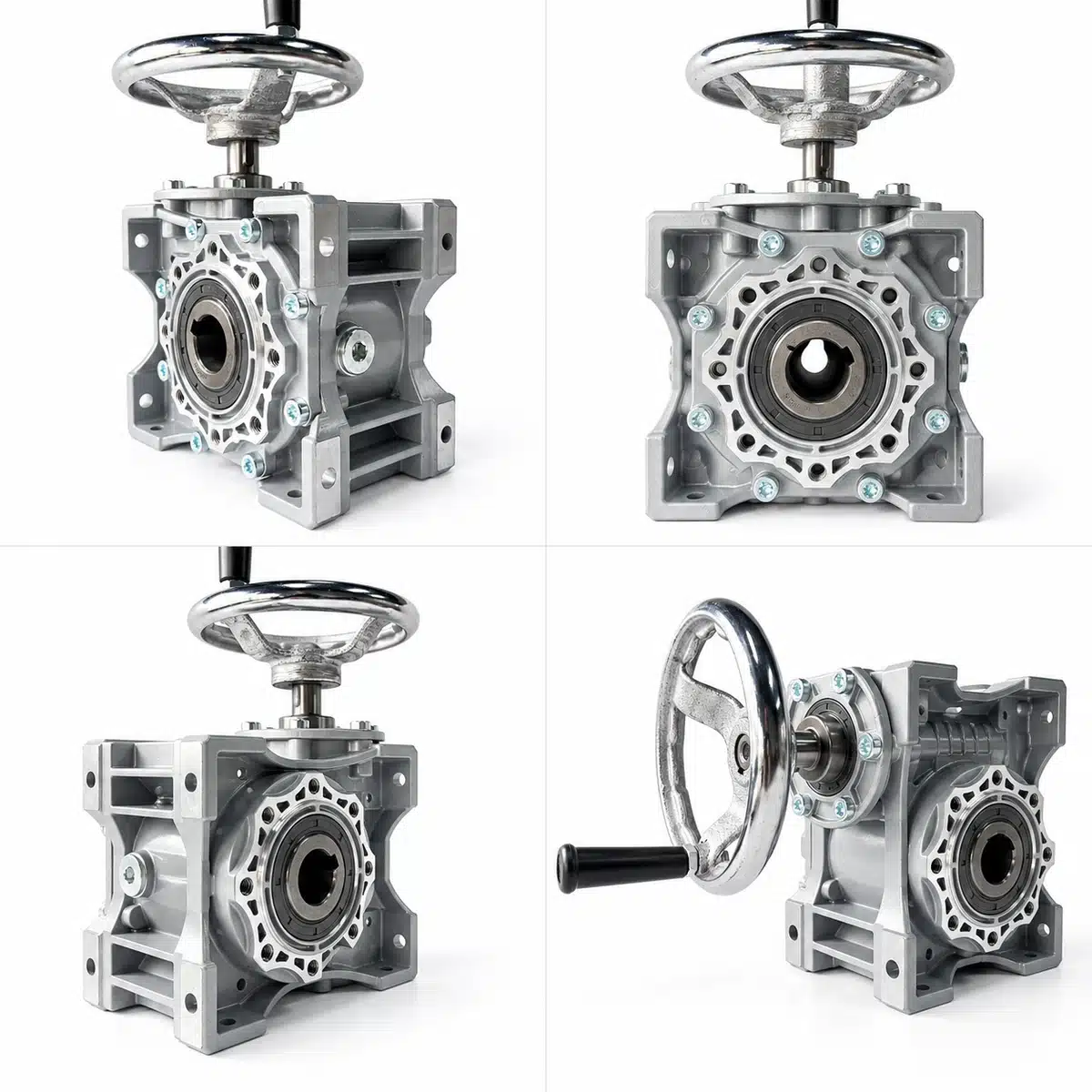

The KKM Series helical-hypoid gearbox is a compact right-angle industrial speed reducer designed for efficient power transmission in packaging machinery, food-processing equipment, conveyors, textile machinery, automated handling systems, and other industrial applications.
Unlike a conventional NMRV worm gearbox, which transmits power through a worm and worm wheel, the KKM Series uses a helical-hypoid gear arrangement. This design offers an alternative for applications where transmission efficiency, compact installation, smooth operation, and long-term reliability are important.
This article focuses on the mechanical construction, gear materials, input and output configurations, mounting options, and industrial applications of KKM gear units.
For detailed efficiency comparisons, reduction-ratio selection, and NMRV replacement engineering, see our NMRV-to-KKM Replacement Guide.
1. KKM Gearbox Mechanical Design
The KKM Series combines a compact gearbox housing with a helical-hypoid gear transmission system.
Its right-angle configuration allows the motor input and gearbox output to be arranged at approximately 90 degrees, making the unit suitable for machinery where installation space is limited.
The principal components include:
- Aluminum-alloy gearbox housing
- Helical-hypoid gear transmission components
- Input shaft and motor connection interface
- Output shaft or hollow-bore interface
- Bearings and shaft seals
- Lubrication system
- Optional mounting and output accessories
The gearbox design supports different motor and output arrangements, allowing OEM equipment manufacturers to select configurations according to their machinery requirements.
2. Gearbox Housing Construction
The KKM Series uses an aluminum-alloy housing designed to provide a compact and lightweight mechanical enclosure.
Main Housing Characteristics
Aluminum-alloy construction
The aluminum-alloy housing helps reduce gearbox weight compared with heavier housing materials.
Compact installation dimensions
The housing is suitable for machinery requiring a right-angle transmission arrangement within a limited installation space.
Corrosion-resistant surface treatment
The housing can be supplied with protective surface finishing and painting options for industrial operating environments.
Multiple mounting arrangements
Depending on gearbox size and configuration, different mounting accessories and installation arrangements can be selected.
The final mounting configuration should always be confirmed against the relevant gearbox dimensional drawing.
3. Helical-Hypoid Gear Materials and Heat Treatment
Gear material selection and heat treatment are important factors affecting gearbox durability, tooth strength, and wear resistance.
The KKM Series technical description specifies the following gear characteristics:
| Technical Item | Specification |
|---|---|
| Gear transmission | Helical-hypoid gear arrangement |
| Gear material | 20CrMnTi alloy steel |
| Heat treatment | Case hardening with surface finishing |
| Specified gear hardness | 58–62 HRC |
| Specified hardened-layer information | 0.3–0.6 mm, subject to manufacturing specification |
| Gear finishing | Precision gear finishing |
The use of hardened alloy-steel gears is intended to improve tooth-surface wear resistance and support reliable torque transmission.
Engineering note: The listed material, hardness, and hardened-layer figures are based on the existing KKM product description. Final material certificates, heat-treatment specifications, and applicable tolerances should be confirmed for the specific production model.
4. Why the KKM Gear Arrangement Matters
The transmission mechanism is one of the main differences between a KKM helical-hypoid gearbox and a conventional worm gear reducer.
A worm gear reducer uses a screw-like worm to drive a worm wheel. This arrangement involves substantial sliding contact between mating tooth surfaces.
A helical-hypoid gearbox uses a different gear geometry and contact arrangement. The design can reduce transmission losses compared with many conventional worm-drive configurations.
For equipment manufacturers, this may provide advantages in:
- Transmission efficiency
- Thermal performance
- Available output torque
- Continuous-duty operation
- Compact right-angle power transmission
Actual performance depends on the gearbox size, reduction ratio, input speed, applied load, lubrication, and operating conditions.
For model-specific efficiency data and engineering comparisons, refer to our NMRV vs KKM Technical Replacement Guide.
5. Available Input Configurations
Different industrial machines require different motor interfaces.
The KKM Series product range includes several input configuration options, depending on model and availability.
Electric Motor Input
KKM gear units can be configured for use with compatible electric motors, including:
- AC induction motors
- Brake motors
- DC motors
- Servo motors
Motor compatibility must be verified using the actual motor dimensions and operating requirements.
IEC Motor Flange Input
IEC motor connection options include:
- IEC B5 flange arrangements
- IEC B14 flange arrangements
The motor frame, flange dimensions, input connection, and mounting configuration must match the selected gearbox.
NEMA Motor Flange Input
NEMA flange configurations may be available for applications using North American motor mounting standards.
The NEMA frame and connection dimensions must be confirmed before ordering.
Servo Motor Flange Input
Servo motor adapter arrangements may be considered for automation applications requiring a compatible motor interface.
Solid Shaft Input
Solid input-shaft configurations may be available for machinery using external couplings or alternative power-transmission arrangements.
Selection note: Not every input configuration is necessarily available for every KKM gearbox size. Confirm the specific model and adapter dimensions before finalizing the drive design.
6. Available Output Configurations
The output interface determines how the gearbox transmits torque to the driven equipment.
Keyed Hollow Shaft Output
A keyed hollow shaft allows the gearbox to connect directly to a compatible driven shaft.
This arrangement is commonly considered for conveyors, packaging machines, and material-handling equipment.
Hollow Shaft with Output Flange
An output flange provides an additional mounting or connection interface where required by the machine design.
Plug-In Solid Output Shaft
A plug-in solid output shaft can provide an alternative connection arrangement for machinery requiring a projecting output shaft.
When selecting an output configuration, engineers should verify:
- Shaft diameter or hollow-bore dimensions
- Keyway size
- Output flange dimensions
- Shaft engagement length
- Permissible radial and axial loads
- Required mounting position
7. Mounting Accessories and Spare Parts
Depending on the gearbox configuration, KKM accessories may include:
| Accessory | Typical Function |
|---|---|
| Output shaft | Provides a solid-shaft connection |
| Output flange | Supports selected output mounting arrangements |
| Torque arm | Supports applicable shaft-mounted installations |
| Dust cover | Protects selected exposed interfaces |
Accessory availability and dimensions should be checked against the specific KKM frame size.
8. Surface Finishing and Painting Options
The existing KKM product specification describes surface preparation and protective painting options for aluminum-alloy gearbox housings.
Available color references include:
- RAL 5010 Blue
- RAL 7035 Light Gray
Surface preparation may include shot blasting and appropriate pretreatment before painting.
The exact coating process, finish, and color should be confirmed according to the order specification.
For OEM projects, consistent gearbox appearance can be important when integrating drive components into a larger equipment product line.
9. Industrial Applications
The KKM Series is suitable for evaluation in various industrial transmission applications.
Packaging Machinery
Compact right-angle gear units can be used in packaging conveyors, feeding mechanisms, and related auxiliary drives.
Food and Beverage Equipment
KKM gear units can be considered for compatible conveying and processing equipment where efficient, continuous mechanical transmission is required.
Suitability for washdown, food-contact, or hygienic environments must be assessed separately.
Textile Machinery
Compact gear transmission is useful in machinery requiring controlled mechanical movement and integration into restricted installation spaces.
Warehousing and Logistics
Conveyor drives and automated material-handling systems frequently require reliable speed reduction and right-angle power transmission.
Industrial Automation
KKM gearboxes can be evaluated for automation equipment using compatible induction motors, brake motors, or servo motor arrangements.
General Manufacturing
Other potential applications include production machinery, environmental equipment, material-handling systems, and industrial auxiliary drives.
Final gearbox selection should be based on the actual output speed, required torque, duty cycle, service factor, and installation conditions.
10. What Engineers Should Confirm Before Ordering
Before selecting a KKM helical-hypoid gearbox, provide the following information:
- Required gearbox size or installation dimensions
- Motor power and motor type
- Required reduction ratio
- Input speed and target output speed
- Required continuous and peak output torque
- Motor frame and flange arrangement
- Output shaft or hollow-bore dimensions
- Mounting position and available installation space
- Daily operating hours and starting frequency
- Environmental and lubrication requirements
For projects replacing an existing worm gearbox, additional dimensional and performance checks are required.
See our NMRV-to-KKM Replacement Engineering Guide for the detailed selection procedure.
11. KKM Helical-Hypoid Gearboxes from KB Transmission Star
KB Transmission Star offers KKM Series helical-hypoid gear units for industrial equipment manufacturers, distributors, and replacement applications.
The product range is intended to support applications requiring compact right-angle speed reduction and multiple motor and output connection options.
For model selection, technical drawings, and quotation requirements, please contact our team with your motor details, required output speed, load conditions, and mounting information.
View KKM Series Helical-Hypoid Gear Units
Frequently Asked Questions
What is a KKM helical-hypoid gearbox?
A KKM helical-hypoid gearbox is a compact right-angle speed reducer using a helical-hypoid gear transmission arrangement. It is designed for industrial applications requiring speed reduction and torque transmission.
What gear material is used in the KKM Series?
The existing KKM technical description specifies 20CrMnTi alloy steel gears with a stated hardness of 58–62 HRC. Exact material and heat-treatment specifications should be confirmed for the selected model.
Can a KKM gearbox connect to an IEC motor?
KKM gear units are offered with compatible IEC motor interface options, including selected B5 and B14 arrangements. The motor frame and flange dimensions must be checked before ordering.
What output configurations are available?
Depending on the selected model, output options can include a keyed hollow shaft, output flange, and plug-in solid output shaft.
Can KKM replace an NMRV worm gearbox?
KKM may be suitable for replacing selected NMRV worm gear reducers, but interchangeability must be verified through ratio, torque, motor interface, output dimensions, mounting dimensions, and operating conditions.
For detailed replacement guidance, read our NMRV-to-KKM Engineering Comparison.