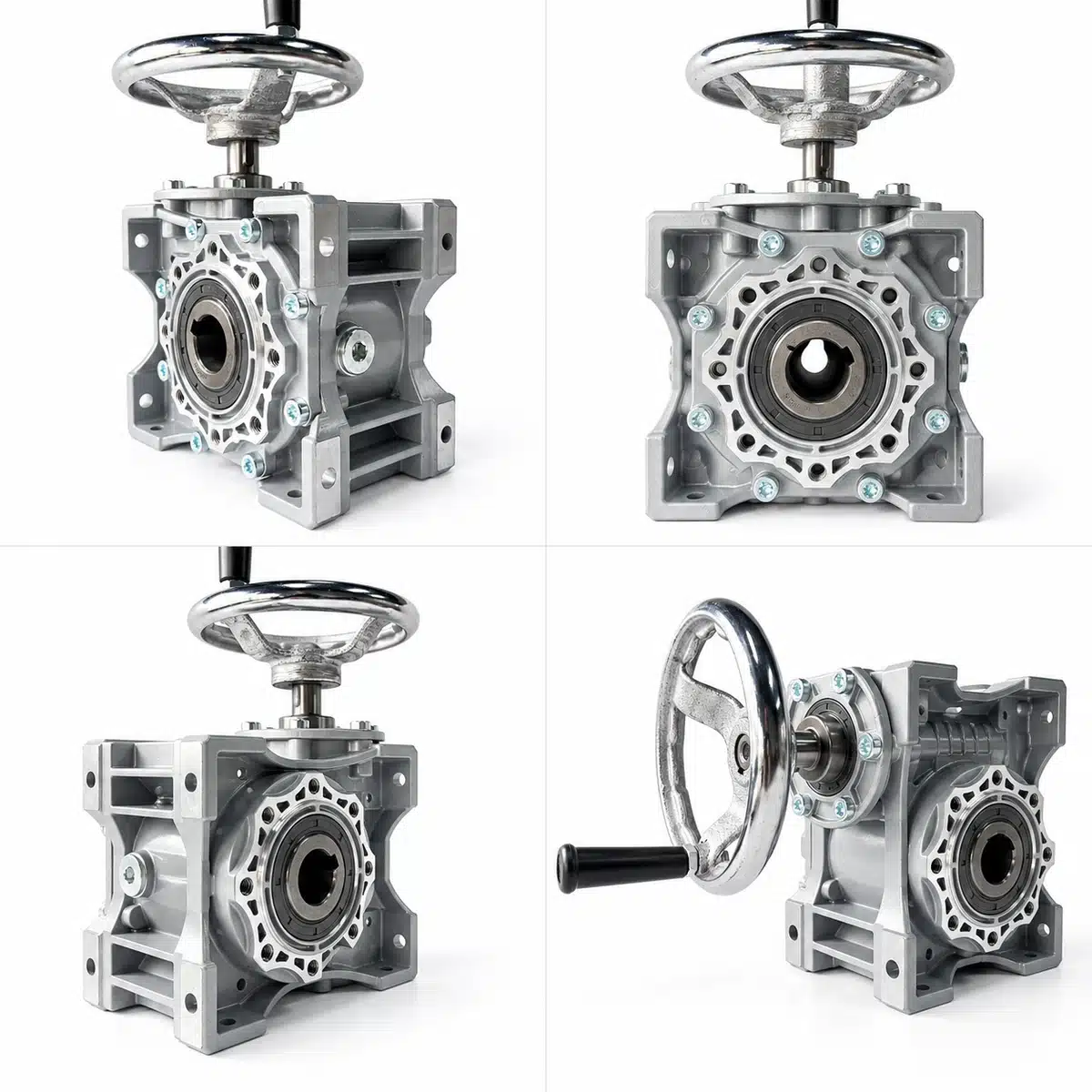
NMRV Worm Gear Reducer: Complete Model Guide for B2B Buyers
Choosing the right NMRV worm gear reducer starts with understanding the differences between frame sizes, reduction ratios, output torque capacities, and mounting configurations.
At KB Transmission Star, we offer a comprehensive range of NMRV worm gear reducers covering 11 frame sizes, from NMRV025 to NMRV150. Our gearboxes are designed for industrial applications including packaging machinery, conveyor systems, material handling, food processing equipment, and automated production lines.
This guide helps OEM engineers, equipment manufacturers, and industrial distributors compare NMRV gearbox sizes, understand key technical specifications, and identify suitable configurations for their applications.
Whether you are designing new machinery, replacing an existing gearbox, or sourcing NMRV reducers for distribution, the following model comparisons and engineering selection guidelines will help you make an informed decision.
For detailed product specifications, mounting options, and OEM purchasing information, explore our NMRV Worm Gear Reducer Manufacturer page.
What Is an NMRV Worm Gear Reducer?
An NMRV worm gear reducer is a compact right-angle transmission unit that uses a worm shaft and worm wheel to reduce rotational speed and increase output torque.
NMRV gearboxes are widely used in industrial machinery where compact dimensions, flexible installation, and right-angle power transmission are important.
The modular design supports different motor interfaces, output configurations, and mounting arrangements, allowing engineers to integrate the gearbox into various machine layouts.
Our NMRV series uses two primary housing constructions:
- NMRV025–NMRV105: Die-cast aluminum alloy housings.
- NMRV110–NMRV150: Cast iron housings.
The model designation indicates the nominal center distance between the worm shaft and worm wheel. For example, NMRV063 has a nominal center distance of 63 mm.
For a more detailed explanation of worm gearing and operating principles, read What Is an NMRV Worm Gear Reducer?.
NMRV Gearbox Size Chart: NMRV025–NMRV150
The NMRV series includes 11 frame sizes to accommodate different motor interfaces, mechanical loads, and installation requirements.
The following chart provides an overview of each frame size and its primary selection considerations.
| NMRV Model | Center Distance | Housing Material | Selection Considerations |
|---|---|---|---|
| NMRV025 | 25 mm | Aluminum alloy | Compact equipment, small motor interfaces |
| NMRV030 | 30 mm | Aluminum alloy | Small machinery, output speed and duty cycle |
| NMRV040 | 40 mm | Aluminum alloy | Light industrial equipment, mounting dimensions |
| NMRV050 | 50 mm | Aluminum alloy | OEM machinery, ratio and output loading |
| NMRV063 | 63 mm | Aluminum alloy | Conveyor drives, radial loads and thermal duty |
| NMRV075 | 75 mm | Aluminum alloy | Industrial drives, motor mounting and service factor |
| NMRV090 | 90 mm | Aluminum alloy | Higher-load applications, torque and heat dissipation |
| NMRV105 | 105 mm | Aluminum alloy | Intermediate frame size, motor and output configurations |
| NMRV110 | 110 mm | Cast iron | Higher-capacity drives, mechanical and thermal limits |
| NMRV130 | 130 mm | Cast iron | Industrial duty, torque and shaft loading |
| NMRV150 | 150 mm | Cast iron | Large-frame applications, load and thermal capacity |
Engineering Note: Frame size alone does not determine the rated motor power or allowable output torque. These values depend on the reduction ratio, input speed, operating conditions, service factor, and thermal capacity.
NMRV025–NMRV050: Compact Gearbox Sizes
These frame sizes are suitable for consideration in compact machinery where installation space is limited.
Common applications include labeling machines, small conveyors, packaging equipment, and auxiliary automation drives.
When selecting a compact NMRV gearbox, engineers should confirm the required output torque, motor interface, reduction ratio, and operating duty.
NMRV063–NMRV105: Intermediate Gearbox Sizes
These models offer additional options for industrial machinery, conveyor drives, and automated equipment.
NMRV105 provides an intermediate frame-size option between NMRV090 and NMRV110.
For these models, output torque, shaft loading, motor compatibility, and continuous operating conditions should be evaluated together.
NMRV110–NMRV150: Cast Iron Gearbox Sizes
The larger NMRV models feature cast iron housings for applications requiring higher mechanical capacity.
They are commonly considered for larger industrial drive systems, subject to the performance limits of the selected configuration.
Permissible output torque, thermal capacity, shaft loads, and service factor should be verified before final selection.
NMRV Gearbox Reduction Ratios
The reduction ratio determines the relationship between gearbox input speed and output speed.
For example, a nominal reduction ratio of 40:1 means that the input shaft rotates approximately 40 times for each revolution of the output shaft.
Single-Stage NMRV Reduction Ratios
Our NMRV gearbox range offers nominal single-stage reduction ratios within an overall range of:
5:1 to 100:1
Available ratios depend on the selected frame size, motor interface, and gearbox configuration.
When specifying an NMRV gearbox, engineers should confirm that the required reduction ratio is compatible with the intended motor and operating conditions.
Double-Reduction NMRV Gearboxes
For applications requiring very low output speeds, two reduction stages can be combined.
Selected double-reduction configurations offer nominal total reduction ratios from:
100:1 to 5000:1
The total reduction ratio is calculated by multiplying the individual stage ratios.
Total Reduction Ratio = First Stage Ratio × Second Stage Ratio
For example, a 30:1 first stage combined with a 60:1 second stage produces a nominal total reduction ratio of 1800:1.
Double-reduction gearboxes provide higher total reduction ratios, but the additional transmission stage also introduces efficiency losses and thermal considerations.
The complete gearbox assembly must be selected according to its permissible input power, output torque, and operating duty.
For high-ratio configurations, explore our Double Reduction Gearbox product range.
NMRV Gearbox Torque and Efficiency
Output torque is one of the most important parameters in NMRV gearbox selection.
However, the allowable output torque cannot be determined from frame size alone.
It depends on several factors:
- Gearbox frame size
- Reduction ratio
- Input speed
- Mechanical efficiency
- Operating load
- Service factor
- Thermal operating conditions
Why Motor Power Alone Is Not Enough
Two gearboxes connected to motors of the same rated power may deliver different output torque values because their reduction ratios and mechanical efficiencies differ.
Similarly, a gearbox may have sufficient mechanical torque capacity but still be unsuitable for continuous operation if its thermal capacity is exceeded.
For reliable performance, mechanical and thermal limits must be considered together.
Understanding NMRV Gearbox Efficiency
Worm gear reducers transmit power through sliding contact between the worm and worm wheel.
Mechanical efficiency varies according to gear geometry, reduction ratio, operating speed, loading, lubrication, and temperature.
For applications with long daily operating hours, efficiency and heat dissipation are important selection considerations.
For detailed torque formulas, engineering examples, and service-factor calculations, see our Worm Gear Reducer Torque Calculation Guide.
NMRV Output Shaft Radial Load Reference Table
Output shaft radial loading is an important consideration when a gearbox drives sprockets, pulleys, gears, or other externally mounted transmission components.
The following table provides reference permissible radial-load values for the NMRV output shaft.
| NMRV Size | Reference Radial Load Fr₂ max |
|---|---|
| NMRV025 | 1,350 N |
| NMRV030 | 1,830 N |
| NMRV040 | 3,490 N |
| NMRV050 | 4,840 N |
| NMRV063 | 6,270 N |
| NMRV075 | 7,380 N |
| NMRV090 | 8,180 N |
| NMRV105 | 12,000 N |
| NMRV110 | 12,000 N |
| NMRV130 | 13,500 N |
| NMRV150 | 18,000 N |
Radial Load Considerations
The radial load values apply to the specified reference loading position, x = L/2.
For loads applied at other shaft positions, the permissible radial load must be evaluated using the appropriate correction method.
Final shaft-load verification should also account for the selected gearbox configuration, operating conditions, and external transmission arrangement.
How to Select the Right NMRV Worm Gear Reducer
Selecting an NMRV gearbox requires evaluating mechanical performance, operating conditions, and installation compatibility.
The following five-step process helps engineers narrow down suitable configurations.
Step 1: Determine the Required Output Speed
Identify the motor operating speed and the required output speed of the driven machine.
The approximate reduction ratio is:
Reduction Ratio = Input Speed ÷ Output Speed
Once the required ratio is known, confirm that the selected NMRV frame supports the intended motor and reduction ratio combination.
Step 2: Confirm the Required Output Torque
Determine the torque required by the driven equipment.
Consider starting torque, normal operating load, shock loading, and other application-specific requirements.
Compare these requirements with the permissible output torque of the selected gearbox configuration.
Motor power alone should not be used as the only selection criterion.
Step 3: Evaluate the Service Factor
The service factor reflects the severity of the operating conditions.
Important factors include:
- Daily operating hours
- Load characteristics
- Starting frequency
- Reversing operation
- Shock loading
- Reliability requirements
A suitable service factor helps ensure the gearbox is selected for the actual operating duty.
Step 4: Check Thermal Capacity
Worm gear reducers generate heat during operation.
Thermal performance is particularly important in continuous-duty applications.
Relevant factors include ambient temperature, operating hours, ventilation, gearbox efficiency, and transmitted power.
Step 5: Confirm Mounting and Motor Compatibility
Before confirming a gearbox model, verify:
- IEC motor frame and flange
- Motor shaft diameter
- Hollow or solid output shaft
- Output bore and keyway
- Mounting-hole dimensions
- Foot or flange mounting arrangement
- Required installation position
- Lubrication requirements
Matching NMRV frame-size numbers do not automatically guarantee dimensional interchangeability between different manufacturers.
NMRV Gearbox Mounting and Installation Options
The modular housing design of NMRV gearboxes supports a variety of machinery layouts.
However, mounting arrangements must be evaluated together with lubrication requirements, shaft loading, and available installation space.
Foot Mounting
Foot-mounted configurations are used when the gearbox is secured directly to a machine frame or mounting platform.
Engineers should confirm mounting-hole spacing, output shaft position, and installation clearance.
Flange Mounting
Flange-mounted arrangements may be suitable for direct connection to machinery structures or driven components.
The required flange dimensions and mounting configuration should be confirmed against the dimensional drawings.
Hollow Shaft and Solid Shaft Configurations
NMRV gearboxes can be supplied with different output configurations, depending on the selected model and accessories.
Buyers should confirm bore diameter, shaft dimensions, keyway, and fit requirements before ordering.
Lubrication and Operating Position
The lubrication arrangement must be suitable for the gearbox installation position.
Factory-filled lubricant can reduce routine servicing requirements, but inspection and maintenance may still be necessary depending on operating conditions.
Typical Industrial Applications of NMRV Worm Gear Reducers
NMRV worm gear reducers are used in a wide range of industrial machinery.
The following applications illustrate common uses of compact right-angle transmission systems.
Packaging and Labeling Machinery
NMRV gearboxes can be used in conveyor drives, labeling machines, and auxiliary packaging mechanisms.
Selection should account for operating speed, starting frequency, and mechanical loading.
Conveyor and Material Handling Systems
NMRV reducers are commonly considered for driving rollers, belts, and other material-handling equipment.
Output torque, radial loads, and operating duty are important selection factors.
Food Processing Equipment
NMRV gearboxes can be used in conveying and auxiliary machinery within food-processing facilities.
Where washdown, corrosion resistance, or hygiene requirements apply, gearbox materials, seals, coatings, and installation arrangements should be evaluated separately.
Agricultural Machinery
Potential applications include feeding systems, conveyors, and auxiliary agricultural equipment.
Dust, moisture, temperature, and other environmental conditions should be considered during selection.
Industrial Automation
Compact dimensions, modular motor interfaces, and right-angle transmission arrangements make NMRV gearboxes suitable for selected automation applications.
The final configuration should match the machine’s mechanical and operating requirements.
NMRV Gearbox Replacement and Compatibility
Industrial buyers often need to replace an existing worm gear reducer without making major modifications to their equipment.
However, an NMRV model number alone is not sufficient to confirm direct replacement compatibility.
Before replacing an existing gearbox, verify:
- Mounting-hole dimensions and installation position
- Output shaft or hollow-bore dimensions
- Motor flange and input interface
- Reduction ratio and required output speed
- Allowable output torque and shaft loading
- Overall dimensions and available installation space
For buyers comparing replacement options for Motovario gearboxes, see our Motovario NMRV Equivalent Gearbox Guide.
This guide focuses on brand replacement, dimensional compatibility, and related engineering considerations.
When Should You Consider a Higher-Efficiency Gearbox?
Traditional worm gear reducers offer compact right-angle transmission and a broad range of reduction ratios.
However, applications involving long operating hours, high energy consumption, or significant temperature rise may benefit from alternative gearbox technologies.
A helical-hypoid gearbox can provide efficiency advantages in suitable operating conditions.
Our KKM Series Helical-Hypoid Gear Units offer an alternative transmission design for selected industrial applications.
Before replacing an NMRV gearbox with a KKM unit, engineers should confirm dimensional compatibility, motor interface, reduction ratio, torque capacity, and operating conditions.
NMRV Gearbox Selection Checklist for OEM Buyers and Distributors
To receive an accurate model recommendation or quotation, buyers should prepare the following information.
| Selection Parameter | Required Information |
|---|---|
| Application | Equipment type and operating requirements |
| Preferred Model | NMRV025–NMRV150, if known |
| Motor Power | kW or HP |
| Motor Input Speed | rpm |
| Required Output Speed | rpm |
| Required Output Torque | Nm |
| Reduction Ratio | Required or estimated ratio |
| Motor Interface | IEC frame, flange, and shaft dimensions |
| Output Configuration | Hollow shaft, solid shaft, or flange arrangement |
| Mounting Position | Required installation orientation |
| Operating Conditions | Daily operating hours, load characteristics, ambient temperature |
| Order Quantity | Sample, OEM production, or distributor stock |
| Destination Market | Country or region of installation |
Providing complete technical information helps ensure that the selected gearbox configuration meets the application’s mechanical and operating requirements.
For replacement projects, dimensional drawings or photographs of the existing gearbox can also be helpful.
Frequently Asked Questions About NMRV Gearboxes
What does NMRV063 mean?
NMRV063 identifies a worm gear reducer with a nominal center distance of 63 mm between the worm shaft and worm wheel.
The model number does not directly indicate motor power, reduction ratio, or output torque.
What NMRV gearbox sizes are available?
Our NMRV gearbox range includes 11 frame sizes: 025, 030, 040, 050, 063, 075, 090, 105, 110, 130, and 150.
Available configurations depend on the selected frame size, reduction ratio, and motor interface.
Are all NMRV gearboxes made from aluminum?
No. Our NMRV025–NMRV105 models use die-cast aluminum alloy housings, while NMRV110–NMRV150 models use cast iron housings.
What is the reduction ratio range of an NMRV gearbox?
Our NMRV series offers nominal single-stage reduction ratios within an overall range of 5:1–100:1.
Selected double-reduction combinations provide higher total reduction ratios.
Available configurations depend on the selected gearbox model and motor interface.
How do I choose the correct NMRV gearbox size?
Start by determining the required output speed and torque.
Then evaluate the reduction ratio, service factor, thermal capacity, motor interface, mounting dimensions, and shaft loading.
The final selection should be based on the gearbox’s applicable performance ratings.
Can an NMRV gearbox directly replace another manufacturer’s gearbox?
Not automatically.
Even when two gearboxes have similar model designations, their mounting dimensions, motor interfaces, output shafts, or performance ratings may differ.
Technical and dimensional compatibility should be confirmed before replacement.
Are NMRV worm gear reducers self-locking?
Self-locking should not be assumed based on gearbox type or reduction ratio alone.
Backdriving behavior depends on gearbox design, efficiency, loading, vibration, and operating conditions.
A worm gearbox should not be used as a safety brake without an appropriately engineered holding system.
Are NMRV gearboxes maintenance-free?
Not under all operating conditions.
Lubrication, inspection, and maintenance requirements depend on the gearbox configuration, duty cycle, environment, and operating conditions.
NMRV Worm Gear Reducer Manufacturer and OEM Supply
KB Transmission Star supplies NMRV worm gear reducers for industrial equipment manufacturers, distributors, and OEM buyers.
Supported by Taizhou Ubuty Co., Ltd., our product range covers compact aluminum-alloy gearboxes and larger cast iron configurations for different industrial transmission requirements.
We support customers sourcing NMRV gearboxes for new machinery, replacement projects, and industrial distribution.
For product specifications, mounting options, and purchasing information, visit our:
NMRV Worm Gear Reducer Manufacturer — Product Specifications
Need Help Selecting the Right NMRV Gearbox?
Our technical team can help review your application requirements, gearbox configuration, motor compatibility, and dimensional requirements.
Please provide your preferred frame size, reduction ratio, motor details, output torque, mounting requirements, and estimated order quantity.